

Out-of-Court Divorce in Poland? New Divorce Procedure – Plans for 2026
Poland is preparing a significant reform of its family law system that may introduce a divorce procedure conducted outside the courts. According to the current legislative plans, spouses who meet specific statutory conditions and remain fully aligned as to their decision could dissolve their marriage before a civil registry office, without initiating judicial proceedings. If implemented, this solution would represent a fundamental change to the Polish divorce framework, which has traditionally required court involvement in all cases.
What is the Background of the Proposed Reform in Divorce in Poland?
Under existing Polish law, divorce is possible exclusively through court proceedings, regardless of whether the case is contested or fully agreed upon by both spouses. Even couples without children, disputes, or claims of fault must file a divorce petition and obtain a court divorce decree in Poland.
The proposed reform aims to address this rigidity by introducing an administrative divorce procedure. The primary objectives are to simplify uncontested divorces, reduce the burden on the judiciary, and offer a faster and less formal route for spouses who have definitively decided to end their marriage and do not require judicial protection.
Who Could Qualify for a Non-Judicial Divorce in Poland?
The proposed out-of-court divorce option would be available only to a limited group of spouses. To qualify, all statutory conditions would need to be met simultaneously. In particular:
- There must be a complete and permanent breakdown of marital life.
- Both spouses must jointly agree to the divorce and waive any request for a ruling on fault.
- The marriage must have lasted for at least one year.
- The spouses must have no common minor children.
- No court proceedings concerning divorce, separation, or annulment may be pending between the spouses.
- Both parties must explicitly choose the non-judicial procedure.
Additional requirements may apply in cases involving foreign nationals, particularly regarding citizenship, habitual residence, and jurisdictional links with Poland.
If any of these conditions are not satisfied, the divorce would have to proceed under the standard judicial procedure.
How Would the New Divorce Procedure Work in Poland?
The draft legislation provides for a two-stage administrative process conducted before the head of a civil registry office.
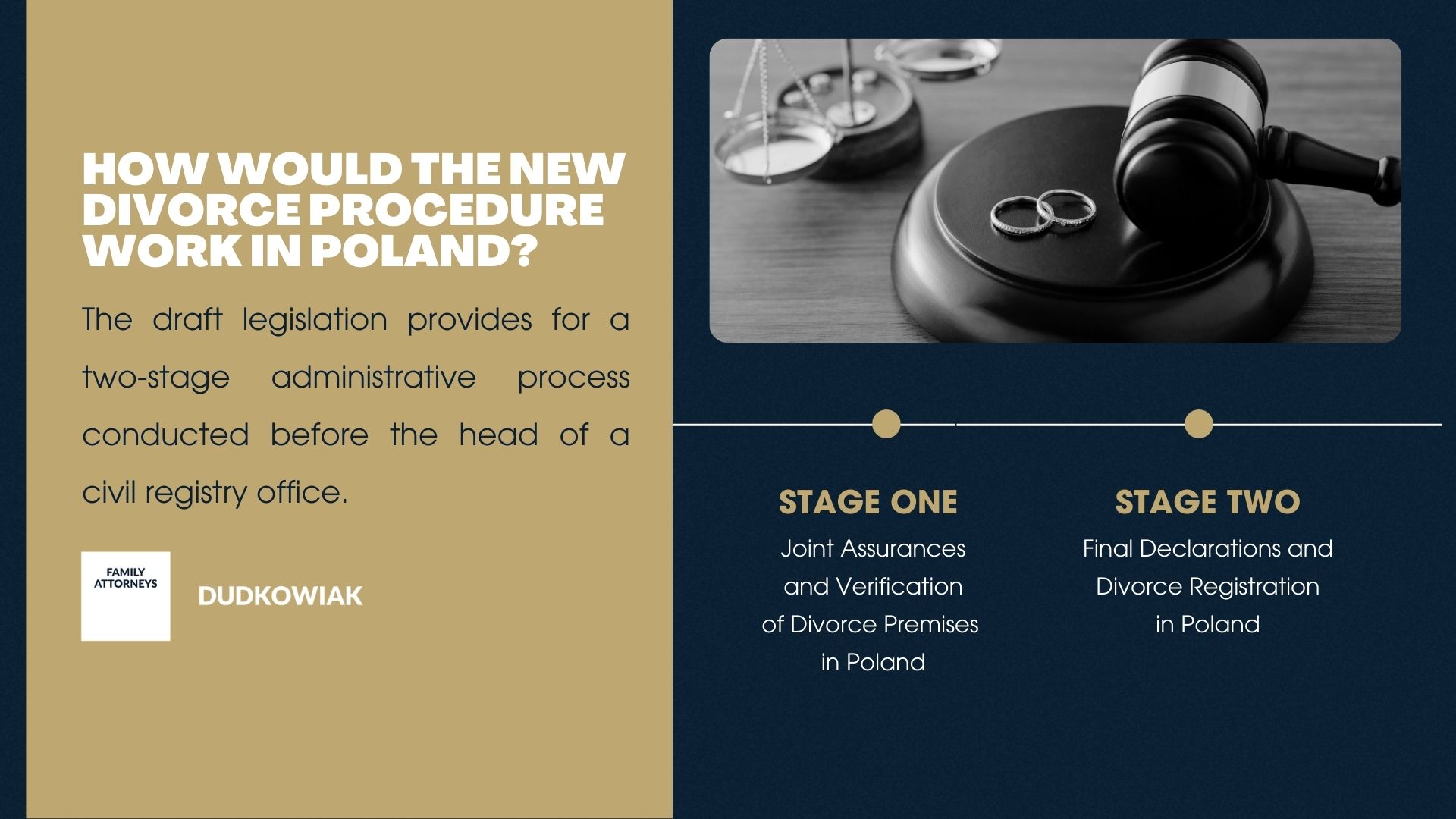
Stage One: Joint Assurances and Verification of Divorce Premises in Poland
In the first stage, both spouses would appear together at the civil registry office and submit written assurances confirming that all statutory requirements are met. The registrar would verify the formal conditions based on official records, including the duration of the marriage and the absence of minor children.
If the registrar determines that the legal prerequisites are not fulfilled, the application would be refused, and the spouses would be directed to pursue divorce through the courts.
Once accepted, the assurances would trigger a mandatory waiting period of at least one month. The assurances would remain valid for a maximum of six months, creating a defined window within which the divorce could be finalized.
Stage Two: Final Declarations and Divorce Registration in Poland
After the waiting period has elapsed, and within the six-month validity period, both spouses must again appear jointly before the registrar to submit final declarations of intent to dissolve the marriage in Poland.
At this stage, the registrar would once more verify compliance with all statutory conditions. If satisfied, the registrar would make an entry in the civil status register confirming the dissolution of the marriage in Poland. The divorce would become legally effective at the moment of registration.
What Are Legal Effects of an Administrative Divorce in Poland?
A divorce registered by the civil registry office in Poland would have the same legal consequences as a divorce granted by a court judgment. This includes changes to the parties’ marital status, the termination of statutory marital property relations, and the ability to remarry.
From a legal standpoint, the administrative divorce in Poland would not constitute a “simplified” or “second-class” dissolution of marriage. It is intended to be fully equivalent to a Polish judicial divorce, including for purposes of recognition in other jurisdictions.
Practical Implications and Limitations
The introduction of a non-judicial divorce route in Poland could significantly shorten the time required to dissolve an uncontested marriage and reduce procedural costs and formalities. It may also allow courts to focus on more complex cases involving children, property disputes, or contested fault.
At the same time, the scope of the reform is deliberately narrow. The administrative procedure will not be available in cases involving minor children, disputes between spouses, claims of fault, or situations requiring judicial assessment of the parties’ interests. In such cases, court divorce proceedings will remain unavoidable in Poland.
What is Expected Timeline of the Divorce in Poland Changes?
The proposed changes are currently at the legislative stage. If adopted, the new regulations are expected to enter into force after a statutory vacatio legis period. According to current plans, the administrative divorce procedure could become available in 2026, although the exact timeline will depend on the pace of parliamentary work and the final wording of the law.
Conclusion – Divorce Before Registry Office in Poland
The planned introduction of divorce in Poland without a court hearing represents a meaningful shift in Polish family law. While it will not replace judicial divorces, it may provide a practical and efficient alternative for a defined group of spouses seeking an uncontested and orderly end to their marriage. Parties considering divorce in Poland should closely monitor the legislative process and assess whether this new procedure may apply to their situation once the law enters into force.
 Family