


What is a separate property regime in Poland? Does this regime have an impact on joint mortgage repayments?
By default, when a couple marries in Poland, they enter into the statutory marital property regime: all assets acquired during the marriage (by either spouse) become joint property, equally owned by both.
In contrast, under a separate property regime, spouses each retain ownership over their individual property (both pre-existing and acquired after marriage) and manage it independently.
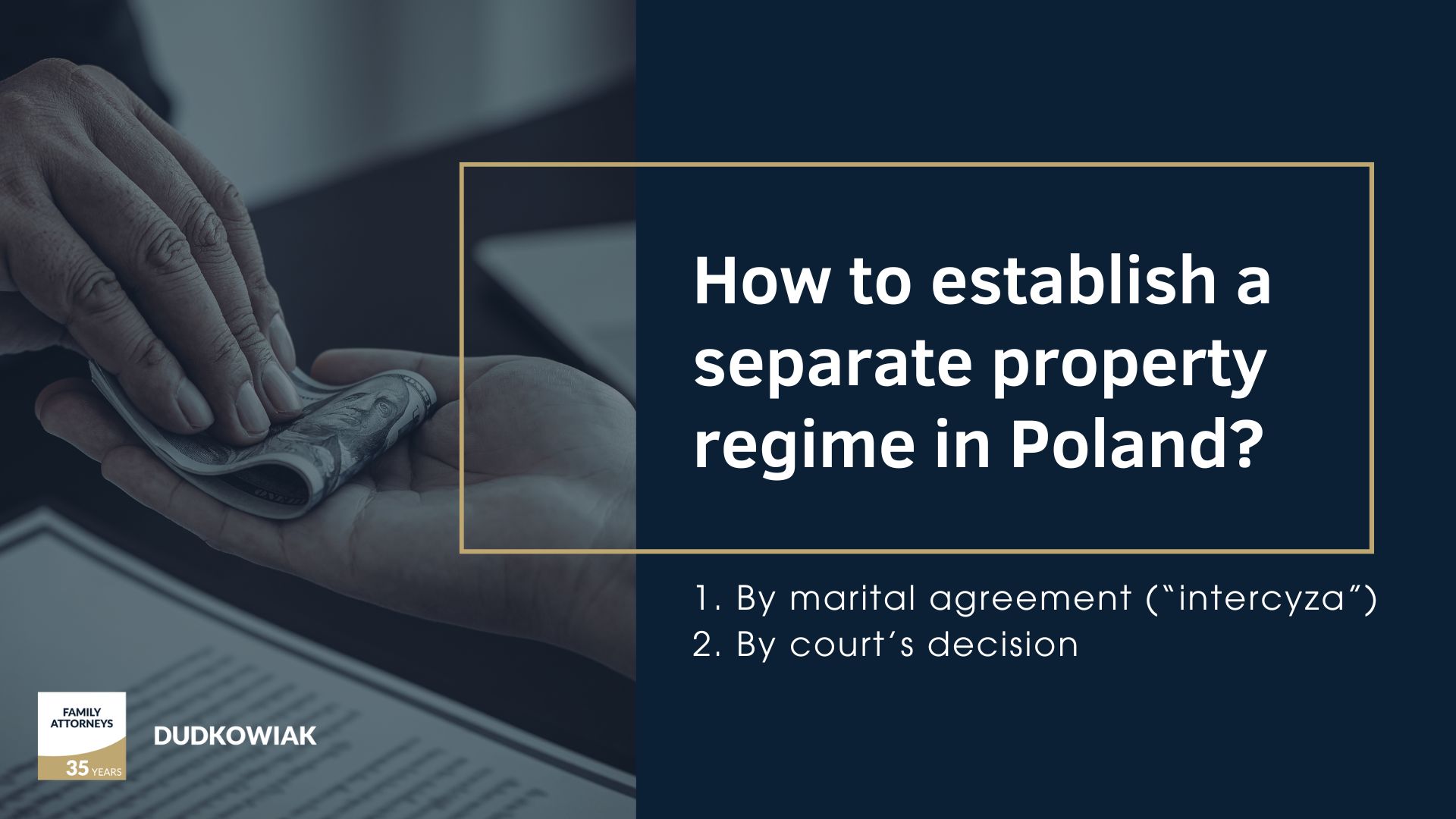
Polish law allows spouses to choose this regime either by a marital agreement (so-called “intercyza”) before or during marriage – concluded before a notary – or through a judicial order, when there are valid reasons.
Other variations are also possible, such as:
- Separate property with equalisation of gains,
- Limited community, or
- Expanded community.
How to establish a separate property regime in Poland?
1. By marital agreement (“intercyza”)
- Can be concluded before or after marriage.
- Requires a notarial deed, agreement of both spouses, and basic documents.
- The agreement takes effect from the moment of signing (or from the date specified in it) – it cannot be backdated by notarial deed.
2. By court’s decision
- Possible when one spouse requests separation of property for “important reasons” (e.g., risk from business activity, financial instability, separation of finances, marriage breakdown).
- It is also the way to obtain a separate-property regime retroactively – by specifying a date from which the separation should be deemed effective.
What is the relationship between a separate property regime and divorce in Poland?
- Upon final divorce, the statutory community property automatically terminates.
- If spouses had a separate property regime already in place (before or during the marriage), each retains only their individual property – there is no joint property to divide.
- The court (in divorce proceedings) must determine which property regime applied at the time of filing for divorce and from what date.
Hence, separate property can considerably simplify or clarify the property-related aspects of divorce.
Does mortgage repayment depend on the marital property regime?
- If a mortgage was taken out jointly (as two borrowers), divorce does not automatically eliminate liability to the bank – both spouses remain jointly and severally liable for repayment.
- If only one spouse was the borrower, the obligation to repay the debt remains with them – divorce does not transfer the debt to the other party.
- Dividing assets or awarding real estate to one of the former spouses (as a result of divorce) does not change the debt’s status in the eyes of the bank.
- To change the situation (e.g., to “sever” the debt), an agreement with the bank is usually necessary: for example, refinancing the loan, assuming the debt by one of the former spouses, or selling the property.
What if only one spouse repays joint mortgage during community of property in Poland?
Repaying the mortgage before the divorce (or establishment of separation of assets regime) using funds that form part of the marital community does not give rise to a reimbursement claim (including the division of assets proceeding), as these payments are treated as expenses made from joint property. There are exceptions to this rule, which require individual assessment by the attorney. Practically speaking, if one spouse made the transfers to the bank but the money originated from the community property – including earnings obtained during the marriage (joint property regime) – that spouse cannot later demand repayment of those amounts from the other party after the divorce (or establishment of separation of assets regime).
The situation changes, however, when the mortgage was serviced using the separate property of one spouse. This may occur, for example, when the paying spouse used funds received as a gift or inheritance or after the separation of assets regime establishment. In such a case, after the divorce, that spouse may pursue reimbursement of those contributions as part of the division of the marital estate.
Advantages and disadvantages of separate property regime in Poland
Advantages:
- Protection of individual assets – especially beneficial when one spouse runs a risky business.
- Avoidance of responsibility for the other spouse’s debts (with exceptions).
- Autonomy in managing one’s own property – buying, selling, disposing without consent of the other spouse.
- In many cases, no complex property division is needed at divorce.
Disadvantages:
- Separate evaluation of creditworthiness – joint loans may be harder to obtain.
- Lack of opportunity for joint tax settlement or other fiscal benefits tied to marital community.

Costs and formalities
- A notarial marital agreement establishing future separate property typically costs a few hundred zloty.
- A court procedure to establish a separate property regime (especially with a retroactive date) involves court fees and often legal representation – the total cost may reach several thousand zloty.
Is separate property always advisable?
Not necessarily. While a separate-property regime provides financial independence and protection, it may also complicate joint financial undertakings – such as obtaining credit together – as well as broader tax or fiscal planning. Its advantages depend heavily on the spouses’ individual circumstances, including their business activities, assets, risk exposure, and future plans.
Introducing a separation-of-assets regime becomes particularly relevant once the marriage has broken down, especially if the spouses remain jointly liable under a mortgage and one of them has stopped contributing to the repayments. Any such decision should be assessed with caution and, ideally, taken after obtaining tailored legal advice.
 Family