


How far can parental authority be restricted in Poland? The Supreme Court is finally set to decide
What the Supreme Court is being asked to decide
A legal question has been submitted to the Polish Supreme Court concerning the extent to which parental authority may be restricted in Poland.
Specifically: can a court limit one parent’s authority solely to the right to receive information about the child’s health and school performance, while excluding all other components of parental authority?
This issue reached the Supreme Court after a regional appellate court expressed doubts as to whether such a far-reaching restriction is even legally permissible – or whether it constitutes, in substance, a de facto deprivation of parental authority, despite not being formally labelled as such.
Background of the parental authority case in Poland
In the underlying proceedings:
- The child’s mother asked the court to entrust her exclusively with the exercise of parental authority.
- The father accepted the child’s place of residence but opposed the proposal to limit his parental authority to a purely passive informational right concerning health and education.
- The first-instance court agreed with the mother and imposed this restrictive framework.
- The appellate court questioned the legality of such a solution, noting that parental authority includes fundamental duties toward the child, and that rights – such as decision-making or participation in upbringing – stem from those duties.
- Due to the significance of the issue, a three-judge panel of the Supreme Court in Poland referred the matter to the full Civil Chamber for a broader, authoritative resolution.
Legal framework for parental authority under Polish family law
Under the Polish Family and Guardianship Code:
- As a rule, both parents hold parental authority, unless the court decides otherwise.
- When parents are separated and cannot agree on how to exercise authority or maintain contact with the child, the court determines a binding set of arrangements.
- The court may entrust parental authority to one parent and limit the other’s rights, but only to the extent necessary to protect the child’s welfare.
- “Contact” with the child is a separate legal category and includes personal visits as well as remote communication; it may be restricted or even prohibited if the child’s wellbeing requires it.
The current dispute concerns the outer boundary of judicial intervention: how far can restrictions go before they effectively extinguish one parent’s authority entirely?
The core legal issue – where is the line?
The Supreme Court must determine whether a parent’s authority can be reduced to a minimal, passive right – access to information – without granting any role in upbringing or decision-making.
Two positions have emerged:
Argument against such restrictions
- Parental authority is fundamentally a set of duties: care, supervision, participation in decisions, and ensuring the child’s welfare.
- Reducing authority to mere information rights risks creating a legal fiction: a parent formally “has” authority but is unable to exercise its essential functions.
- Such an approach may amount to indirect deprivation of parental authority in Poland, which is only permissible under strict statutory conditions.
Argument supporting the restriction
- In highly conflicted families, shared decision-making may be impossible.
- If parents cannot cooperate and their disputes harm the child, the court may seek a pragmatic solution.
- Allowing one parent a limited informational role may be the only workable arrangement to safeguard stability in the child’s life.
The Supreme Court in Poland must therefore decide whether the restrictive model used in this case falls within the bounds of lawful judicial discretion – or exceeds it.
Why the upcoming parental authority ruling matters
The Supreme Court’s decision will carry significant consequences:
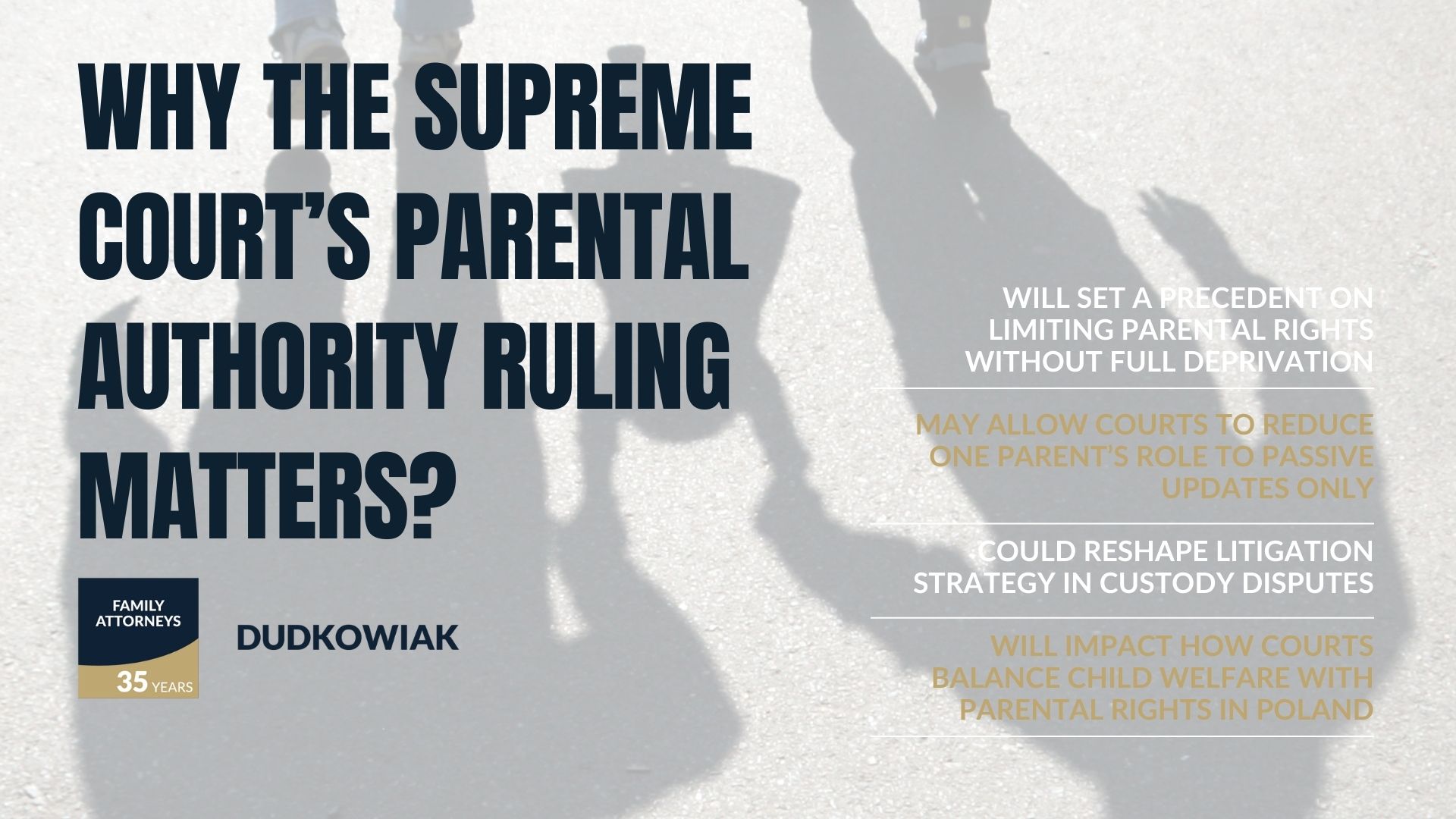
- It will set a precedent for how broadly courts may intervene in parental authority cases without formally depriving a parent of rights.
- It will determine whether courts in Poland may legally create a situation where one parent remains involved only passively, without the capacity to influence the child’s upbringing in any meaningful way.
- It may reshape litigation strategies in family cases:
if such restrictions are upheld, similar motions will likely increase.
Ultimately, the judgment will shape the balance between the child’s welfare, parental rights, and the court’s power to manage family disputes in Poland.
Expert assessment on parental authority – risks and considerations
From a legal-policy perspective, limiting parental authority to a mere right of information raises considerable concerns:
- It dilutes the constitutional and statutory meaning of parental authority.
- It risks excluding one parent from the child’s life in ways not expressly provided for by law.
- It may undermine the principle that a child benefits from active involvement of both parents unless serious counter-indications exist.
That said, in exceptional, high-conflict situations, courts understandably look for practical solutions. If cooperation is impossible and constant disputes destabilize the child’s environment, the judiciary must sometimes choose the least harmful option.
The Supreme Court’s ruling will clarify whether such a restrictive approach is legally defensible or exceeds judicial powers by creating an outcome akin to covert deprivation of parental authority.
In my view, it is also important that the courts in parental authority cases thoroughly examine and take into account both the underlying causes of the conflict between the parents and the difficulties they experience in joint decision-making.
Unfortunately, in my professional experience, it is increasingly common for the parent who has day-to-day custody of the child to deliberately create conflicts and later use them to their advantage in court proceedings.
Attempts to consult or coordinate decisions are too often interpreted by the custodial parent as an alleged attack or an effort to obstruct the exercise of parental authority.
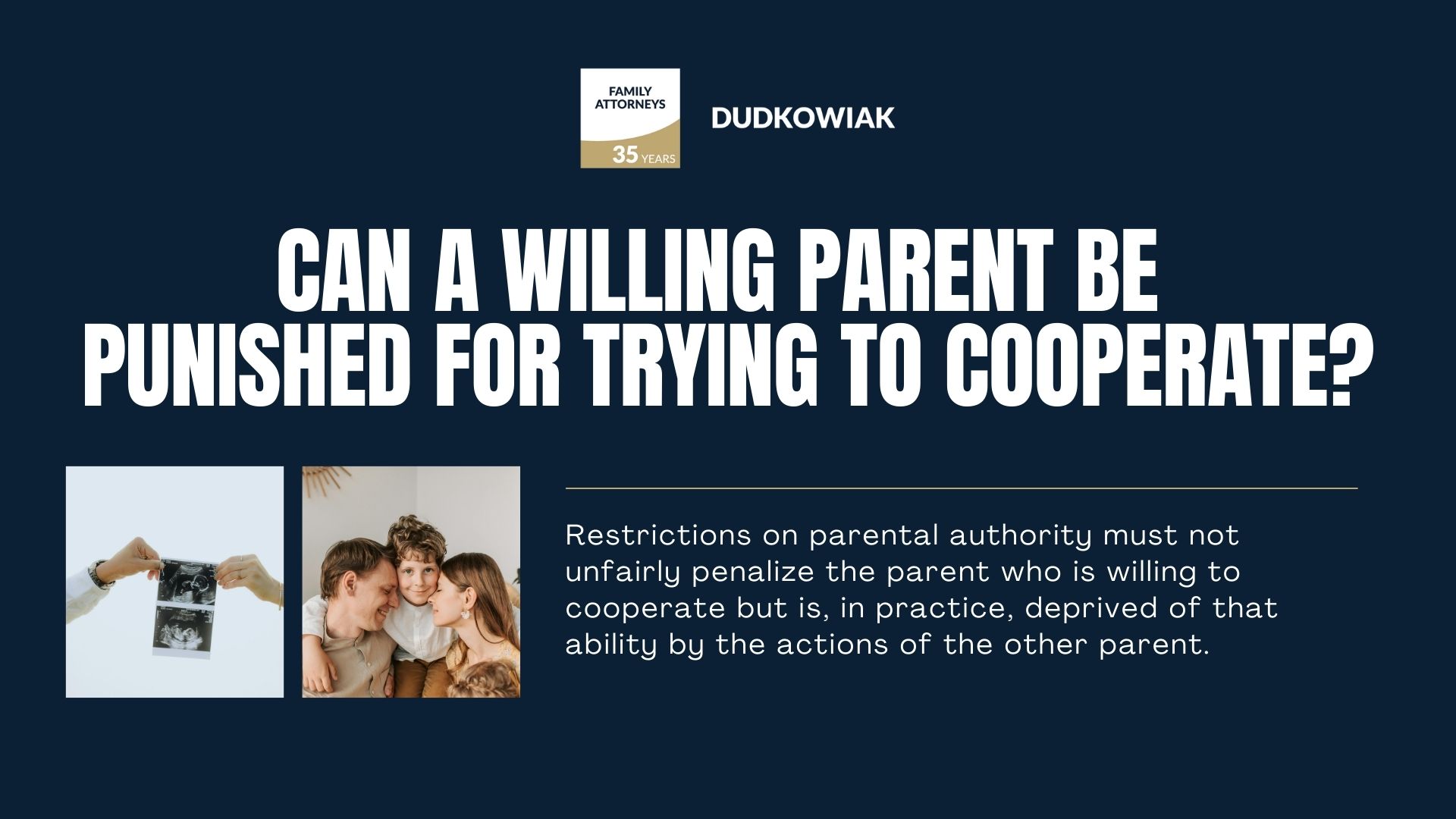
It is essential that courts begin to scrutinize and properly assess such behavior, so that restrictions on parental authority do not unfairly penalize the parent who is willing to cooperate but is, in practice, deprived of the real ability to do so due to the actions of the other parent.
This issue is currently under review by the Polish Supreme Court in a legal question proceeding registered under docket number III CZP 39/25. Full details of the case can be accessed via the Supreme Court’s official website:view case
 Family