Travelling or Relocating Abroad with a Child from Poland – Other Parent’s Consent and Passport
Quick answer · law as of October 2026
Do you need the other parent’s consent to take a child abroad from Poland?
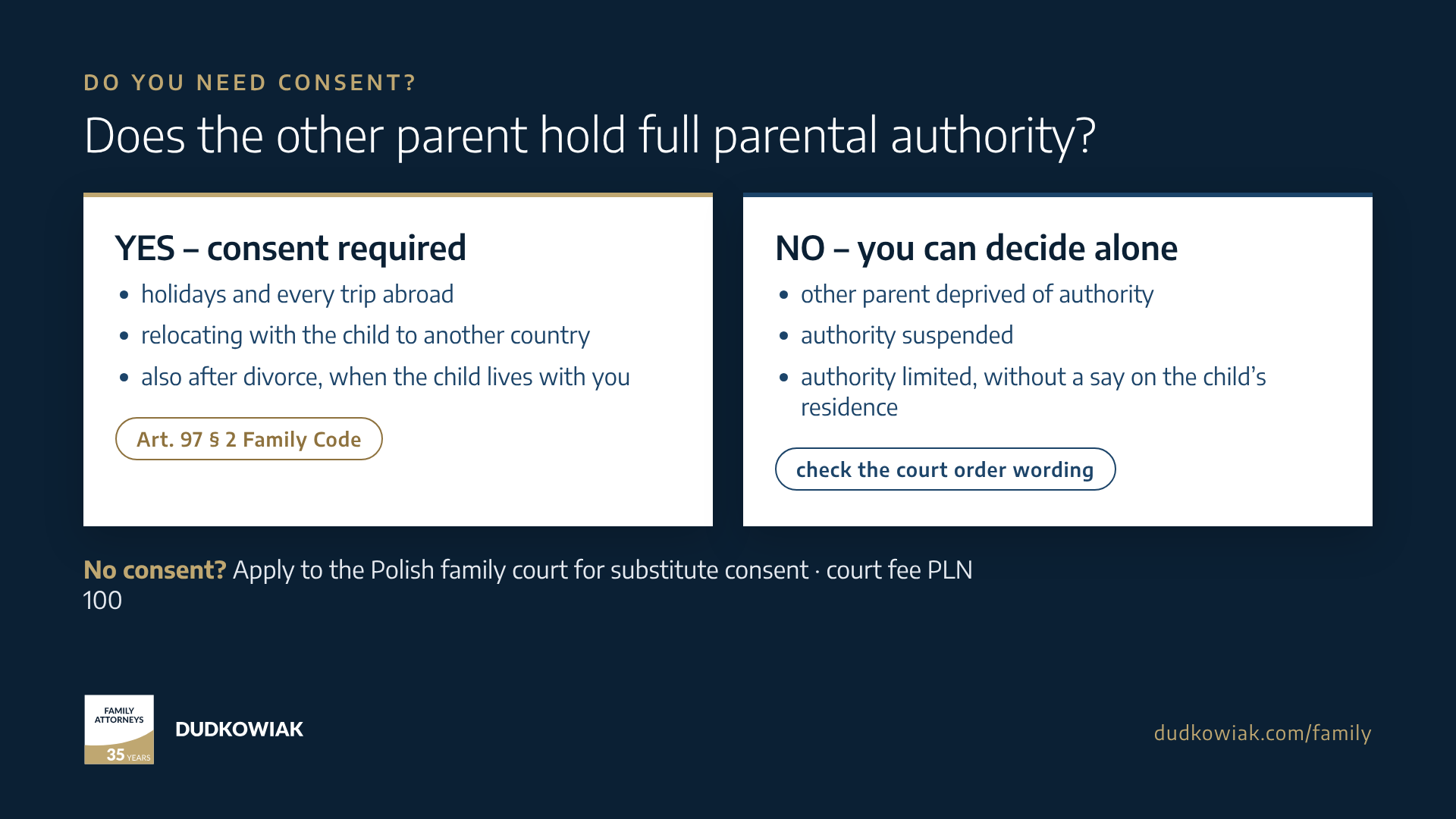
Yes – if the other parent holds full parental authority. Under Polish law, taking a child abroad – whether relocating or going on holiday – is an “important matter” that parents decide jointly (Article 97 § 2 of the Family and Guardianship Code). Divorce does not change this, and neither does the fact that the child lives mainly with one parent.
A Polish passport for a child requires both parents’ consent, but passport consent is not consent to travel. An ID card, which is enough for travel within the EU, can be obtained by one parent alone.
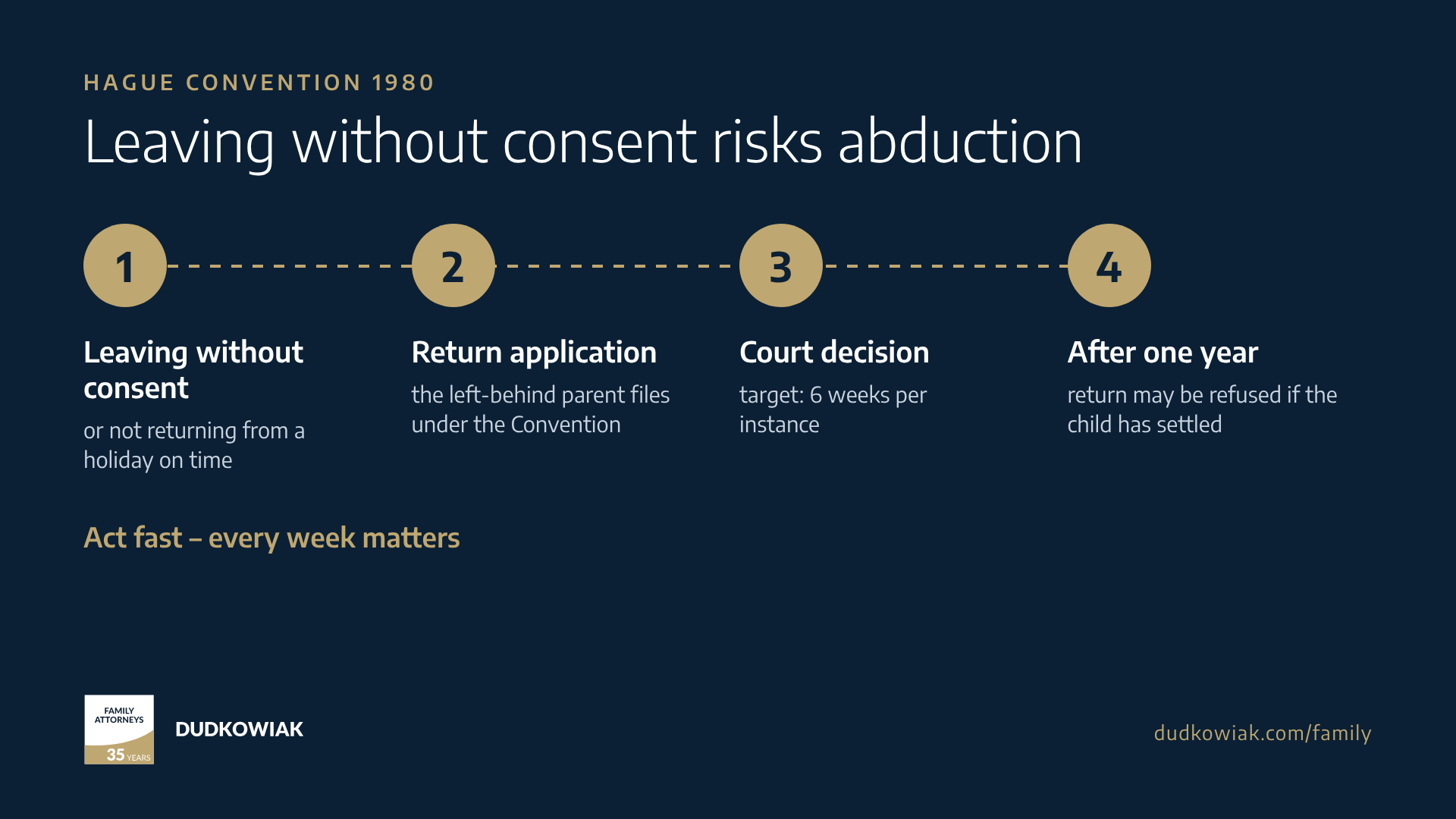
If the other parent refuses, a Polish family court decision can replace their consent. Leaving without consent, or not returning on time, is abduction under the 1980 Hague Convention and can lead to an order for the child’s return.
— Martyna Dudkowiak, Attorney (Advocate), Partner, Dudkowiak Family Lawyers
International relocation and child travel – how we help
Dudkowiak Family Lawyers is a Polish family law firm established in 1994, with offices in Poznań, Warsaw, Cracow and Zielona Góra. We draft parenting agreements and travel consents, apply to Polish courts for consent to travel, relocate or issue a child’s passport, seek interim orders to prevent a child being taken abroad, and represent parents in Hague Convention return cases.
International cases are led by Martyna Dudkowiak, in English and Polish.
Describe your situation briefly – we will reply with the next steps.
PLN 100
court fee to ask for court consent to travel or a passport
6 weeks
target time for a decision in a child return case
Jump to
When consent is needed | Holiday or relocation | Consent letter | Child’s passport | Applying to court | When it becomes abduction | Our cases | Preventing abduction | Checklist | FAQ
When do you need the other parent’s consent to travel abroad with a child?
In Poland, parents exercise parental authority jointly and decide important matters concerning the child together. If they cannot agree, the family (guardianship) court decides (Article 97 § 2 of the Family and Guardianship Code). Polish courts have long treated taking a child abroad as an important matter – both permanent relocation and temporary stays. The Supreme Court has held that even a holiday abroad is an important matter (decision of 1985, III CRN 19/85; earlier resolution III CZP 69/71).
In practice, this means that the other parent’s consent is required both for relocation and for a holiday abroad, as long as that parent holds full parental authority. This does not change after divorce or separation, nor because the child lives mainly with one parent. A divorce judgment stating that the child lives with the mother or father does not entitle that parent to move with the child to another country.
When is consent not required?
A parent may decide alone if the other parent:
- has been deprived of parental authority (Article 111),
- has had parental authority suspended (Article 110),
- has limited parental authority that excludes deciding on the child’s place of residence (Articles 107 or 109) – the exact wording of the court order always matters,
- has lost the right to decide on the child’s residence under a foreign judgment recognised in Poland.
If the other parent’s authority is limited only, for example, by the supervision of a court guardian, consent is still needed. We discussed the limits of restricting parental authority in our article on the upcoming Supreme Court decision.
Holiday or relocation – what is the difference?
The rule is the same, but the consequences of a dispute are very different:
| Temporary trip (holiday, visit) | Relocation abroad | |
|---|---|---|
| Other parent’s consent | Yes, if they hold full parental authority | Yes, if they hold full parental authority |
| Form of consent | Any form; written consent with dates and destination recommended | Written, ideally with a notarised signature and a contact plan |
| No consent | Application to court for consent to a specific trip; interim measures if urgent | Application to court for consent to change the child’s residence; full evidence, often expert reports |
| Main risk | Not returning on time = wrongful retention | Leaving without consent = abduction under the Hague Convention |
What should a parental consent to travel contain?
Polish law does not prescribe an official form – consent can be given in any form. We strongly recommend written consent. It helps at the border and with airlines, and in a dispute it is key evidence of exactly what the other parent agreed to (and what they did not). A good consent letter includes:
- details of both parents and the child (names, PESEL numbers, document numbers),
- the destination country (or countries) and address,
- departure and return dates – for relocation, a clear statement that the child’s permanent residence will change,
- the person the child is travelling with,
- for relocation – the agreed contact arrangements with the other parent and how travel costs are shared,
- date and signature, preferably notarised.
The Polish Border Guard does not, as a rule, require a parent travelling with a child to show the other parent’s written consent. However, border authorities in the destination country or the airline may ask for it – especially outside the European Union. Have the consent ready in English or in the language of the destination country.
A Polish passport for your child – both parents must consent
Passports are governed by the Act of 27 January 2022 on passport documents. One parent may file the application for a minor, but the consent of both parents is required. The other parent can give it:
- in person, by applying together with the first parent,
- in writing, with a signature certified by a notary, a passport office or a Polish consul,
- electronically, through the “Wyraź zgodę na wydanie paszportu” service on gov.pl (using a trusted profile, e-ID signature or qualified electronic signature).
A passport for a child under 12 is valid for 5 years. The fee is PLN 30 (under 12) or PLN 70 (12–18); holders of the Large Family Card pay half. A child over 5 must be present when the application is filed. Parents living abroad apply through a Polish consulate; paper consents scanned and sent by email are not accepted.
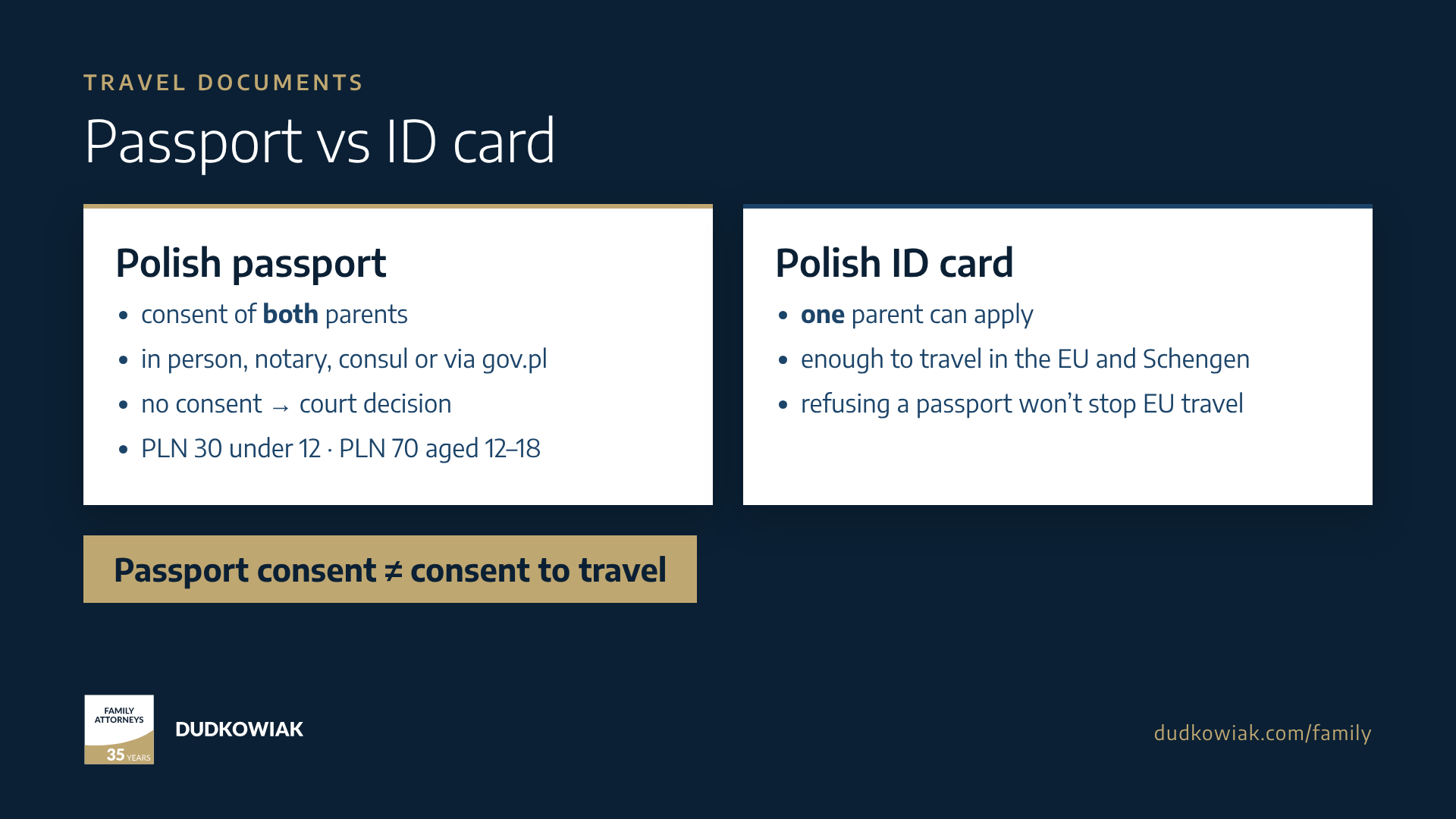
Important: consent to the passport is not consent to travel. A parent who signed the passport consent can still object to a specific trip or relocation. Conversely, a court ruling that the child lives with one parent does not replace the other parent’s consent to the passport.
What if the other parent refuses to consent to the passport?
The missing consent can be replaced by a final decision of the Polish family court (Article 97 § 2). The original decision must be submitted. Consular practice treats one decision as covering one passport – a new document will require consent again. It is therefore worth asking the court, in one application, for consent to the passport and to the specific trip.
What about a Polish ID card?
Unlike a passport, an ID card for a child can be applied for by one parent without the other’s consent. This matters in practice: within the European Union and the Schengen area, an ID card is enough to travel. Refusing consent to a passport therefore does not prevent a child from being taken to another EU country. If you fear abduction, other measures are needed – see below.
The other parent refuses – applying to the court
If the parents cannot agree, the parent who wants to travel files an application for the court to decide an important matter concerning the child (substitute consent). The competent court is the district court (family and juvenile division) for the child’s place of residence. The court fee is PLN 100. Representation by a lawyer is not mandatory, but in relocation cases, how the plan is presented is often decisive.
In relocation cases, the court is guided by the child’s best interests and looks in particular at:
- the child’s bond with each parent and how relocation would affect it,
- a realistic contact plan for the parent staying in Poland – frequency, holidays, video calls, who pays for travel,
- conditions in the new country: housing, school or nursery, language, healthcare, support network,
- the reason for the move (work, family, a new partner) and how well it has been prepared,
- the child’s age and views – the court hears the child if their development and maturity allow,
- expert reports from the court’s family assessment team (OZSS), if ordered.
When the trip is urgent (a booked holiday, the start of a school year abroad), you can apply for interim measures. Do not leave it to the last minute, though – relocation proceedings usually take many months.
Leaving without consent – when does it become child abduction?
If a parent takes a child abroad without the other parent’s or the court’s consent – or leaves with consent “for the holidays” and does not return on time – this is wrongful removal or retention under the 1980 Hague Convention on the Civil Aspects of International Child Abduction. Between EU Member States (except Denmark), Council Regulation (EU) 2019/1111 (Brussels IIb) also applies.
The left-behind parent can then seek an order for the child’s return to the country of habitual residence. The proceedings are meant to be fast, and the court does not decide which parent the child should live with – it restores the situation before the removal. In Poland, Hague cases are heard by specialised regional courts in the cities where courts of appeal sit (Article 5691 of the Code of Civil Procedure).
An important distinction: a parent with full parental authority who takes the child without the other parent’s consent generally does not commit the criminal offence of child abduction under Article 211 of the Polish Criminal Code. The consequences are still serious: a return order, possible restriction of parental authority and a weaker position in any dispute about the child’s residence. We cover this in detail in:
- What is the difference between parental kidnapping and child abduction in Poland?
- Hague Convention: child abduction to Poland
From our practice
Hague Convention
A holiday that was meant to end in summer
A mother travelled with a young son from North America to Poland for a holiday of several months, then announced she was staying for good. We acted for the father. Using her own messages, we showed the stay was always meant to be temporary, and that enrolling the child in a nursery and obtaining a Polish passport did not amount to consent to relocation. The mother’s custody case was stayed. The first-instance court ordered the child’s return about two months after the application.
Passport
A passport without a court battle
A mother asked the court to consent to a passport for her daughter, claiming the father living abroad was blocking it – and also sought to strip him of parental authority. Using years of correspondence, we showed it was the father who had long wanted the passport, and arranged for him to give his consent at the passport office. The court discontinued the passport case and dismissed the application to remove his parental authority; the father kept the right to co-decide on longer trips abroad. The appeal court upheld this.
Contact abroad
Holidays with dad abroad
A father living in another European country could see his son almost only in Poland, and the mother wanted to limit contact to a single region. We proposed a predictable schedule: fixed holiday dates, early notice of flights and handovers at the airport. The court allowed the father to take his son abroad at Christmas, Easter and for two weeks in summer, and ordered the mother to hand over the child’s travel documents.
In every travel and passport case we have concluded, we achieved the client’s goal – some by agreement, before the court had to rule. In Hague cases we act for parents whose children were kept in Poland after a holiday; in every case decided so far, the court ordered the child’s return.
Case descriptions are anonymised: details that could identify the parties have been changed or generalised.
Worried the other parent may take your child abroad? What you can do
- Do not sign consent to a passport or a trip without clear terms (dates, country, address, return date).
- Apply to the court for interim measures – the court may, for example, prohibit taking the child abroad without the other parent’s consent or order the child’s passport to be deposited.
- Consider applying to limit the other parent’s parental authority as regards deciding on the child’s place of residence.
- Collect evidence: messages about plans to leave, job offers abroad, bookings.
- If the child has already been taken – act immediately: report to the police, contact a lawyer and the Central Authority (in Poland, the Ministry of Justice). Time matters: after one year from the abduction, the court may refuse to order the return if the child has settled in the new environment.
Checklist before a trip or relocation
- Does the other parent hold full parental authority? Check the wording of the divorce judgment or court decision.
- Do you have written consent with dates, country and address (for relocation – with a contact plan)?
- Does the child have a valid document: ID card (EU) or passport (outside the EU)?
- Does the destination country or airline require extra documents (consent in a foreign language, birth certificate)?
- For relocation: will the contact order be enforceable in the new country?
- If there is no agreement – has the court application been filed well in advance?
Frequently asked questions
Do I need my ex-husband’s consent to take our child on holiday to Croatia?
Yes, if he holds full parental authority. A trip abroad – even a short one – is an important matter concerning the child. Nobody is likely to check it at internal Schengen borders, but travelling without it may be treated as a breach of the other parent’s parental authority, and failing to return on time as wrongful retention.
I have a divorce judgment and the child lives with me. Can I move abroad with the child?
Not without the other parent’s or the court’s consent, as long as the other parent has kept the right to decide on the child’s place of residence. The residence set out in the judgment concerns life in Poland, not moving the child to another country.
Is passport consent enough to travel with my child?
No. Consent to a passport concerns only the document. A specific trip or relocation requires separate consent (or a court decision).
The other parent lives abroad. How can they consent to a Polish passport?
Before a Polish consul, before a notary (in writing with a certified signature) or electronically via gov.pl, using a trusted profile or a qualified electronic signature. Scanned paper consents sent by email are not accepted.
How long does a court case for consent to travel take?
It depends on the court and the complexity of the case. Consent to a short trip can be granted quickly, especially as an interim measure. A relocation case with expert reports usually takes several months or longer.
Related topics
Need help?
We handle applications for consent to travel and relocate abroad with a child, passport disputes and Hague Convention cases – acting both for the relocating parent and for the parent who stays. We work in English and Polish.
Martyna Dudkowiak, Attorney (Advocate), Partner – Dudkowiak Family Lawyers
[email protected] · [email protected] · +48 222 662 219 · contact us
Legal basis and sources: Articles 97 § 2, 107, 109–111 of the Polish Family and Guardianship Code; Act of 27 January 2022 on passport documents; Act on identity cards; Article 5691 of the Polish Code of Civil Procedure; Article 211 of the Polish Criminal Code; Hague Convention of 25 October 1980; Council Regulation (EU) 2019/1111; European e-Justice Portal – moving abroad with children (Poland); gov.pl – consent to a child’s passport. Law as of October 2026. This article is for general information and is not legal advice on an individual case.
 Family