What is the Difference Between Parental Kidnapping and Child Abduction in Poland? How to Respond and Legal Consequences
Parental kidnapping is a serious family law issue that requires swift and structured action. Although it often arises in the context of disputes over child custody or parental authority, it must be clearly distinguished from criminal child abduction under Polish penal law.
Definition: Parental Kidnapping in Poland
Parental kidnapping occurs when one parent with full parental authority takes or retains a child permanently without the consent or knowledge of the other parent who also holds parental rights. This act often happens under the pretense of a short visit, but in reality it deprives the other parent of the opportunity to maintain contact with their child in the scope that the law grants.
Importantly, parental kidnapping is not a criminal offence under Polish penal code, unlike the legally defined “child abduction” offence.

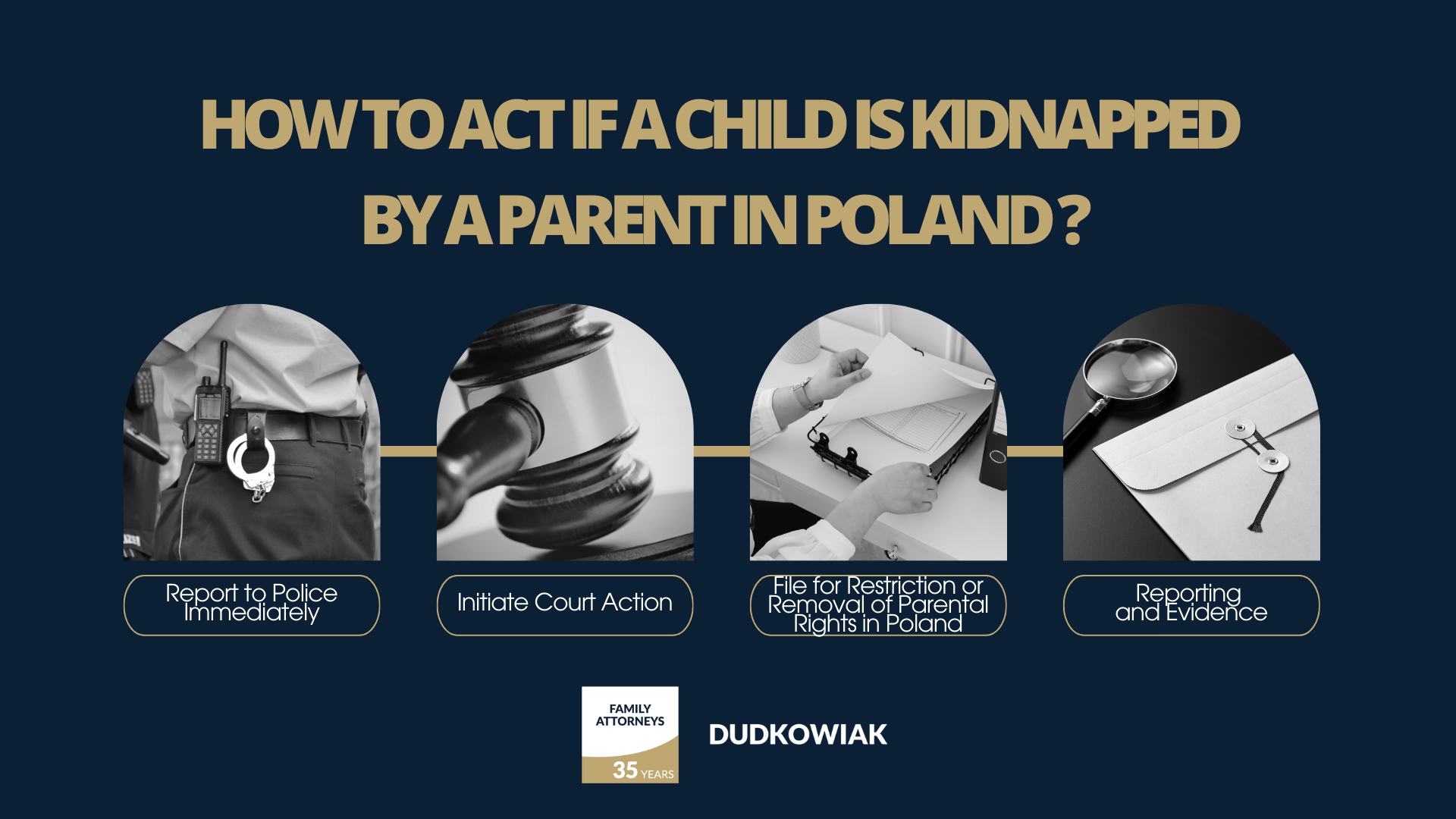
How to Act if a Child Is Kidnapped by a Parent in Poland
The article outlines a practical three-step response:
Report to Police Immediately
Contact law enforcement as soon as possible. If you can reasonably determine the child’s location, include that information to enable quicker action. Police must record the incident in an official note, which becomes key evidence.
Initiate Court Action
Apply to the family court for an order to have the child returned. If the child’s location is unknown, the court may issue a directive to determine the child’s whereabouts and set a deadline for voluntary return; if this lapses, compulsory return measures can follow.
File for Restriction or Removal of Parental Rights in Poland
You may submit a motion to limit or revoke the other parent’s parental rights. It is advisable to explain the circumstances thoroughly, demonstrating why such measures are necessary, as this can influence the court’s decision.
Reporting and Evidence
Once reported, police document the parental kidnapping, which:
- Serves as proof of abuse of parental authority,
- Supports future family court actions (e.g., restricting parental rights).
Despite not being a criminal offence, this documentation has significant weight in civil proceedings.
Difference Between Parental Kidnapping and Child Abduction in Poland
Criminal vs. Non-Criminal
Child abduction (defined in Article 211 of the Polish Criminal Code) is a crime and is prosecuted automatically once authorities become aware. Parental kidnapping is not a criminal offence when committed by a parent with full parental rights.
Who Can Commit It?
The criminal child abduction offence in Poland can only be committed by someone who no longer holds parental rights, or whose rights have been suspended or restricted.
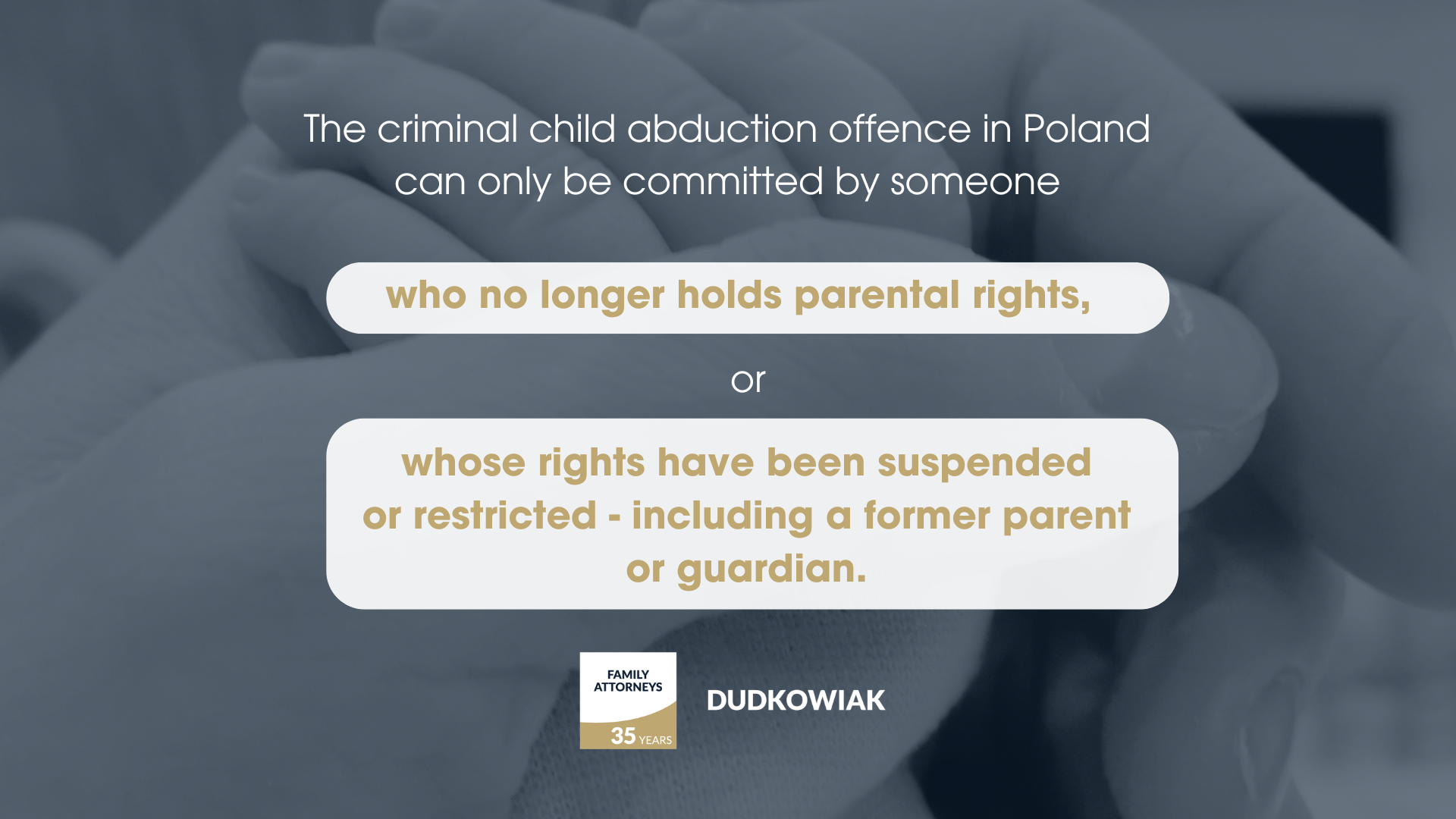
Parental kidnapping, conversely, involves a parent who still retains full parental authority.
Cross-Border Scenarios and Return of the Child
When a child is taken abroad, international legal tools apply.
The Hague Convention on the Civil Aspects of International Child Abduction (1980) facilitates the return of abducted children between member countries, including Poland and many European states.
Parents seeking the child’s return can file a request with the central authority in Poland or with the relevant authority in the country where the child is currently located.
Summary
- Parental kidnapping involves a parent removing or retaining a child without the other parent’s permission but is not a criminal offence if the perpetrator has full parental authority.
- Child abduction under criminal law is an offence with potential imprisonment but is only applicable when the perpetrator’s parental authority is removed, suspended or limited.
- Immediate action – police reporting, family court proceedings, and (where relevant) international legal instruments – is essential to protect parental rights and secure the child’s return.
 Family