


Battery Energy Storage in Poland: Legal Requirements and Investment Risks in 2025
Battery energy storage systems (BESS) are becoming increasingly important not only in the Environment sector, but also in the Automotive industry, where reliable and efficient battery infrastructure plays a crucial role in the growth of e-mobility and charging networks.
Despite the growing market interest, the development of BESS projects in Poland remains legally complex. Investors must navigate unclear zoning rules, fragmented permitting procedures, and evolving regulatory classifications that vary between municipalities.
Below, we outline the key legal requirements for building and operating BESS in Poland in 2025, including zoning, environmental permits, grid connection, and operational licensing.
Where can a BESS be built in Poland?
Before initiating a BESS investment, selecting a suitable site is critical. While no dedicated zoning rules for BESS exist, the project must comply with local planning law. Two legal pathways are available:
- Local Spatial Development Plan (MPZP)– the preferred option; allows direct permitting if BESS fits within the plan.
- Zoning Decision (WZ)– required if no MPZP is in place; only possible under strict spatial and infrastructure criteria.
The zoning process depends heavily on how BESS is classified. Some municipalities treat standalone BESS as technical infrastructure, others as commercial facilities. Without explicit MPZP provisions, authorities may reject the application or require a full plan amendment.
Do you need a building permit for BESS?
Yes. In nearly all cases, a building permit must be obtained before construction begins. BESS are not currently exempt from permitting requirements, even if they are standalone facilities.
A draft amendment to the Construction Law may introduce future exemptions for small-scale Battery energy storage systems (up to 20 kWh), but this change has not yet entered into force. As of 2025, investors should assume that a full construction permit is required.
Do I need an environmental permit for a BESS project?
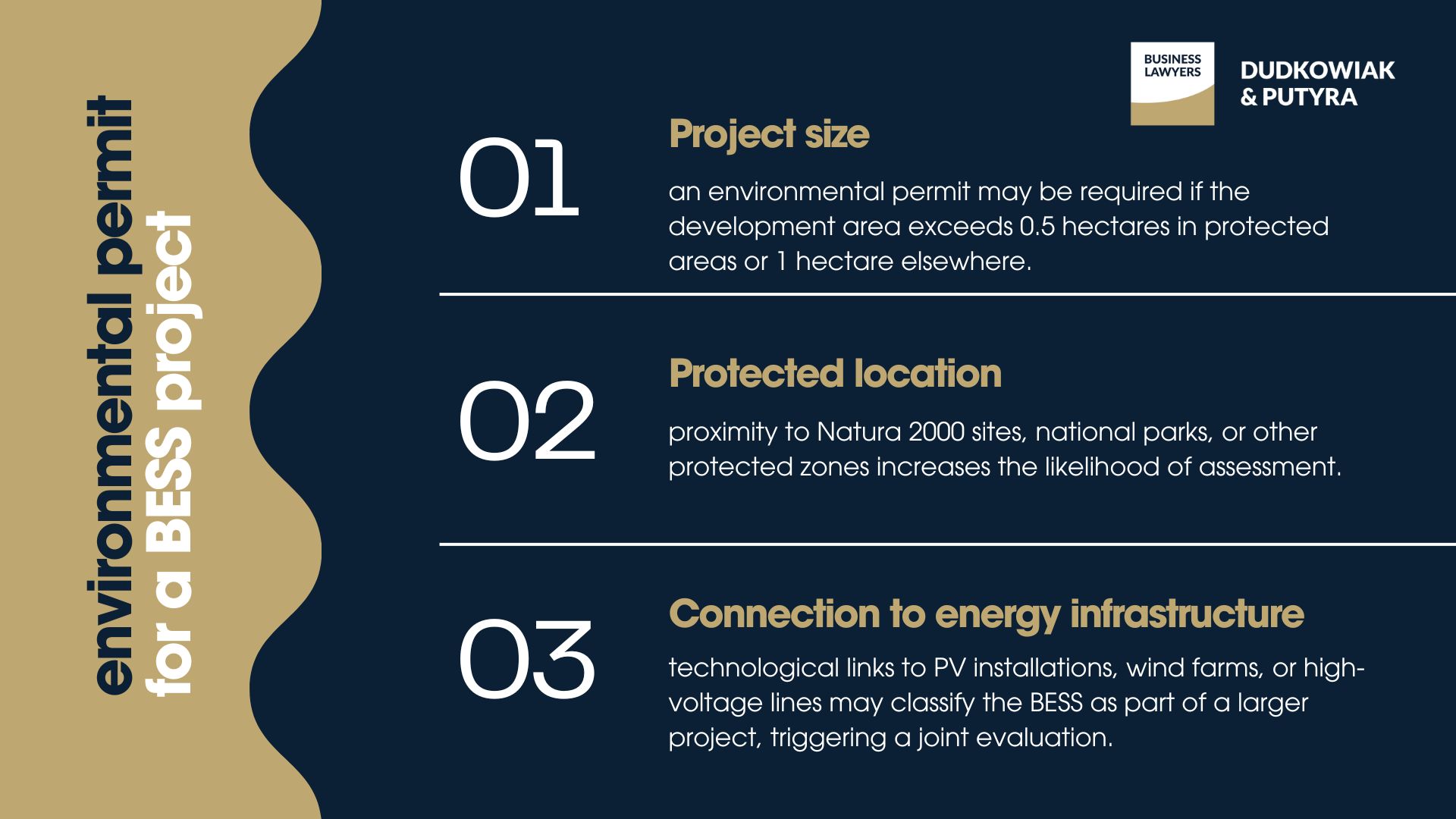
Not all BESS projects require an environmental decision (DUŚ), but certain factors may trigger this obligation:
- Project size– an environmental permit may be required if the development area exceeds 0.5 hectares in protected areas or 1 hectare elsewhere.
- Protected location– proximity to Natura 2000 sites, national parks, or other protected zones increases the likelihood of assessment.
- Connection to energy infrastructure– technological links to PV installations, wind farms, or high-voltage lines may classify the BESS as part of a larger project, triggering a joint evaluation.
Even if a full environmental impact assessment (EIA) is not required, authorities may still issue binding conditions as part of the environmental decision.
How to connect BESS to the power grid?
BESS installations with >50 kW capacity must apply for grid connection conditions from the relevant system operator (DSO or TSO). These conditions include:
- Technical parameters (capacity, transformer specs, connection point)
- Grid impact assessments (for projects >2 MW)
- Upfront deposit (PLN 30/kW requested)
Once granted, conditions are valid for 24 months and serve as a temporary capacity reservation. A connection agreement must follow before physical connection begins.
Is a license required to operate a BESS?
It depends on the installed capacity:
- >10 MW– requires a concession under the Energy Law
- 50 kW to 10 MW– must be registered in the energy storage register, but no license is required
- <50 kW– no license or registration is needed
The registration process is handled by the grid operator and must follow the official procedure set by the Ministry of Climate and Environment.
What legal risks should BESS investors be aware of?
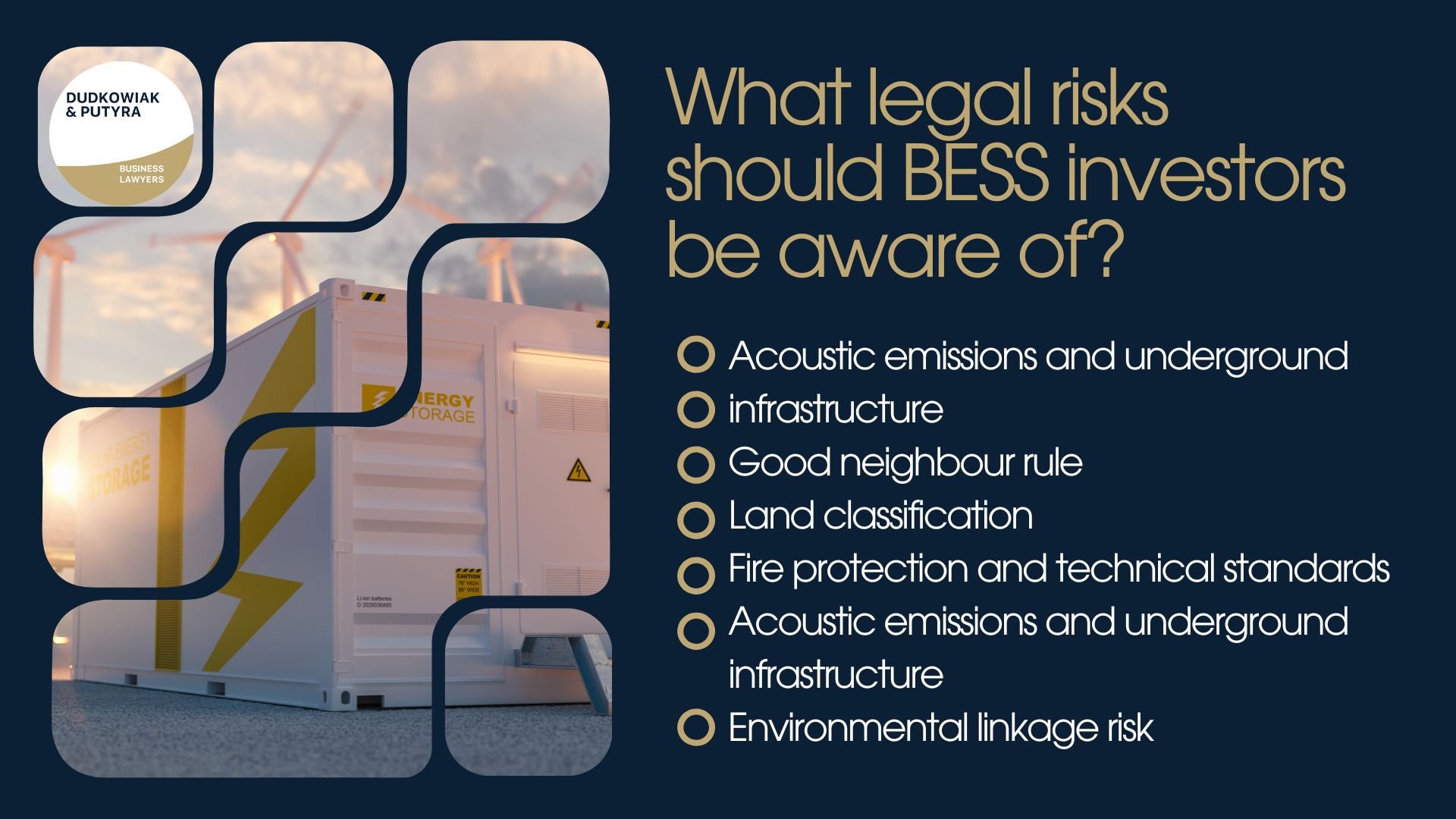
Despite increasing regulatory activity, Poland still lacks a dedicated legal framework for Battery energy storage systems. Key risks include:
- Zoning uncertainty– MPZP provisions are often unclear; some authorities reject BESS unless explicitly allowed
- Good neighbour rule– WZ decisions may be denied if no comparable infrastructure exists nearby
- Land classification– agricultural land in classes I–III may require conversion (odrolnienie) before development
- Fire protection and technical standards– not yet codified, but required in practice (e.g. expert fire assessments)
- Acoustic emissions and underground infrastructure– require individual analysis and third-party approvals
- Environmental linkage risk– if BESS is connected to other projects (e.g. PV farms), their impact may affect permitting
Investors should conduct due diligence early and maintain close coordination with public authorities.
Need legal support for a BESS project in Poland?
Our Real Estate team assist international investors with BESS permitting, zoning approvals, grid connection, and concession licensing. Contact us to assess your project’s compliance and reduce legal risk at every stage of development.
 D&P Legal





 MILAN
MILAN