


Gross Negligence of a Carrier – Supreme Court Judgment Redefines Standards in the TSL Sector
In its judgment of 22 January 2026, the Supreme Court adopted a strict approach to assessing a carrier’s standard of care in international transport. The ruling clearly indicates that deficiencies in the organisation of transport may be classified as gross negligence, resulting in the loss of protection arising from liability limits under the CMR Convention.
The judgment is of significant importance for businesses in the TSL sector, as it clarifies when shortcomings in transport organisation cease to be ordinary errors and become gross negligence, depriving the international carrier of the protection afforded by compensation limits under the CMR Convention.
Factual Background – Cargo Contamination and Carrier Liability
The case concerned damage to goods consisting of 26 pallets of polypropylene film intended for the production of food packaging. During a stop on the route from Italy to Belgium, unauthorised persons gained access to the trailer, leaving behind personal belongings, beverage packaging and various contaminants. Due to the risk of contamination of goods intended for contact with food, the consignee refused to accept the shipment.
The carrier argued that the driver had complied with working time regulations, parked in designated areas and had no knowledge of risks in the region. However, both the Court of Appeal and subsequently the Supreme Court held that the cumulative omissions in this case amounted to gross negligence.
Professional Standard of Care for Carriers
The starting point for the analysis is the determination of the appropriate standard of care. Under Polish law, the Civil Code requires the level of care generally expected in a given type of relationship; however, in the context of business activity, this standard is significantly stricter.
The Supreme Court confirmed that an international road carrier subject to the CMR Convention is required to exercise the highest standard of care, resulting from the professional nature of its services. This standard includes not only professional knowledge and formal qualifications, but above all diligence in anticipating risks.
In practice, this means that a carrier cannot limit itself to routine actions- it must actively manage risk, taking into account the objective level of threat along the planned route.
Criteria for Establishing Gross Negligence on the Part of the Carrier
A key element of the ruling is the recognition that deficiencies in the organisation of transport itself may constitute gross negligence. The Supreme Court stated that gross negligence may result from a cumulative series of failures on the part of the carrier.
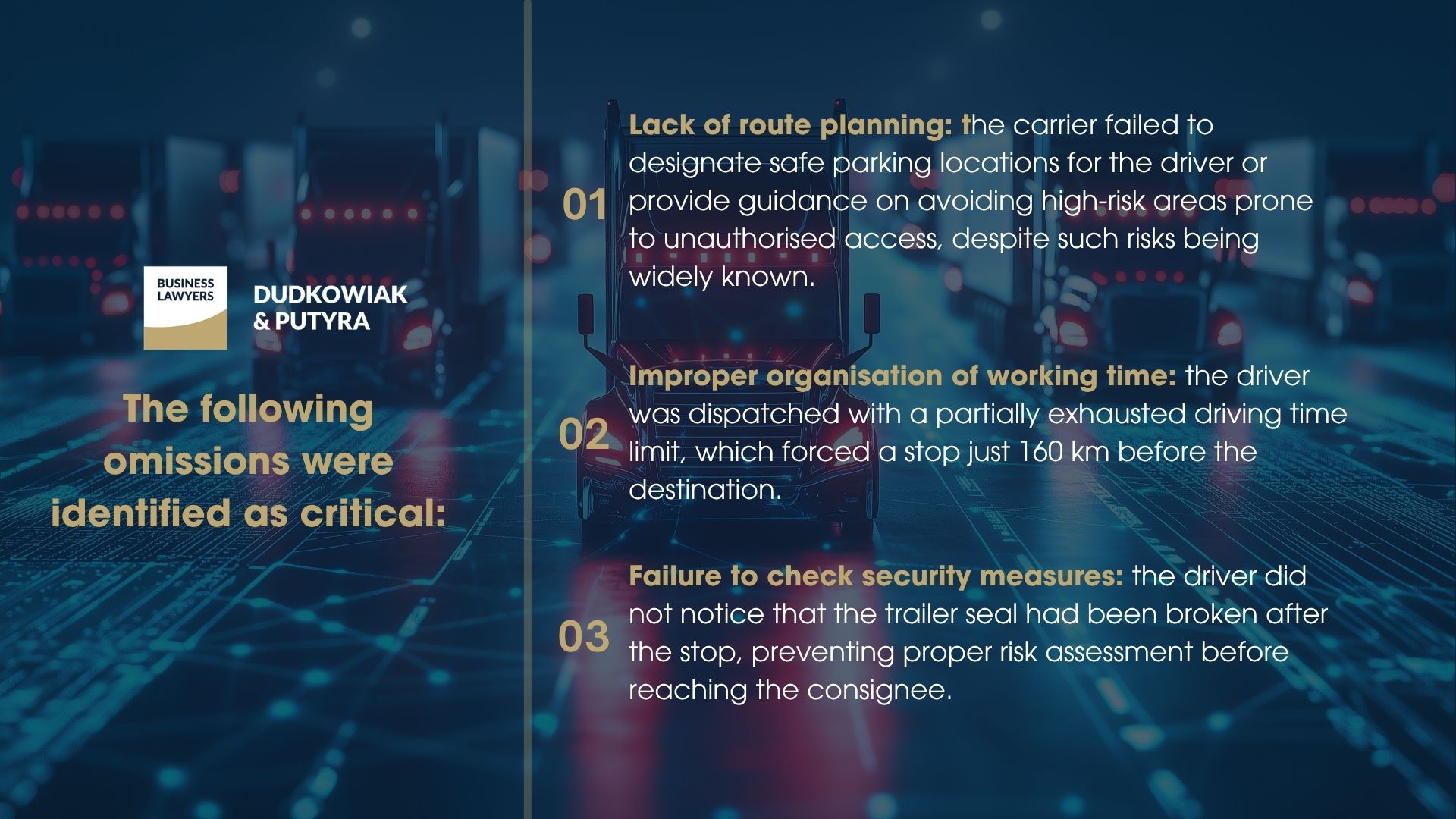
The following omissions were identified as critical:
- Lack of route planning: the carrier failed to designate safe parking locations for the driver or provide guidance on avoiding high-risk areas prone to unauthorised access, despite such risks being widely known.
- Improper organisation of working time: the driver was dispatched with a partially exhausted driving time limit, which forced a stop just 160 km before the destination.
- Failure to check security measures: the driver did not notice that the trailer seal had been broken after the stop, preventing proper risk assessment before reaching the consignee.
The Court clearly stated that checking trailer security and planning safe stops are fundamental duties of a professional carrier. These omissions constitute a breach of the basic standards of care expected from a professional operator.
Legal Consequences of a Finding of Gross Negligence
This interpretation has fundamental implications for business practice, as a finding of gross negligence excludes the liability limitations provided under the CMR Convention.
In practice, classifying a carrier’s conduct as gross negligence leads to the following consequences:
- Loss of liability limits– the carrier loses the right to limit compensation (typically to 8.33 SDR per kilogram) and becomes liable for the full amount of the damage.
- Extended limitation period– instead of the standard one-year period, claims may be pursued within three years.
Moreover, gross negligence creates a risk that the insurer may deny coverage under the carrier’s insurance policy, unless the policy provides otherwise.
Is Your Organisation Prepared for the New Liability Standards?
The Supreme Court’s judgment clearly establishes a more stringent standard for assessing carrier conduct in international transport. In practice, this requires more conscious and proactive risk management, both at the stage of planning transport and during its execution.
If your company operates in the TSL sector and you would like to assess liability risks or need support in disputes concerning cargo damage, feel free to contact our team.
 D&P Legal





 MILAN
MILAN