


Supreme Court: Filing for a Declaration of Inheritance Acquisition Interrupts the Limitation Period
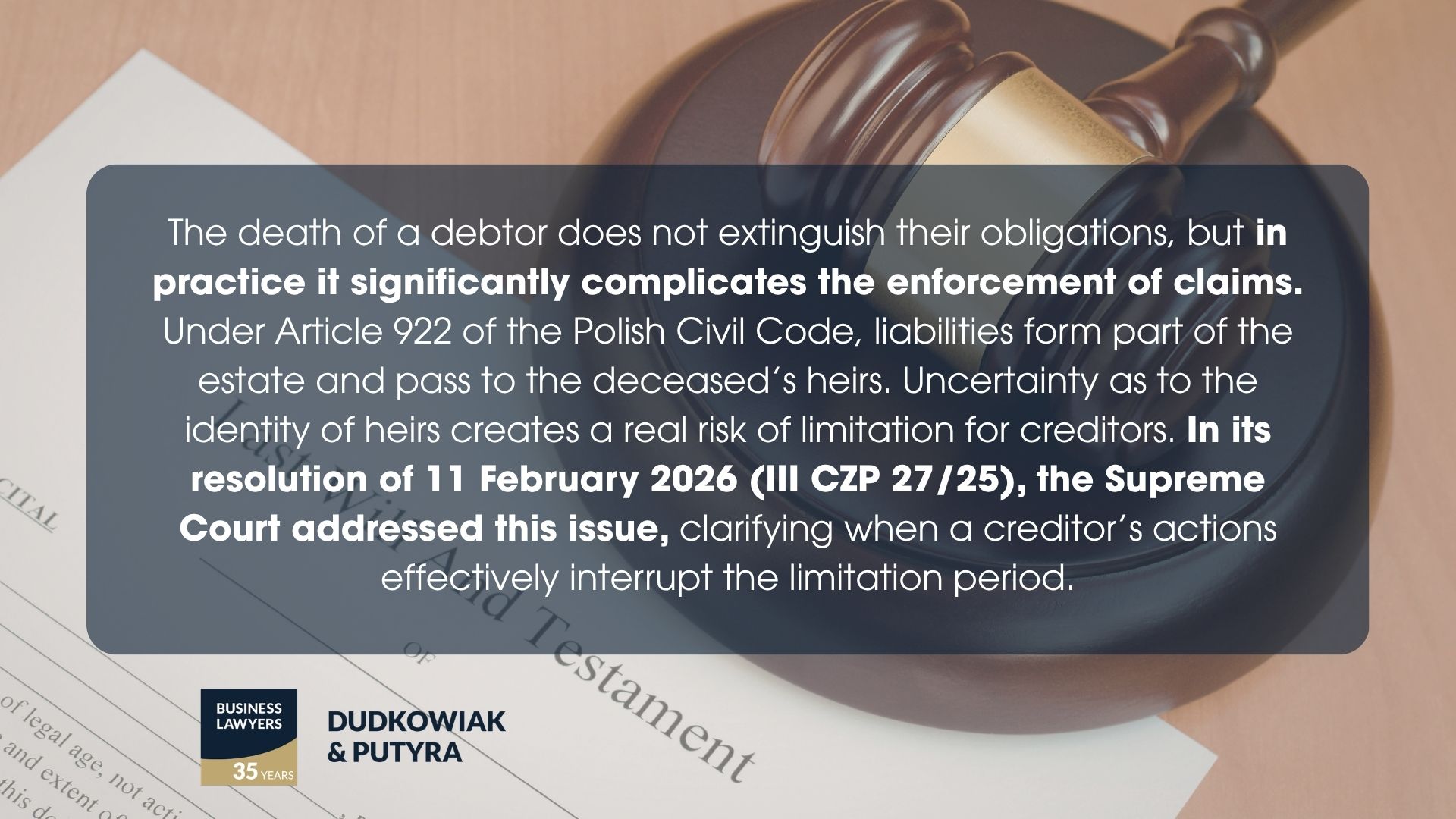
The death of a debtor does not extinguish their obligations, but in practice it significantly complicates the enforcement of claims. Under Article 922 of the Polish Civil Code, liabilities form part of the estate and pass to the deceased’s heirs. Uncertainty as to the identity of heirs creates a real risk of limitation for creditors. In its resolution of 11 February 2026 (III CZP 27/25), the Supreme Court addressed this issue, clarifying when a creditor’s actions effectively interrupt the limitation period.
Interruption of the Limitation Period – Diverging Interpretations in Practice
The problem becomes particularly acute when a debtor dies shortly before the statute of limitations expires. A creditor cannot sue the “estate” itself; they need to identify specific entities. In many cases, the only way to do this is for the creditor to file an application for a declaration of inheritance acquisition, which they are entitled to do as a person with a legal interest under Art. 1025 § 1 of the Civil Code.
The legal dispute brought before the Supreme Court concerned the interpretation of Art. 123 § 1 point 1 of the Civil Code. This provision states that the statute of limitations is interrupted by any action taken before a court “directly” in order to pursue, establish, satisfy, or secure a claim. The word “directly” divided legal experts. Some argued that inheritance proceedings are exclusively preparatory and do not meet the directness requirement.
The opposing side argued that without establishing the circle of heirs, the creditor is effectively deprived of the possibility to assert their rights, making the application a necessary step.
Supreme Court Clarifies the Rules on Limitation Period Interruption
In a resolution adopted by a panel of three judges, the Supreme Court sided with creditors, but not unconditionally. The Court ruled that the filing of an application for a declaration of inheritance acquisition by a creditor after a deceased debtor interrupts the limitation period of the claim, provided that it is “necessary” to pursue, establish, satisfy, or secure that claim.
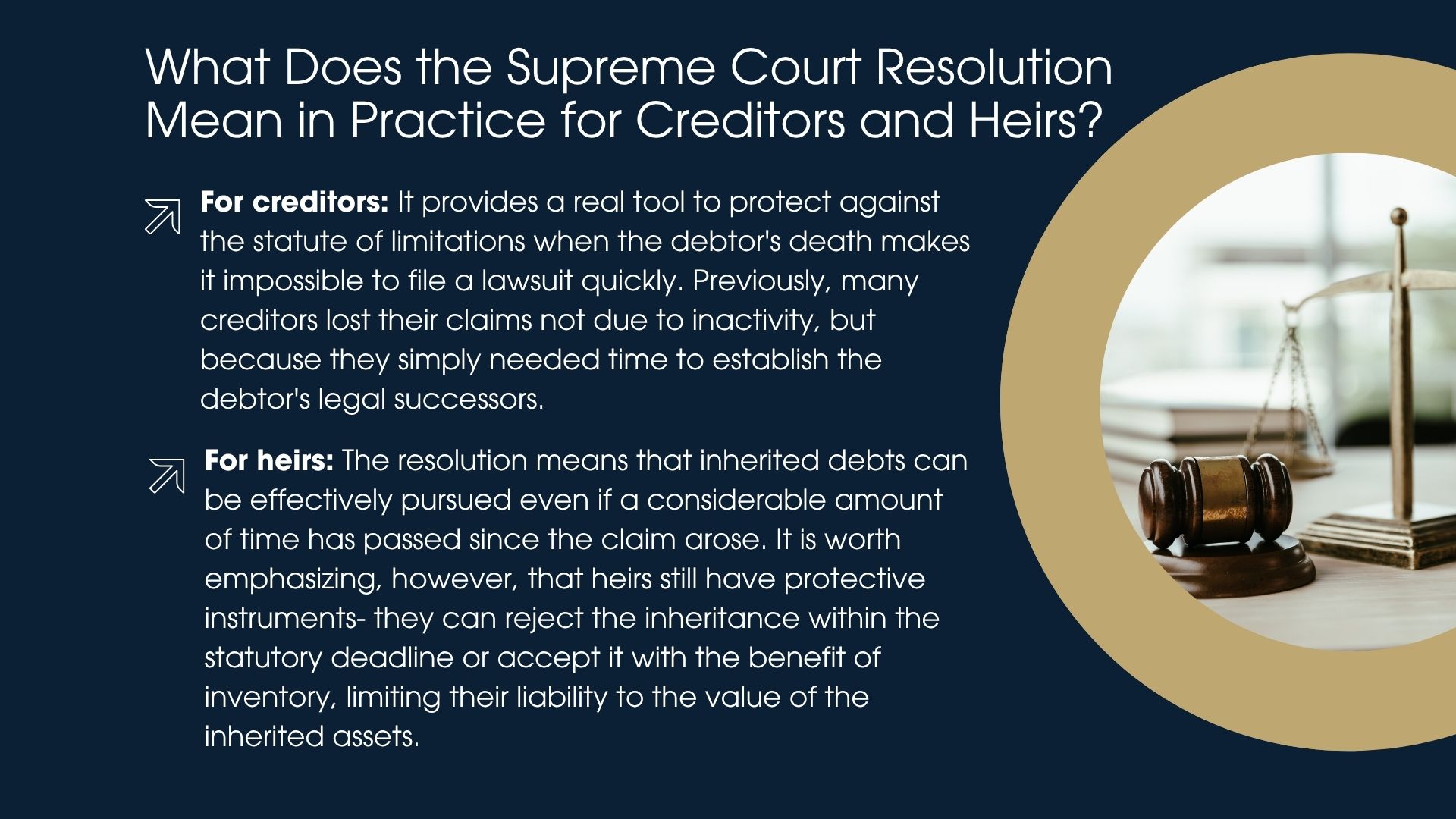
What Does the Supreme Court Resolution Mean in Practice for Creditors and Heirs?
This ruling has momentous practical significance:
- For creditors: It provides a real tool to protect against the statute of limitations when the debtor’s death makes it impossible to file a lawsuit quickly. Previously, many creditors lost their claims not due to inactivity, but because they simply needed time to establish the debtor’s legal successors.
- For heirs: The resolution means that inherited debts can be effectively pursued even if a considerable amount of time has passed since the claim arose. It is worth emphasizing, however, that heirs still have protective instruments – they can reject the inheritance within the statutory deadline or accept it with the benefit of inventory, limiting their liability to the value of the inherited assets.
Although a resolution adopted by a panel of three Supreme Court judges does not have the formal power of a legal principle binding other courts, in practice, it constitutes a very strong interpretive guideline. Common courts are highly likely to follow it when deciding similar cases.
How Does the Supreme Court Resolution Affect Your Legal Position?
Although the Supreme Court’s resolution is not formally binding, it will in practice serve as a significant interpretative guideline for courts. It may substantially improve the effectiveness of claim enforcement in inheritance-related cases.
If you would like to assess how this development affects your situation or secure your claims, feel free to contact our team.
 D&P Legal




 MILAN
MILAN