


Written by Anna Cichoń, Lawyer, Counsel
Reviewed by Natalia Chudzicka-Szwajka, Barrister (adwokat), Counsel
First published: 19 October 2026
Last updated: 19 October 2026
In short
Who owns AI-generated designs and who is liable
Generative AI is now part of everyday work in the fashion business: prints and silhouettes sketched with image generators, product photos shot on AI-generated models, campaigns fronted by virtual influencers. Each of these uses raises two questions: who owns the rights to what the AI produces, and when using it infringes someone else’s intellectual property (IP).
Copyright protects an AI-assisted design only to the extent of the human creative input behind it, and the law on authorship is still unsettled. Training AI models on protected content may infringe copyright or database rights. Using an output that resembles an existing product may infringe trademarks, designs or copyright, and liability can fall on the brand that uses the output as well as on the provider of the tool.
This guide covers the AI questions first: designs, model training, liability, a checklist for brands and AI-driven marketing, including virtual influencers. It then turns to two brand-protection issues that arise with or without AI: what online marketplaces must do about infringing listings under the Digital Services Act (DSA), and where a dupe stops being lawful inspiration.
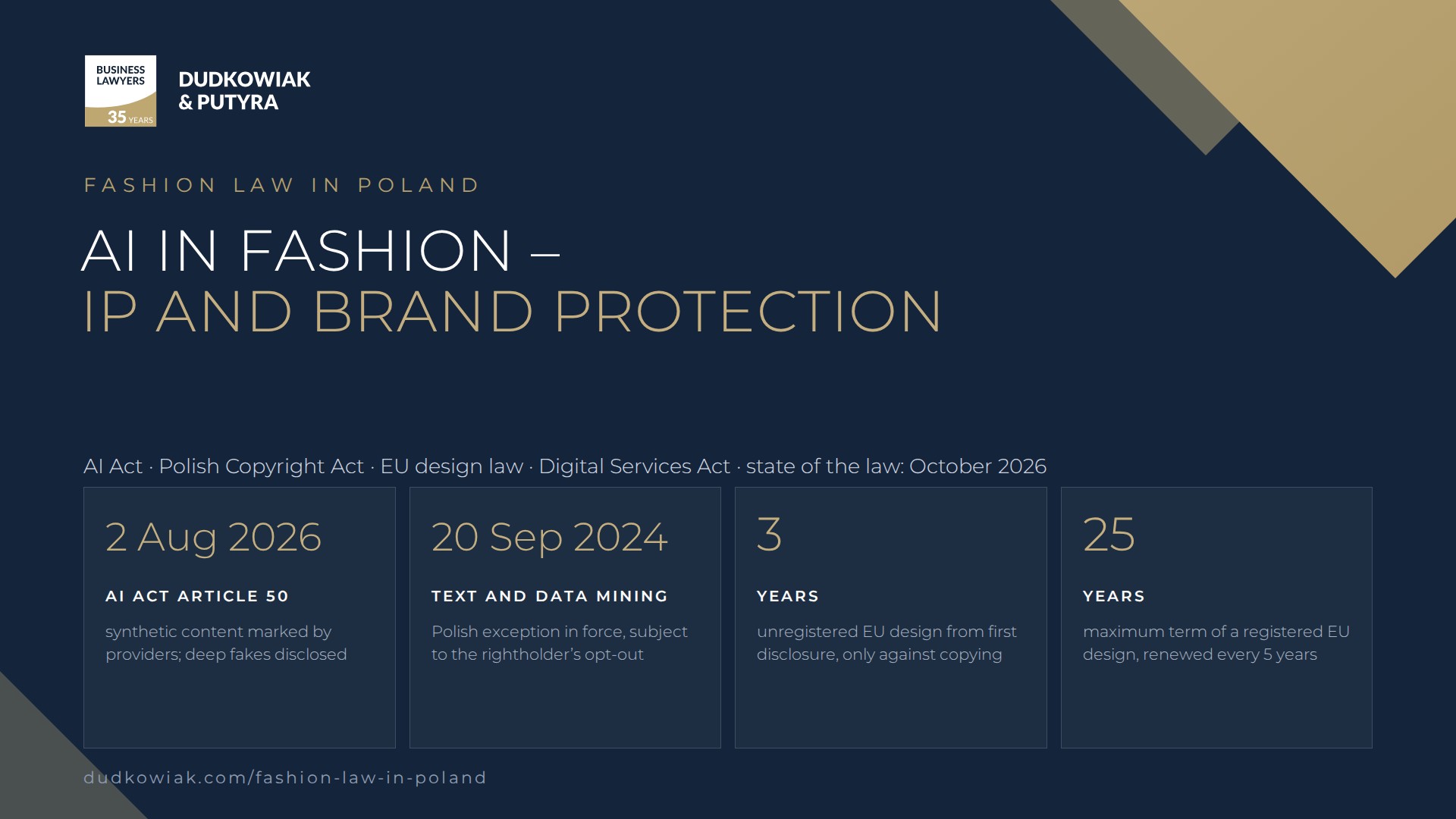
2 Aug 2026
AI Act Article 50 applies: providers must mark synthetic content; deep fakes must be disclosed
20 Sep 2024
Polish text and data mining exception in force, subject to the rightholder’s opt-out
3 years
protection of an unregistered EU design from first disclosure
25 years
maximum term of a registered EU design, renewed every 5 years
AI, IP AND FASHION – THE TERMS USED ON THIS PAGE
AI-generated (synthetic) content – images, video, audio or text produced by an AI system rather than drawn, photographed or written by a person.
Text and data mining (TDM) (eksploracja tekstów i danych) – automated analysis of large amounts of text, images or data – the way AI models are trained. Rightholders can opt out by reserving their rights.
Registered and unregistered EU design (wzór UE) – protection for the appearance of a product: its shape, lines, colours and texture. A registered design is filed with the EUIPO; an unregistered one arises automatically when the design is first shown to the public in the EU.
Individual character (indywidualny charakter) – the test a design must pass: an informed user, someone familiar with products of that kind, must get a different overall impression from it than from earlier designs.
Deep fake (deepfake) – AI-generated or manipulated image, audio or video that resembles real people, objects or places and would falsely appear authentic.
Notice and action – the procedure under the DSA through which anyone can report illegal content, such as an infringing listing, to an online platform.
Personal rights (dobra osobiste) – rights protecting a person’s image, name, privacy and reputation under the Polish Civil Code.
AI-generated fashion designs – copyright and intellectual property protection in Poland
The first question for a brand using generative AI is whether what the tool produces – a print, a sneaker silhouette, a lookbook image – is protected at all.
The law has not settled this. It is still unclear who is the author of output created through human interaction with an AI system, and who holds the rights to it. When assessing whether an AI-assisted design is protected by copyright, the extent of the human creative contribution to the design process is particularly relevant, because copyright law requires a human author.
In Poland, Article 1(1) of the Act on Copyright and Related Rights protects any manifestation of creative activity of an individual character. Polish legal writing and the case law of the Court of Justice of the EU read this as requiring the author’s own intellectual creation. In practice, a print that a designer drew, reworked and finished using AI as one of several tools stands a better chance of protection than one generated from a single prompt.
Training generative AI models – IP infringement risks
A separate concern is how AI models are trained. Training a model on protected content – for example, a competitor’s lookbook or a photographer’s catwalk images copied from the internet – may, depending on the circumstances, infringe copyright, database rights or other exclusive rights.
Polish law has had a text and data mining exception since 2024. Under Article 263 of the Copyright Act, works made available to the public may be copied for text and data mining unless the rightholder has reserved this in an appropriate way; the Database Protection Act contains a parallel rule. A brand that does not want its collections or product photos used for training therefore needs an effective opt-out. Under Article 53(1)(c) of the AI Act, providers of general-purpose AI models must have a policy to comply with EU copyright law, including identifying and respecting such opt-outs.
Risk also comes from what the tool produces. If an AI-generated design or image resembles an existing product or creative work – a bag with a well-known quilted pattern, a print close to another designer’s artwork – the brand using it needs to check whether it infringes trademark rights, a registered or unregistered design, or copyright.
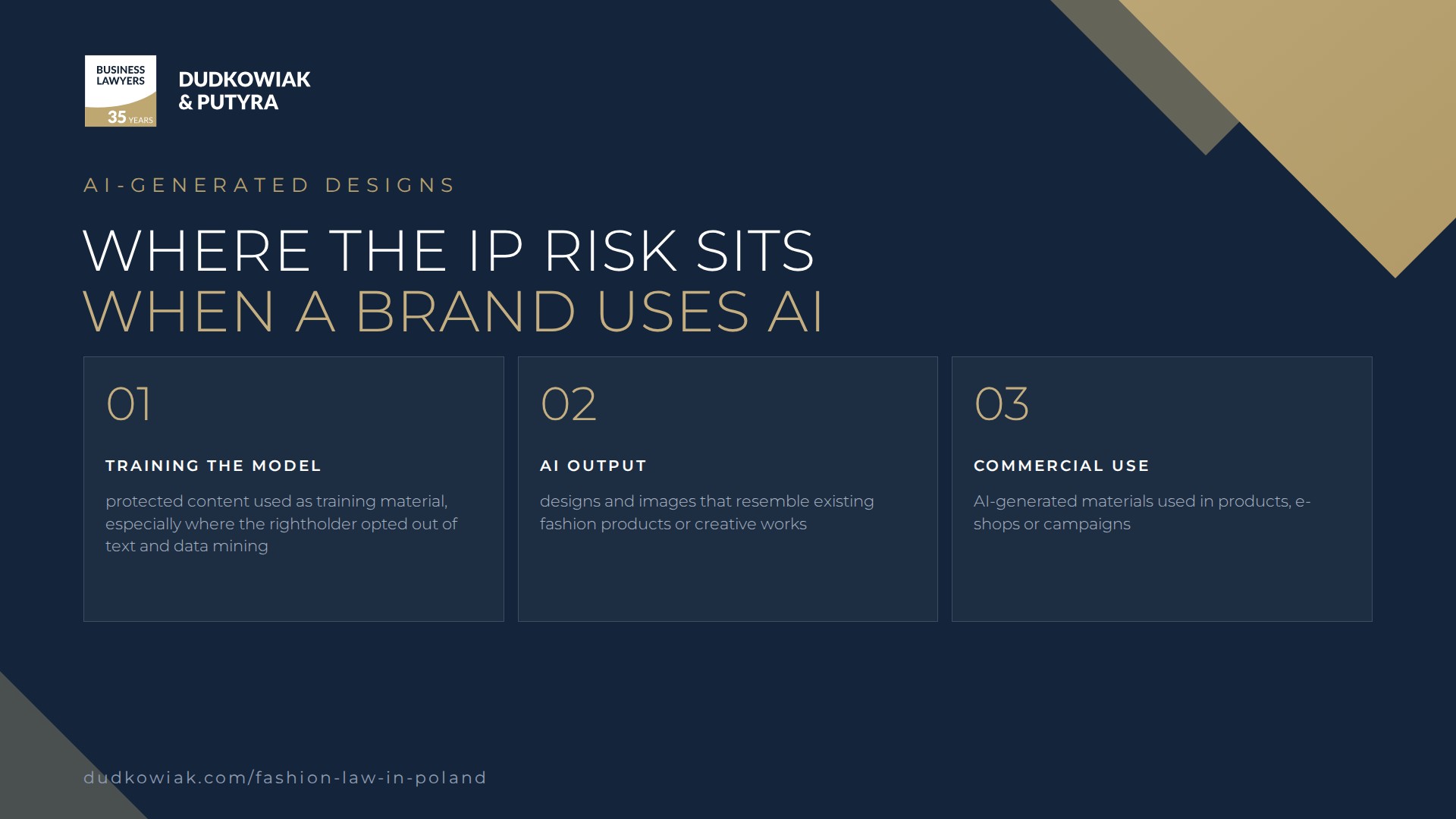
| Stage | Source of the risk | Rights that may be infringed |
|---|---|---|
| Training the AI model | Protected content used as training material, in particular where the rightholder has opted out of text and data mining | Copyright, database rights, other exclusive rights |
| AI output | Designs, images or other materials that resemble existing fashion products or creative works | Trademarks, registered or unregistered designs, copyright |
| Commercial use | AI-generated materials used in products, e-shops or campaigns | Third-party IP rights |
Who is liable for IP infringement involving AI?
Liability for IP infringement may arise both for users of AI tools and for providers of AI technologies. How liability is allocated depends on the circumstances of each case: how the technology is used, the degree of human control over the generated output and the contractual arrangements that apply.
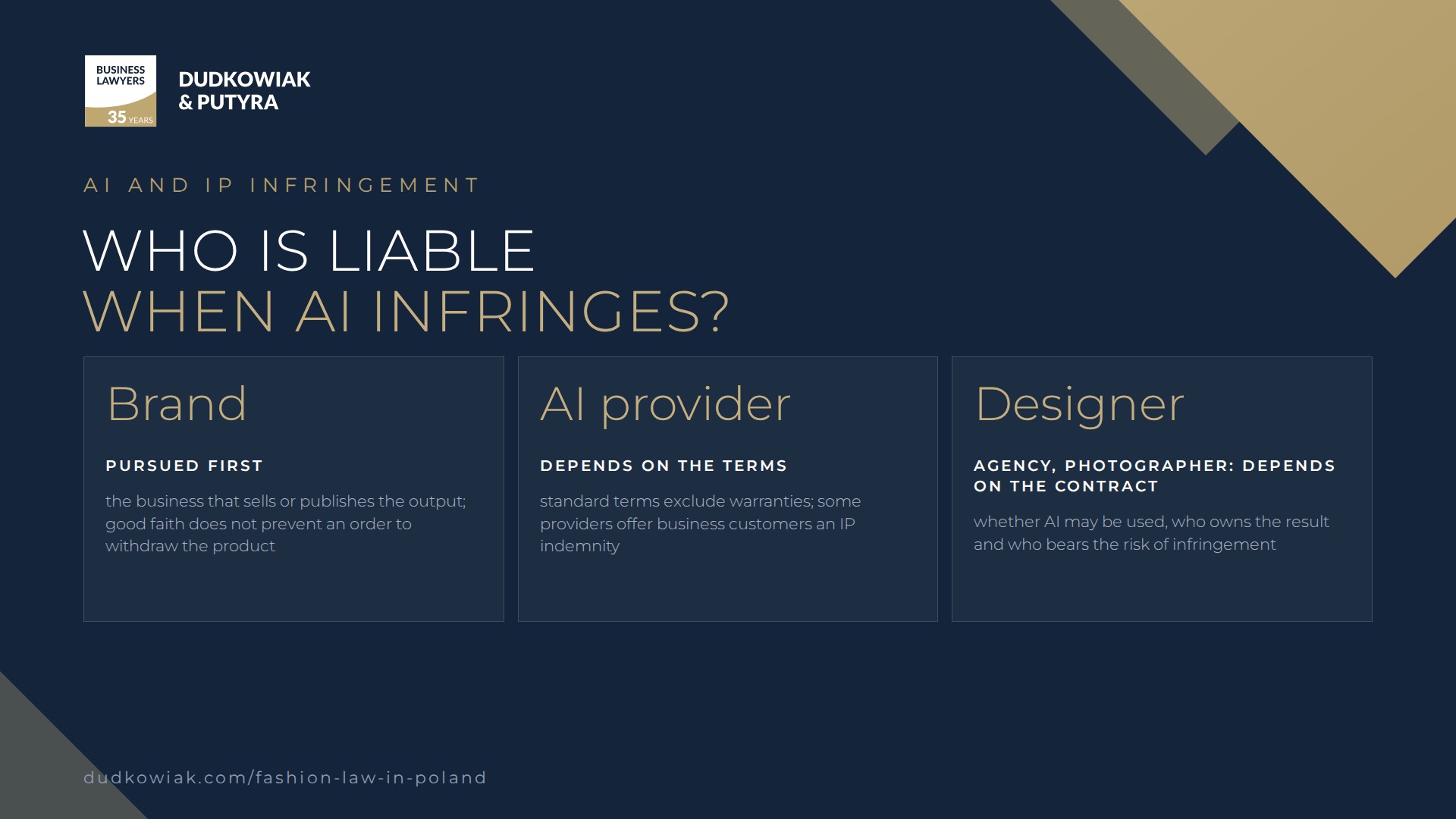
In practice, a claim is usually brought first against the business that puts the AI output on the market – the brand that sells the T-shirt with the print or runs the campaign – rather than against the AI provider. Under Polish law the rightholder can demand that the infringement stops, that its effects are removed and that profits made from it are handed over; where the infringer was at fault, damages are also available (Article 79 of the Copyright Act; Article 296 of the Industrial Property Law for trademarks).
Using an AI tool in good faith does not protect a brand from an order to withdraw an infringing product.
Whether the brand can then turn to the provider depends on the tool’s terms of use. Standard terms usually give the user whatever rights exist in the output but exclude any warranty that it does not infringe third-party rights. Some providers offer business customers a contractual indemnity against IP claims, typically on conditions such as using a paid plan and not deliberately prompting for protected content. Contracts with designers, agencies and photographers who use AI should state whether AI may be used, who owns the result and who bears the risk of infringement.
Checklist for a fashion brand starting to use AI
Ten steps that cover the risks described above, in three stages: once before you start, for every collection or campaign, and continuously after launch. They can be ticked off as you go; the PDF version also lists the evidence to keep for each step.
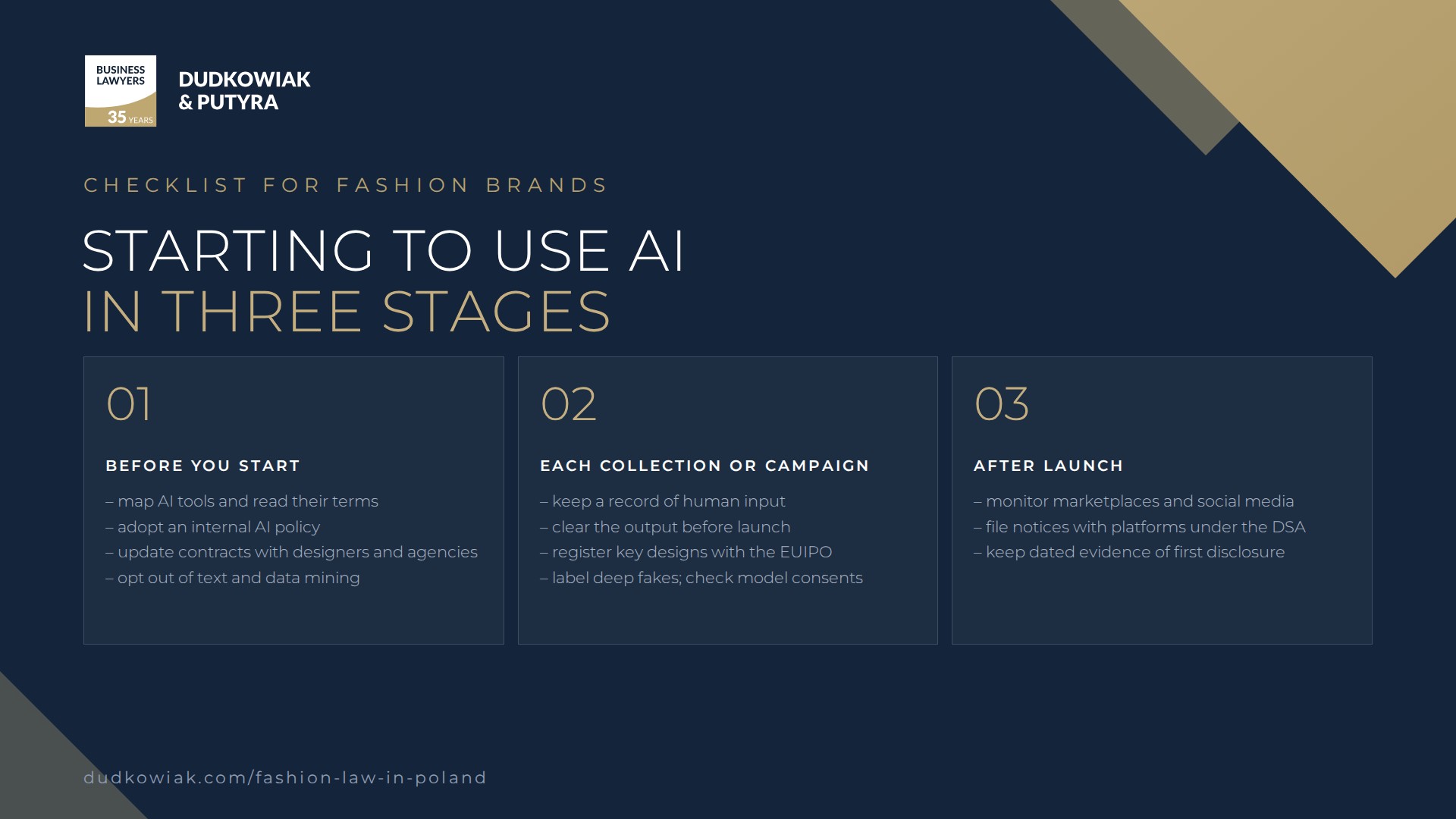
BEFORE YOU START
FOR EACH COLLECTION OR CAMPAIGN
AFTER LAUNCH
What it costs
Most of the steps cost nothing but time: opting out of text and data mining, labelling synthetic content and filing notices with platforms carry no official fees. The main official cost is registering key designs with the EUIPO: €350 for the first design and €125 for each additional design in the same application (up to 50 designs per application). Fees for registering the brand itself are set out in our guide to EU trademark registration, and the industrial designs service page covers design protection more broadly.
Virtual influencers and generative AI in fashion marketing – key legal risks
A growing number of fashion brands use virtual influencers, digital models and AI-generated content in their marketing – from e-shop product photos showing clothes on an AI-generated model to a virtual brand ambassador with her own Instagram account. These tools lower the cost of content creation and open new ways of engaging customers, but they also carry legal risks that have to be managed.
In practice, businesses increasingly face questions about:
- personality rights in relation to digital characters,
- the protection of trademarks used in virtual environments,
- IP rights in AI-generated content.
Further issues arise where content published by a virtual influencer may infringe third-party rights or raise concerns under advertising and consumer protection law.
Polish law addresses several of these points directly. A digital character modelled on a real person engages that person’s rights: disseminating a person’s image generally requires their consent (Article 81 of the Copyright Act), and personal rights are protected under Articles 23 and 24 of the Civil Code. Advertising that is not clearly identified as paid content can be an unfair market practice under the Act on Counteracting Unfair Market Practices. Under Article 50(4) of the AI Act, those who publish AI-generated or manipulated images or video that constitute a deep fake must disclose that the content is artificial, with a lighter regime for evidently artistic, creative or fictional works.
Introducing AI-based tools in marketing campaigns therefore involves more than technology and marketing decisions. Copyright ownership, contractual liability and the terms of use of AI tools need to be regulated properly. Well-structured documentation and internal procedures can significantly reduce the risk of disputes and claims arising from the use of new technologies in the fashion industry.
E-commerce platforms in fashion – intellectual property infringement and legal liability in Poland
As fashion sales have moved online, IP infringements have moved with them. Online marketplaces are now a main channel for selling fashion products – and also for copies that infringe trademarks, designs and copyright, often listed by dozens of sellers at once.
Platform obligations under the Digital Services Act
The key EU instrument is the Digital Services Act (DSA). It requires providers of intermediary services, including marketplaces, to act against illegal content. For brand owners the most important obligations are:
- notice and action: anyone can report an infringing listing, and the platform must handle the notice in a timely, diligent, non-arbitrary and objective manner (Article 16);
- seller verification: marketplaces must collect and check basic information about the traders who sell through them (Article 30).
A platform is not liable for listings it does not know about and has no general obligation to monitor what its users post (Articles 6 and 8). Once it receives a sufficiently precise notice, it must act quickly – typically by removing the listing or blocking access to it – or it may lose that protection. In certain cases platforms can also be required to take preventive measures, such as stopping the same seller from listing the same copies again.
The DSA applies directly in Poland. The first Polish implementing act, the Act of 4 September 2026 amending the Act on Providing Services by Electronic Means (Journal of Laws 2026, item 1296), was signed by the President on 25 September 2026 and published on 6 October 2026. It makes the President of the Office of Electronic Communications (UKE) the Digital Services Coordinator and gives supervisory roles to the President of the Office of Competition and Consumer Protection (UOKiK) and the Chairman of the National Broadcasting Council (KRRiT). It enters into force on 6 November 2026. A second act, setting a national procedure for orders blocking access to illegal content, was passed by the Sejm and adopted by the Senate with amendments on 13 October 2026; as of 15 October 2026 it is back before the Sejm.
What this means for brands, sellers and importers
| Who | What to do |
|---|---|
| Fashion brands | Register key trademarks and designs before launch, monitor marketplaces and social media, file takedown notices and act quickly against repeat sellers. |
| Sellers and importers | Check where goods come from and keep supplier documents; do not list products that copy protected trademarks or designs. |
E-commerce platforms are no longer merely distribution channels. They are becoming a key area for the enforcement of intellectual property rights within the European Single Market.
Dupe culture – where does inspiration end and brand infringement begin?
The growing popularity of so-called dupe products is one of the most complex legal challenges in fashion – think of a sandal that copies a distinctive buckle, sold without the original brand’s name. A dupe is not a counterfeit, and the difference decides how the product is assessed.
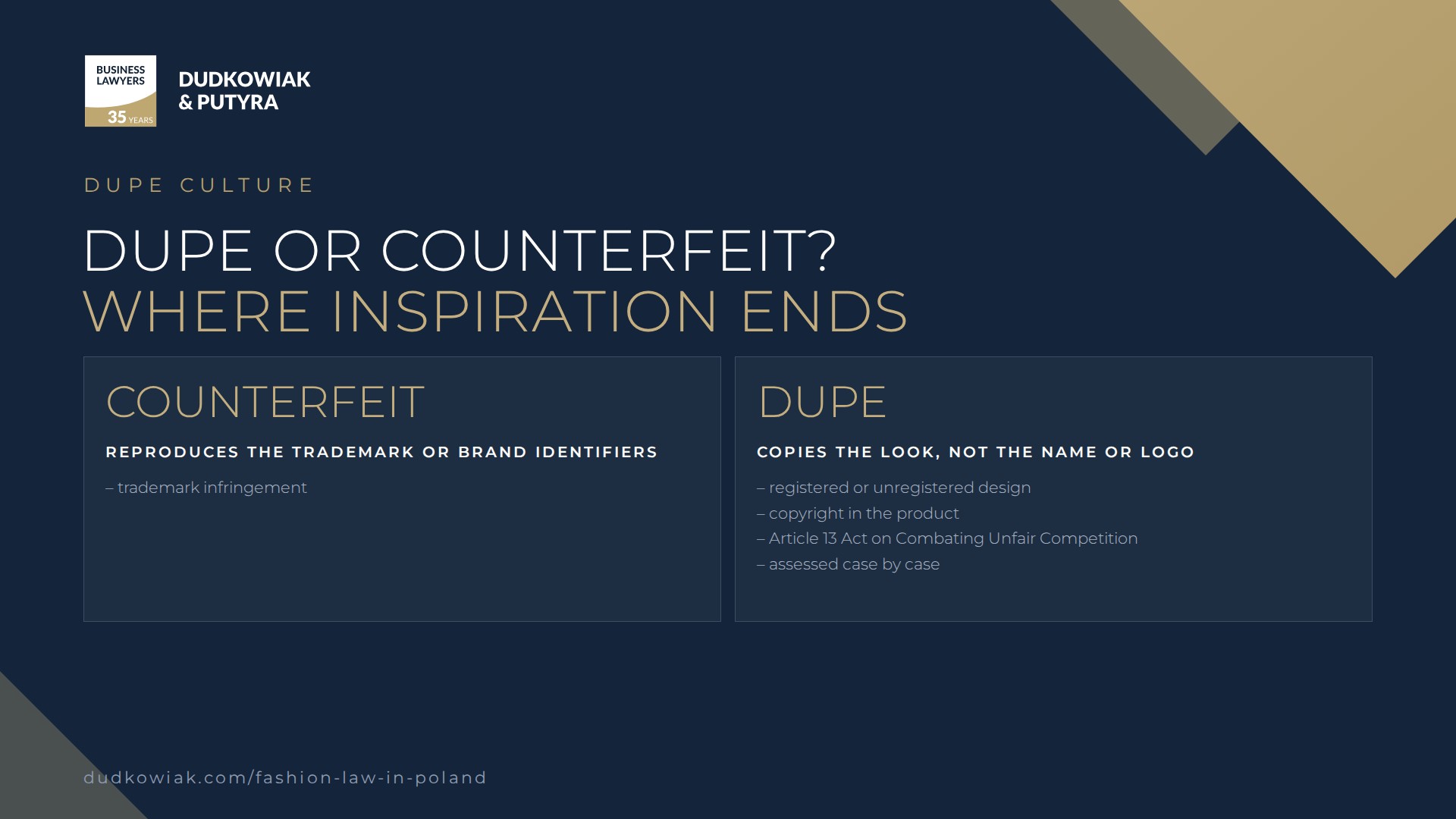
Counterfeit
Reproduces the trademarks or brand identifiers of the original.
Dupe
Typically does not reproduce trademarks or brand identifiers. It imitates the appearance, style or distinctive features of products of established brands.
For that reason, whether a dupe is lawful can only be decided case by case.
In practice, disputes over dupe products increasingly go beyond trademark law and extend to industrial design protection, unfair competition rules and the unlawful exploitation of brand reputation.
Under Polish law, these claims rest on several acts at once. A registered design, Polish under the Industrial Property Law or EU-wide, protects the appearance of a product for a long, renewable term; an unregistered EU design gives shorter protection, and only against copying (see the key figures at the top of this page). Under Article 13 of the Act on Combating Unfair Competition, copying the external form of a finished product by technical means is an act of unfair competition if it may mislead customers about who made the product or what it is. The general clause in Article 3 of the same act covers other conduct that is contrary to law or good practice and threatens or harms another business’s interests.
The key issue is whether a product is permissible market inspiration or parasitic exploitation of the value and goodwill a luxury brand has built.
Brand owners therefore need to register what matters, watch the market and act against businesses that trade on the reputation of established brands. Manufacturers offering products inspired by popular designs should, in turn, carefully assess the legal risk before entering the market.
Case study: invalidating a copied design – the test that also protects fashion collections
CASE · EU DESIGN INVALIDATION · 2025
Invalidating a competitor’s EU design registration for a copied product
In 2024 Dudkowiak & Putyra acted for a Swedish manufacturer of wood-fired outdoor hot tubs after a Polish competitor registered an EU design for a product closely resembling the client’s own model. We applied to the EUIPO for a declaration of invalidity and proved the earlier disclosure of the client’s design with archived copies of its website. In 2025 the EUIPO declared the competitor’s registered EU design invalid for lack of individual character and ordered the holder to bear the costs.
What it shows. Registering a copy does not make it lawful: a registered EU design that produces the same overall impression as an earlier product can be cancelled. Different colours, finishes and proportions did not save the contested design, because where the designer’s freedom is not restricted the shape dominates the overall impression – the same test applies to clothing, footwear and accessories. Dated evidence of when a design was first shown is what makes such an application succeed.
How we help
Dudkowiak & Putyra’s intellectual property lawyers represent clients before the EUIPO and the Polish Patent Office in trademark and design cases, handle IP litigation including copyright infringement and invalidation proceedings, and advise on unfair competition, e-commerce compliance and the protection of IP in online business models.
Who you work with

Lawyer, Counsel
Author of this guide
Graduate in law (Master of Law) of Adam Mickiewicz University in Poznań. At Dudkowiak & Putyra she is one of the contacts for the firm’s fashion law work and advises on EU regulatory matters. Works in English and Spanish.

Barrister (adwokat), Counsel
Reviewer of this guide
Member of the Poznań Bar Association; graduate in law of Adam Mickiewicz University. At Dudkowiak & Putyra she represents clients before the EUIPO and the Polish Patent Office in trademark and design cases, handles copyright infringement and invalidation proceedings, and advises on unfair competition and e-commerce. Works in English and French.
Sources and methodology
Legal basis. Regulation (EU) 2022/2065 of 19 October 2022 on a Single Market for Digital Services (Digital Services Act; EUR-Lex), in particular Articles 6 (hosting), 8 (no general monitoring obligation), 16 (notice and action) and 30 (traceability of traders); Regulation (EU) 2024/1689 of 13 June 2024 laying down harmonised rules on artificial intelligence (AI Act; EUR-Lex), Articles 50 (transparency, applicable from 2 August 2026) and 53 (copyright policy of general-purpose AI providers), as amended by Regulation (EU) 2026/1744 (Digital Omnibus on AI); Council Regulation (EC) No 6/2002 on Community designs, as amended by Regulation (EU) 2024/2822 (EU design, applicable from 1 May 2025; EUR-Lex); Directive (EU) 2019/790 on copyright and related rights in the Digital Single Market (EUR-Lex), Article 4 (text and data mining). Act of 4 February 1994 on Copyright and Related Rights (ustawa o prawie autorskim i prawach pokrewnych) – Articles 1 (work), 263 (text and data mining), 79 (infringement claims) and 81 (image); text and data mining provisions added by the Act of 26 July 2024 (Journal of Laws 2024, item 1254; ELI), in force from 20 September 2024; Act of 27 July 2001 on the Protection of Databases (ustawa o ochronie baz danych); Act of 30 June 2000 – Industrial Property Law (Prawo własności przemysłowej) – trademarks and industrial designs, Article 296 (trademark infringement claims); Act of 16 April 1993 on Combating Unfair Competition (ustawa o zwalczaniu nieuczciwej konkurencji) – Articles 3 (general clause) and 13 (imitation of a product); Act of 23 August 2007 on Counteracting Unfair Market Practices (ustawa o przeciwdziałaniu nieuczciwym praktykom rynkowym); Act of 23 April 1964 – Civil Code, Articles 23 and 24 (personal rights); Act of 18 July 2002 on Providing Services by Electronic Means (ustawa o świadczeniu usług drogą elektroniczną), as amended by the Act of 4 September 2026 implementing the DSA (Journal of Laws 2026, item 1296; ELI), in force from 6 November 2026. Official information: uprp.gov.pl (Polish Patent Office), euipo.europa.eu (EU trademarks and designs, official fees) and uke.gov.pl (Digital Services Coordinator).
State of the law: October 2026. This page is general information, not legal advice; whether an AI-assisted design is protected, or a given use infringes third-party rights, depends on the facts of each case.
Corrections: none since publication.
FAQ – AI in fashion, intellectual property and brand protection in Poland
Can an AI-generated fashion design be protected by copyright in Poland?
Only to the extent it reflects human creative input: the Polish Copyright Act protects manifestations of creative activity of an individual character, and the extent of the human contribution to the design process decides whether an AI-assisted design qualifies.
Is it lawful to train an AI model on other brands’ images and designs in Poland?
Polish law allows works made available to the public to be copied for text and data mining unless the rightholder has opted out, so training on content with a valid opt-out may infringe copyright or database rights.
How can a fashion brand stop its content being used to train AI?
By reserving text and data mining rights in machine-readable form, for example in robots.txt or TDM metadata on its website, and stating the reservation in its website terms as well.
Do AI-generated fashion images have to be labelled in the EU?
Since 2 August 2026 Article 50 of the AI Act requires those who publish deep fakes to disclose them and AI providers to mark synthetic content, with providers of systems already on the market given until 2 December 2026 for the marking duty; the brand does not have to label an AI-generated print on a garment.
How long does an unregistered EU design protect a new collection?
Three years from the date the design was first made available to the public in the EU, and only against copying, not against independent creation of a similar design.
How long does registered design protection last?
Up to 25 years from the filing date, renewed in five-year periods, both for a registered EU design and for an industrial design registered with the Polish Patent Office.
Are dupe products illegal in Poland?
Not automatically: a dupe that avoids trademarks may still infringe a registered or unregistered design, copyright, or Article 13 of the Polish Act on Combating Unfair Competition where it copies a product’s form in a way that may mislead customers.
Who is liable when an AI tool produces an infringing design?
Usually the business that sells or publishes the output is pursued first; whether it can recover from the AI provider depends on the tool’s terms, which often exclude liability, although some providers offer business customers an IP indemnity.
How quickly must a marketplace act on a notice about infringing listings?
The DSA sets no fixed number of days; under Article 16 platforms must process notices in a timely, diligent, non-arbitrary and objective manner and inform the person who filed the notice of their decision.
Who enforces the DSA in Poland?
The President of the Office of Electronic Communications (UKE) is Poland’s Digital Services Coordinator under the implementing act of 4 September 2026, in force from 6 November 2026, with supervisory roles also given to the President of UOKiK and the Chairman of KRRiT.
Can a brand use a virtual influencer modelled on a real person?
Generally only with that person’s consent: under Article 81 of the Polish Copyright Act disseminating someone’s image requires consent, subject to narrow exceptions, and using a likeness can also infringe personal rights protected by Articles 23 and 24 of the Civil Code.
How much does it cost to make an AI-assisted collection legally safe?
Most steps, such as a text and data mining opt-out, labelling and platform notices, have no official fee; the main official cost is registering key designs with the EUIPO, at €350 for the first design and €125 for each additional one in the same application.

