Last updated: 01.10.2026
 Professional sport involves a range of legal and business decisions – from choosing a club structure and bringing in an investor, through player contracts and transfers, to sponsorship, marketing and the commercial use of image rights.
For club boards, investors, agents, sponsors and other market participants, this means navigating both generally applicable law and the rules of national and international sports organizations.
What is sports law and what does it cover in Poland?
Sports law does not function as a standalone branch of law in the traditional sense. Rather, it is an area where civil law, employment law, administrative law, tax law, criminal law, data protection and intellectual property law overlap.
As a result, sports law covers a broad range of matters – from player contracts and image rights, through the liability of event organizers and disciplinary proceedings, to sports arbitration, cross-border transfers and international regulations.
The Sports Act and other sources of sports law in Poland
The primary legal act governing sport in Poland is the Sports Act of 25 June 2010. It sets out the key rules concerning the organization of sports competition, the operation of sports clubs and Polish sports federations, as well as disciplinary liability and the financing of sport from public funds.
Sports activities are not governed by the Sports Act alone. The legal position of clubs, athletes, coaches and sports event organizers is also affected by a range of other regulations.
Specific legislation is also relevant. For example, the Act on Combating Doping in Sport governs the national anti-doping system and liability for breaches of anti-doping rules. The Copyright law applies, among other things, to sports broadcasts, audiovisual materials and the protection of content and designations used by sports organizations.
Social security rules are also relevant because they affect how athletes, coaches and other members of coaching staff are engaged. Infrastructure projects, such as stadiums, sports halls or training complexes, may also be subject to public-private partnership rules. Sports-related NGOs may in turn be affected by rules governing public fundraising and the financing of statutory activities.
Business activity regulations are particularly important for professional sports clubs operating as capital companies. Professional sport is increasingly a business generating revenue from media rights, sponsorship, ticket sales and player transfers.

Rules and bylaws of sports organizations – why do they matter?
A distinctive feature of sports law is the number of internal rules that apply alongside generally applicable law. Each Polish sports federation has its own statutes and disciplinary, licensing, transfer and competition regulations. Rules adopted by international organizations such as FIFA, UEFA, FIBA, World Athletics and the International Olympic Committee may also apply.
This means that a specific legal issue often has to be assessed across several layers of regulation at the same time. A player transfer, for example, may be governed by national law, the rules of the relevant Polish sports federation, international federation regulations and the player contract itself.
Sports federations have broad powers to set competition rules, license clubs and regulate disciplinary liability. For example, Article 37(1)(12) of the PZPN Statutes authorizes the Executive Board to adopt and issue regulations, provisions, rules and guidelines governing football in Poland, as well as rules of the game consistent with FIFA and UEFA regulations.
A specific matter therefore needs to be assessed against both statutory law and the rules of the relevant sports organizations.
Sports clubs in Poland – legal form, business activity and investment
Sports activity in Poland is conducted primarily through sports clubs, which under the Polish Sports Act must operate as legal entities. Founders have some freedom in choosing the legal form, but in professional sport – particularly in professional leagues – that choice may be limited by statute, federation rules and league regulations.
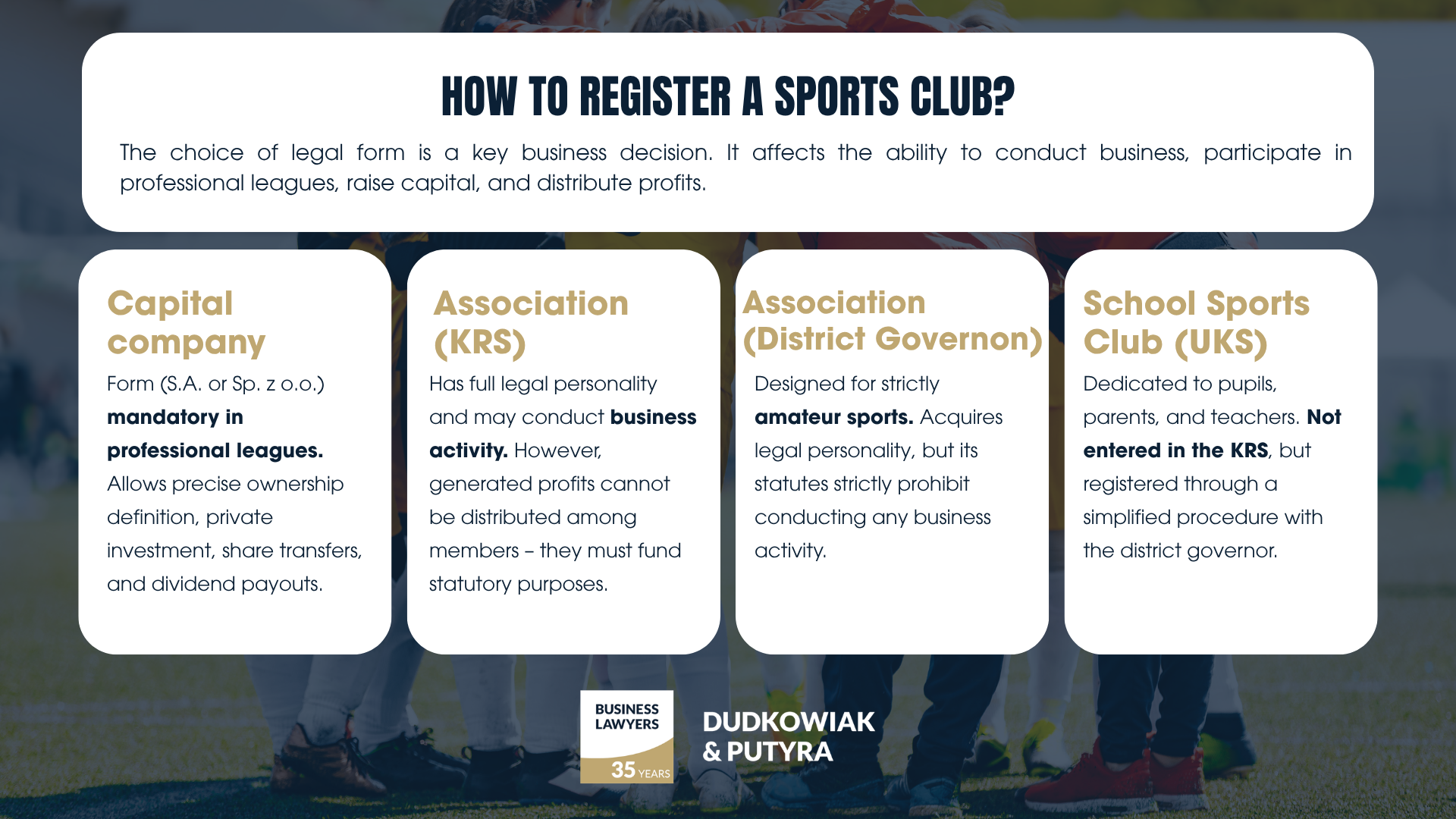
The choice of legal form is one of the club’s key organizational and business decisions. It affects, among other things, the ability to conduct business activity, distribute profits to investors, raise capital, structure governance and participate in specific competitions.
A sports club may operate as:
- a capital company – a joint-stock company (S.A.) or a limited liability company (Sp. z o.o.);
- an association;
- a foundation.
Each form has different organizational, business and tax consequences.
Sports club as a company in Poland
Only clubs operating as a joint-stock company (S.A.) or a limited liability company (Sp. z o.o.) may participate in a professional league in team sports.
If a sport is organized in a league format, the relevant Polish sports federation may establish a professional league. Polish law provides that where more than half of the clubs in the top division operate as joint-stock companies, the federation must establish a professional league. From an investor’s perspective, the key point is that a professional league in team sports consists exclusively of clubs operating as an S.A. or Sp. z o.o.
A company structure allows, among other things, private investment, transfers of shares and dividend distributions.
Capital companies are designed for business activity. They allow the ownership structure to be clearly defined, facilitate transfers of shares and limit shareholders’ liability. They also allow external strategic investors to acquire an interest in the club and, subject to the applicable corporate and financial rules, profits to be distributed to owners.
Sports club as an association
An association remains one of the basic legal forms used in sport, particularly for amateur activities and organizations focused on statutory purposes. The scope of permitted activity and the way the club operates depend on the type of association and the relevant register.
Association registered in the National Court Register (KRS)
A traditional form of sports club is an association entered in the National Court Register (KRS). It has legal personality and may conduct business activity. Profits cannot, however, be distributed among the association’s members – they must be allocated to its statutory purposes.
Association entered in the records maintained by the district governor (starosta)
For clubs of a typically amateur nature, the Sports Act provides for entry in simplified records maintained by the district governor (starosta). Such an association acquires legal personality, but its statutes may not provide for conducting business activity.
School sports club (UKS)
A School Sports Club (Uczniowski Klub Sportowy, UKS) is a specific type of sports club operating under the rules applicable to associations, with separate registration rules. Its members may include, in particular, school pupils, parents and teachers.
A UKS is not entered in the National Court Register (KRS). Instead, it is entered in the records maintained by the district governor (starosta) competent for the club’s registered office. The registration application must include, among other things, the club’s statutes, a list of founders and information on its registered office.
Foundation in sports activities
Foundations are less commonly used to operate professional teams, but they play an important role in sports training. A football, volleyball or basketball academy may be established as a separate foundation. This structure may facilitate fundraising through the 1.5% tax designation where the foundation has public benefit organization (OPP) status, as well as CSR projects.
Share deal vs asset deal – sports M&A transactions in Poland
The club’s legal form is also relevant to mergers and acquisitions (M&A) in the sports sector. Private investors and investment funds may acquire existing clubs or youth academies instead of building the relevant structures from scratch.
The most common structure for acquiring a professional club operating as a capital company is a share deal, i.e. the acquisition of shares in the club. Depending on the structure and size of the transaction, merger control requirements may also need to be assessed.
Where an acquisition of shares is not possible, an asset deal may be considered, involving the acquisition of selected assets or an organized part of an enterprise (ZCP).
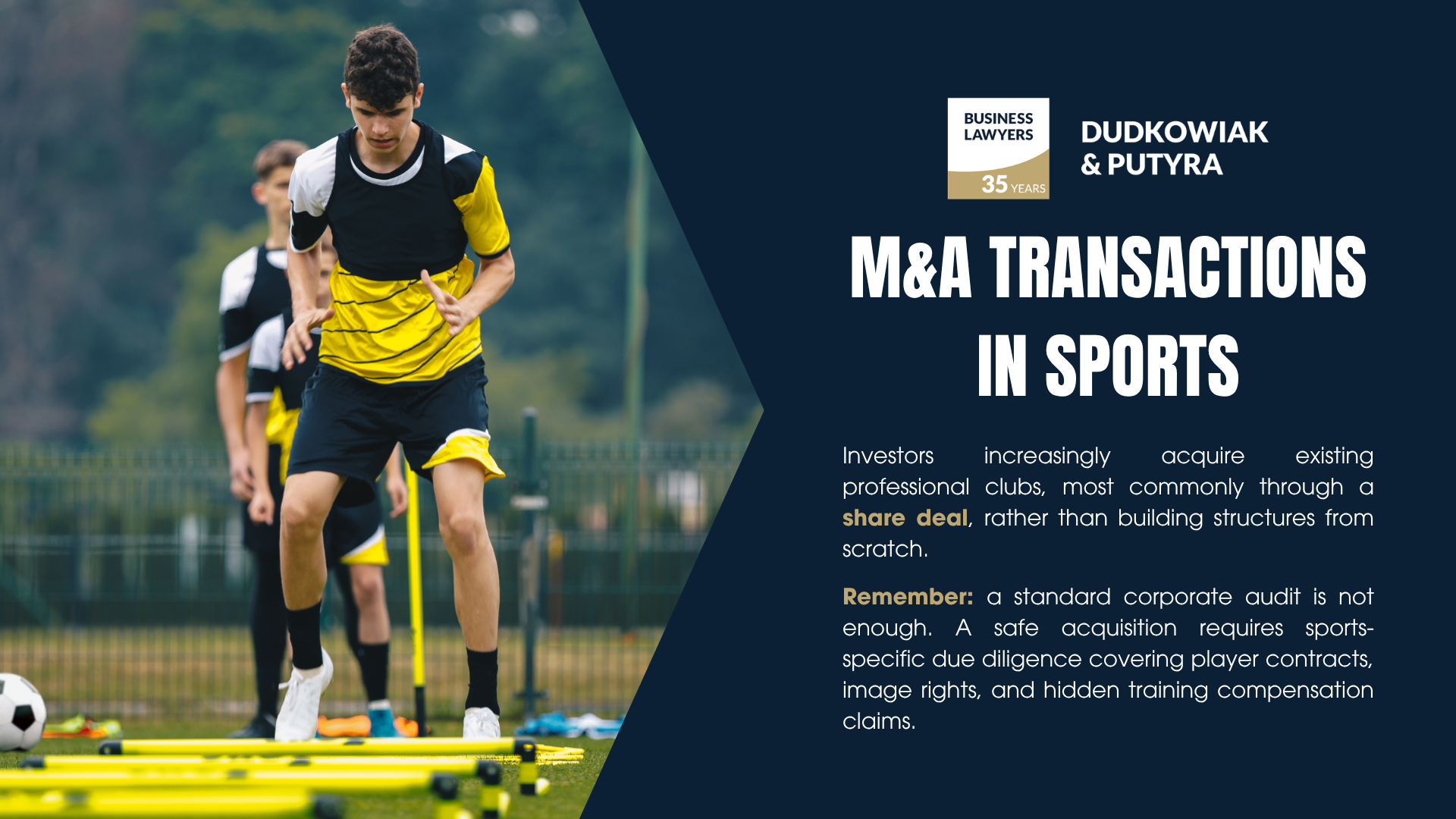
Regardless of the structure, the transaction should be preceded by due diligence covering both standard corporate risks and sports-specific matters. The review may include player and coach contracts, potential claims relating to training, image rights and sponsorship agreements.
Funding and day-to-day operations of sports clubs
Operating a sports club requires not only an appropriate legal structure but also funding, compliance with licensing requirements and proper arrangements for the use of infrastructure. For a club board, these issues directly affect the club’s ability to operate and participate in competitions.
Grants and public funding for sports clubs
The Sports Act provides mechanisms for public support. A sports club operating in a given area that does not conduct its activities for profit may receive grants from the local government budget.
Such grants may be used, in particular, for:
- sports training programs;
- the purchase of sports equipment;
- the costs of organizing or participating in competitions;
- the costs of using sports facilities;
- sports scholarships and coaching staff remuneration.
Local authorities may also fund periodic sports scholarships, awards and distinctions for athletes and support sports infrastructure through grants.
Sports club license and participation in competitions
Even if a club has the appropriate legal form, a stable budget and players, participation in professional competitions depends on satisfying the requirements of the relevant sports federation and completing the licensing process.
The federation reviews, among other things, financial documentation, sports documentation and infrastructure requirements. The licensing process is closely linked to national and international sports regulations.
Lease agreements for sports facilities and training venues
Many clubs in Poland do not own their sports facilities. Access to pitches, courts, tracks or sports halls is therefore often based on lease, rental or loan-for-use agreements with local authorities, schools or private operators.
Such agreements should address, in particular, the club’s right to use the facility on specified dates and a clear allocation of operating costs.
Organization of mass events by sports clubs
Although the Sports Act does not itself regulate all safety requirements for mass events, organizing a match for a large audience requires cooperation with the competent authorities and services. The organizer must prepare the venue and event regulations and ensure appropriate security and information services.
The club, as organizer, bears legal risk relating to the safety of participants, making appropriate insurance and compliance with organizational and administrative requirements particularly important.
Players, contracts and transfers (using football as an example)
The relationship between a club and a player is governed not only by the contract itself but also by statutory provisions and the rules of the relevant sports organizations. The key issues include the player’s status, the structure of the contract and the rules governing a change of club affiliation.
Amateur vs professional status – key differences
Sport may be practiced on both an amateur and a professional basis. In football, the distinction is particularly visible.
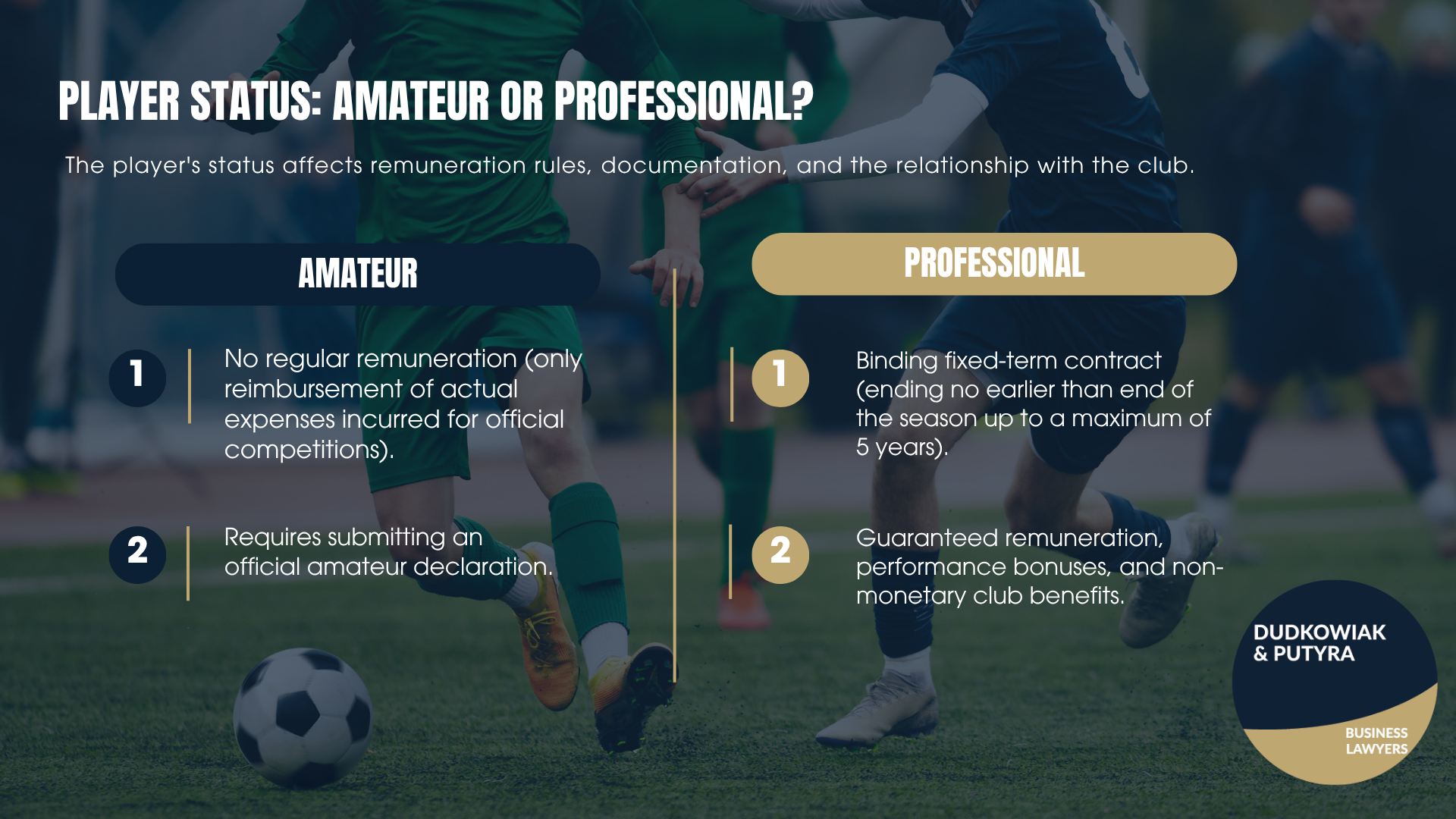
The key difference between an amateur and a professional player is the existence of a legal relationship with the club and the receipt of remuneration for playing the sport.
Amateur status
Amateur players do not receive remuneration or other monetary or in-kind benefits for playing football, except for reimbursement of actual expenses incurred in connection with participation in official competitions.
A player competing as an amateur must submit an appropriate amateur declaration. Receiving remuneration for playing may affect the player’s amateur status.
Professional status
Professional players have a contract with a football club and receive remuneration or other benefits exceeding those available to amateur players.
The minimum requirements for professional player contracts are set out in a resolution of the Polish Football Association (PZPN).
As a general rule, a contract with a club is concluded for a fixed term ending no earlier than the end of the competition season and lasting no longer than five years.
The contract sets out, among other things:
- the player’s individual remuneration;
- additional remuneration linked to sporting results;
- non-monetary benefits provided by the club;
- the player’s obligations towards the club.
Before the contract is signed, the club should, among other things, provide the player with the relevant rules and internal regulations and arrange a medical examination. The validity of the contract may not, however, be made conditional on the results of subsequent medical examinations.
Before signing, the player should also inform the club of agreements connected with the performance of the player’s duties.
U18 contract – rules for agreements with young players
A U18 contract may be entered into only by a player who is at least 15 years old but has not yet turned 18, and it may run for no more than three years.
A contract with a minor requires the consent of the player’s statutory representatives or other legal guardians. Provisions providing for a term longer than three years are invalid.
As a general rule, the U18 contract is the only agreement governing the legal relationship concerning the practice of football between a club and a player under 18.
Player transfers and transfer agreements
Football transfers are governed both by FIFA rules, in particular the FIFA Regulations on the Status and Transfer of Players (RSTP), and by PZPN regulations.
The player’s consent is a necessary condition for changing clubs. A transfer generally involves negotiations between the player and the new club, as well as between the clubs regarding the terms of the change of affiliation and the transfer fee.
If the player remains bound by a valid contract, the clubs must enter into an agreement setting out the transfer terms. Transfer agreements often include additional financial mechanisms such as performance bonuses, instalment payments and sell-on clauses, under which the former club participates in a future transfer fee.
A loan is an alternative to a permanent transfer and may include an option or an obligation to purchase the player later. FIFA rules also protect training clubs through training compensation and the solidarity mechanism. Players may be registered to play only during the applicable registration or transfer windows, even if negotiations or contract signing take place earlier.
Athlete image rights and marketing
An athlete’s image may have significant commercial value for the athlete, the club and sponsors. It is used, among other things, in advertising campaigns, club communications, promotional materials, broadcasts, social media and the sale of official merchandise.
Protection of an athlete’s image
An individual’s image is a personal right protected by law. Unauthorized use may give rise to claims seeking cessation of the infringement, removal of its effects and, in certain cases, financial remedies.
For clubs, athletes and sponsors, the key issue is to determine who may use the athlete’s image, to what extent and for what purpose. This is particularly relevant in player contracts, sponsorship agreements and advertising arrangements.

Commercial use of an athlete’s image
The image of a recognizable athlete may form an important part of the athlete’s commercial activity, including advertising campaigns, sponsorships and social media activities.
Club agreements often define the extent to which the club may use the athlete’s image. At the same time, the athlete may retain the right to enter into separate advertising and sponsorship agreements.
The agreement should clearly define the scope of use, territory, duration of the consent and the athlete’s remuneration. It should also address any restrictions on cooperation with brands that compete with the club’s sponsors.
Unclear contractual rules may lead to disputes over the scope of consent, remuneration or continued use of the athlete’s image after the relationship ends.
Sports sponsorship agreements in Poland
A sponsorship agreement is an unnamed (innominate) contract – the Civil Code does not provide a comprehensive statutory regime for it. This makes it particularly important to define the reciprocal obligations of the sponsor and the sponsored party precisely.
Proper vs improper sponsorship – tax consequences
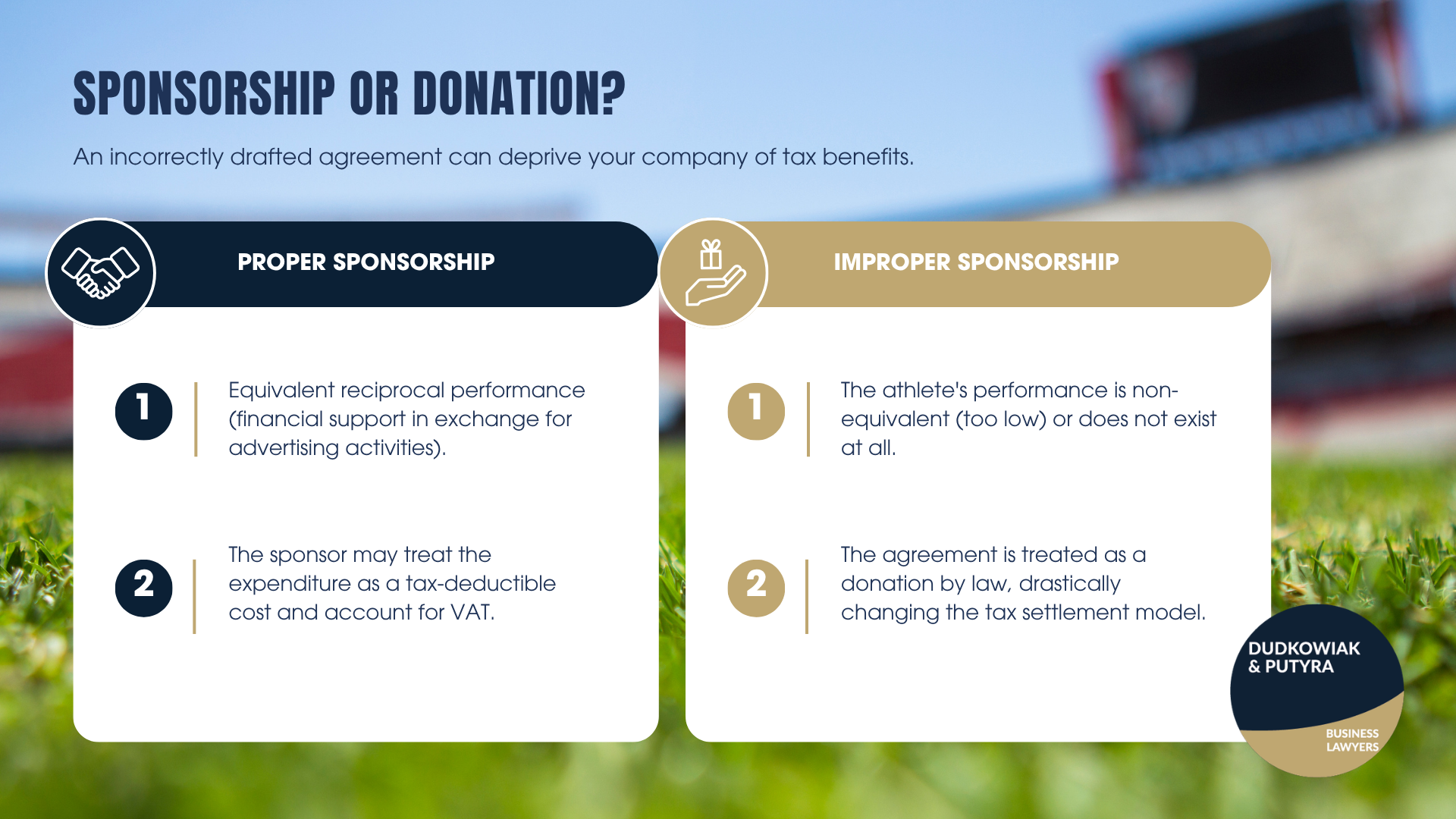
One of the risks in drafting a sponsorship agreement is an incorrect assessment of its legal nature, which may have tax consequences. A distinction can be made between:
- Proper sponsorship: the agreement is based on equivalent reciprocal performances. In exchange for financial or in-kind support, the sponsor receives an advertising benefit, such as promotion of its name or display of its logo. In such a case, the sponsor may treat the expenditure as a tax-deductible cost and account for VAT, subject to the applicable tax rules.
- Improper sponsorship: the sponsored party’s performance is not equivalent, or the sponsor receives no reciprocal performance. In substance, the arrangement may have the character of a donation and therefore produce different tax consequences.
Written form and copyright
As a general rule, a sponsorship agreement does not have to be in writing to be valid and may in principle be concluded orally or by email. Sponsorship agreements often contain provisions concerning the transfer of economic copyrights, however.
Under the Copyright and Related Rights Act, the transfer of economic copyrights or the grant of an exclusive licence requires written form under pain of nullity. If the required form is not observed, the invalidity will generally affect the copyright transfer provisions. If the agreement shows that the parties would not have entered into the sponsorship agreement without the transfer of those rights, the validity of the agreement as a whole may also be affected.
League and club restrictions in sponsorship agreements
In many sports, federation rules determine which advertising spaces on a player’s kit are controlled by the club and which may be used by the athlete. An athlete should not agree to display a sponsor’s logo in an area already reserved by the club for another commercial partner.
National team status and Olympic rules
Under the Sports Act, a Polish sports federation has the exclusive right to use an athlete’s image in the national team kit.
For athletes participating in the Olympic Games, Rule 40 of the Olympic Charter also introduces specific rules and restrictions on the use of participants’ images in campaigns conducted by their personal sponsors during the Games period.
Before entering into another sponsorship agreement, it is advisable to review the athlete’s existing obligations towards the club, sports federation, national team and under applicable Olympic rules.
Sports sponsorship on social media and advertising disclosures
Sponsorship agreements increasingly regulate an athlete’s social media obligations in detail, including the number and format of posts, tagging of the sponsor’s profile and the period for which content must remain available.
Under current UOKiK guidance, sponsored content should be clearly identified as advertising or commercial cooperation. Incorrect disclosure may expose both the brand and the athlete to legal and financial consequences.
Disciplinary proceedings and sports arbitration in Poland
Under the Sports Act, disciplinary liability within a Polish sports federation is governed by the federation’s disciplinary regulations. The Act nevertheless requires certain fundamental safeguards, including the right to a defence and a two-instance disciplinary procedure.
Available sanctions may include a warning, reprimand, suspension, disqualification, a financial penalty, relegation to a lower division and, in serious cases, removal or exclusion from the federation.
The regulations of individual sports federations identify the competent disciplinary bodies and the rules for appeals. Appeals may be brought by clubs against decisions of federation bodies and by players or coaches against penalties imposed directly on them by their clubs. Final disciplinary decisions of Polish sports federations may be reviewed by the Arbitration Tribunal for Sport at the Polish Olympic Committee.

Deadlines may be very short: federation rules may provide as little as seven days to file an appeal, the Sports Act provides 14 days to file a complaint with the Arbitration Tribunal, and in specified cases 30 days to file a cassation appeal with the Supreme Court.
Sports law in Poland – legal support for clubs, investors, athletes and sponsors
Operating in the sports sector often requires combining sports law with corporate, transactional, tax, contract and intellectual property law. Legal risks may arise in day-to-day club management, investment transactions, player transfers, contract negotiations, sponsorship arrangements and the commercial use of athletes’ images.
Dudkowiak & Putyra advises sports clubs and their boards, investors and investment funds, athletes, sports agents and managers, sponsors and businesses operating in sports marketing.
If you are planning an investment or transaction in the sports sector, negotiating a player contract or transfer, preparing a sponsorship agreement or need support with a club’s day-to-day operations, contact our team to discuss the structure of the project, the key legal risks and the available solutions.