


Last updated: 13.10.2026

Real estate development in Poland involves a series of legal steps from spatial planning and building permits through construction, completion and occupancy. The requirements also depend on the type of project and the way the property will be sold or commercialised.
This article is for developers, investors and companies planning residential or commercial projects in Poland. It explains the main regulatory steps, the additional obligations that apply to residential developments and the key differences affecting commercial projects. It also covers the September 2026 expiry of the Lex Deweloper act and the planning routes now available for new investments.
Polish real estate market at a glance
Poland remains one of the most active real estate markets in Central and Eastern Europe. Residential development is supported by a persistent housing shortage in major urban areas and growing demand for institutional rental housing, while the logistics sector continues to benefit from e-commerce and nearshoring. In 2024, total real estate investment volume in Poland exceeded €5 billion, confirming the scale of investor activity in the market.
Real estate development in Poland: key legal requirements at a glance
Residential and commercial developments follow the same core spatial planning and building process, but their legal treatment differs significantly once the project moves towards sale or contractual arrangements with buyers. Residential projects are subject to the Developer Act and its buyer-protection mechanisms, including statutory payment safeguards and disclosure requirements. Commercial developments are not subject to an equivalent regime and are governed mainly by general civil law and contractual arrangements.
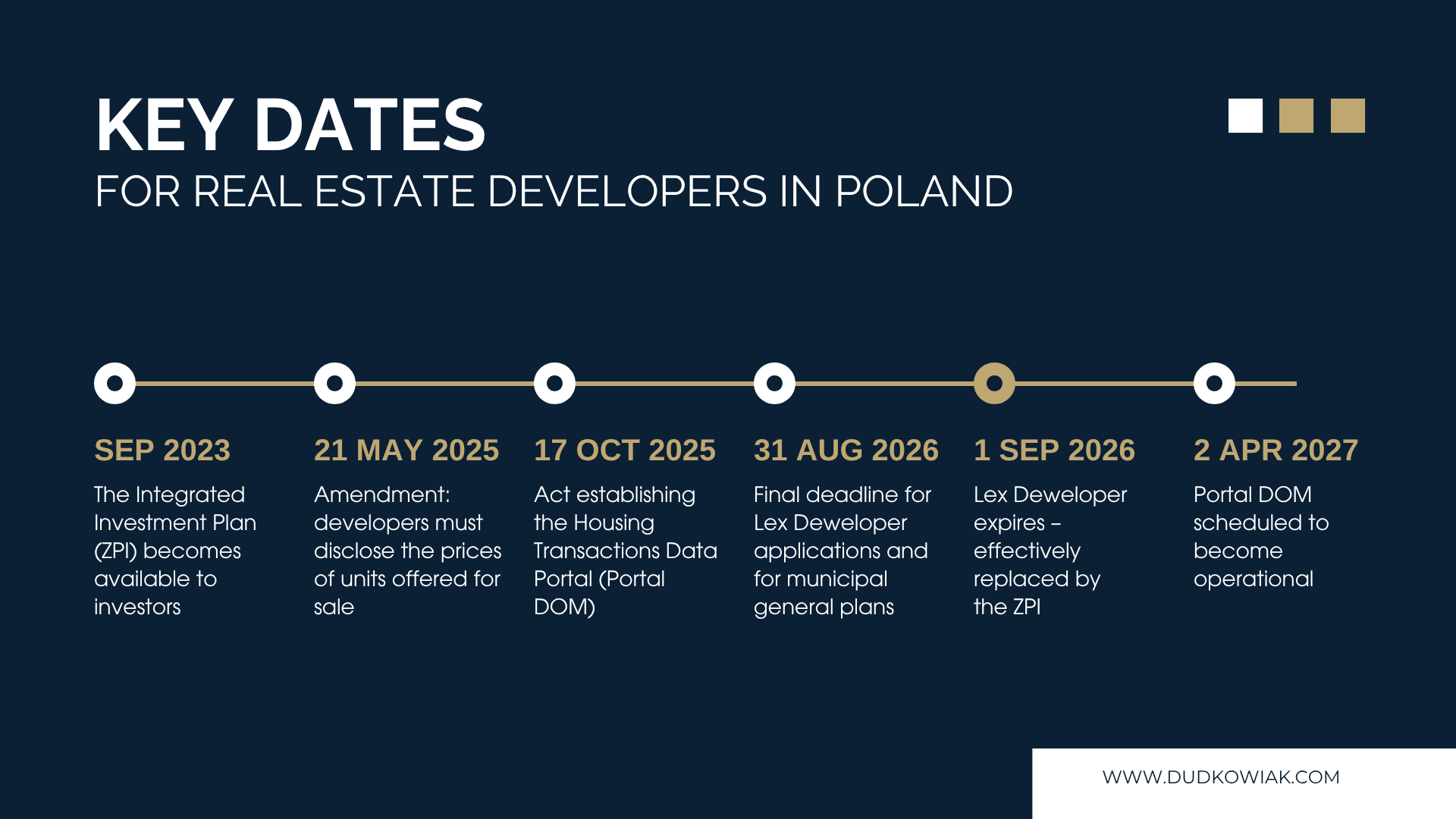
A further change affects the planning process: the Lex Deweloper act expired on September 1, 2026. The Integrated Investment Plan (ZPI) is now available as a planning instrument for both residential and commercial projects.
Spatial planning requirements for real estate development in Poland
Project feasibility depends on the applicable spatial planning instrument: the local spatial development plan (MPZP), a decision on development conditions (WZ decision) where no MPZP is in place, or the municipal general plan, which municipalities must adopt by August 31, 2026 to replace the former studies of conditions and directions of spatial development.
September 2026 planning update: Lex Deweloper has expired
As of September 1, 2026, the Act of July 5, 2018 on facilitating the preparation and execution of housing investments (Lex Deweloper) has expired. The final deadline for applications was August 31, 2026; proceedings initiated and resolutions adopted before that date remain fully valid. The act has effectively been replaced by the ZPI, making it advisable to check the current municipal planning status before proceeding.
Integrated Investment Plan (ZPI) in Poland
Since September 2023, investors have also had access to the Integrated Investment Plan (ZPI), a bespoke local plan adopted at the investor’s request. Unlike the now-expired Lex Deweloper act, the ZPI is available for both residential and commercial, industrial, logistics, and renewable energy projects.
Building permits and the construction process in Poland
Once land-use parameters are secured, the project requires a building design prepared by authorized designers and compliant with the applicable planning instrument (MPZP, WZ, or ZPI). Construction itself requires a building permit (a final administrative decision issued by the starosta or, in specific cases, the mayor or voivode) which lapses by operation of law if works do not commence within 3 years of the decision becoming final, or are suspended for more than 3 years.
Before starting works, the investor must appoint a licensed construction manager and notify the District Inspectorate of Building Control (PINB) of the intended start date.
Completion and occupancy requirements
Construction closes in one of two ways: a completion notification, based on the PINB’s tacit consent (for simpler structures and single-family houses), or an occupancy permit, an administrative decision issued after a mandatory PINB inspection plus fire safety and sanitary approvals.
An occupancy permit is mandatory for multi-family residential buildings and for most commercial facilities, including office buildings, retail and service centers, and warehouses – making this one of the few requirements genuinely shared across both regimes.
Residential vs commercial real estate development in Poland: key differences
The main differences arise at the sales and contractual stage. Residential developments are subject to statutory buyer-protection rules, while commercial projects rely primarily on contractual arrangements between the parties.
| Regulatory feature | Residential | Commercial |
| Main legal basis | Developer Act (2021) | Civil Code (freedom of contract) + Building Law |
| Buyer/purchaser payment protection | Mandatory escrow account + Developer Guarantee Fund contributions | No statutory requirement; escrow or bank guarantees negotiated contractually |
| Pre-contract disclosure | Mandatory information prospectus | No mandatory disclosure; informational memorandum is optional |
| Reservation agreement | Fee capped at 1% of price; statutory refund rules (100% or 200%) | Unregulated; fully negotiable |
| Contract form | Notarial deed required, or the contract is void | Ordinary written form for preliminary contracts; notarial deed only for the final transfer |
| Assignment of rights | Limited by law (broadly: one unit, once every 3 years) | Freely negotiable between the parties |
| Planning route (post-2026) | ZPI or local plan/WZ decision | Same: ZPI or local plan/WZ decision |
Residential development in Poland: additional legal requirements
Under Polish law, residential development is subject to a more extensive regulatory framework than commercial projects because of the statutory protection granted to individual purchasers. In addition to the general planning, construction and occupancy requirements, residential developers must comply with rules on buyer payment protection, pre-contract disclosure, reservation agreements, contract formalities, withdrawal rights and price transparency.
The Developer Act: when does it apply?
Consumer protection in residential construction is governed by the Act of May 20, 2021 on the protection of rights of purchasers of residential units or single-family houses and on the Developer Guarantee Fund. It applies to contracts with individuals purchasing residential property in the form of a residential unit or house for purposes unrelated to their business or professional activity.
The regime also covers ancillary units (such as garage spaces or storage rooms) where these are sold jointly with a residential unit as part of the same development. Where a developer sells an ancillary unit on its own, statutory protection does not apply, and the developer must inform the buyer on a durable medium, before signing, that the unit is not residential and that the buyer’s payments are not covered by statutory protection.
Buyer payment protection: residential escrow accounts
Under the Developer Act, the developer is required to secure buyer payments through one of two escrow account mechanisms:
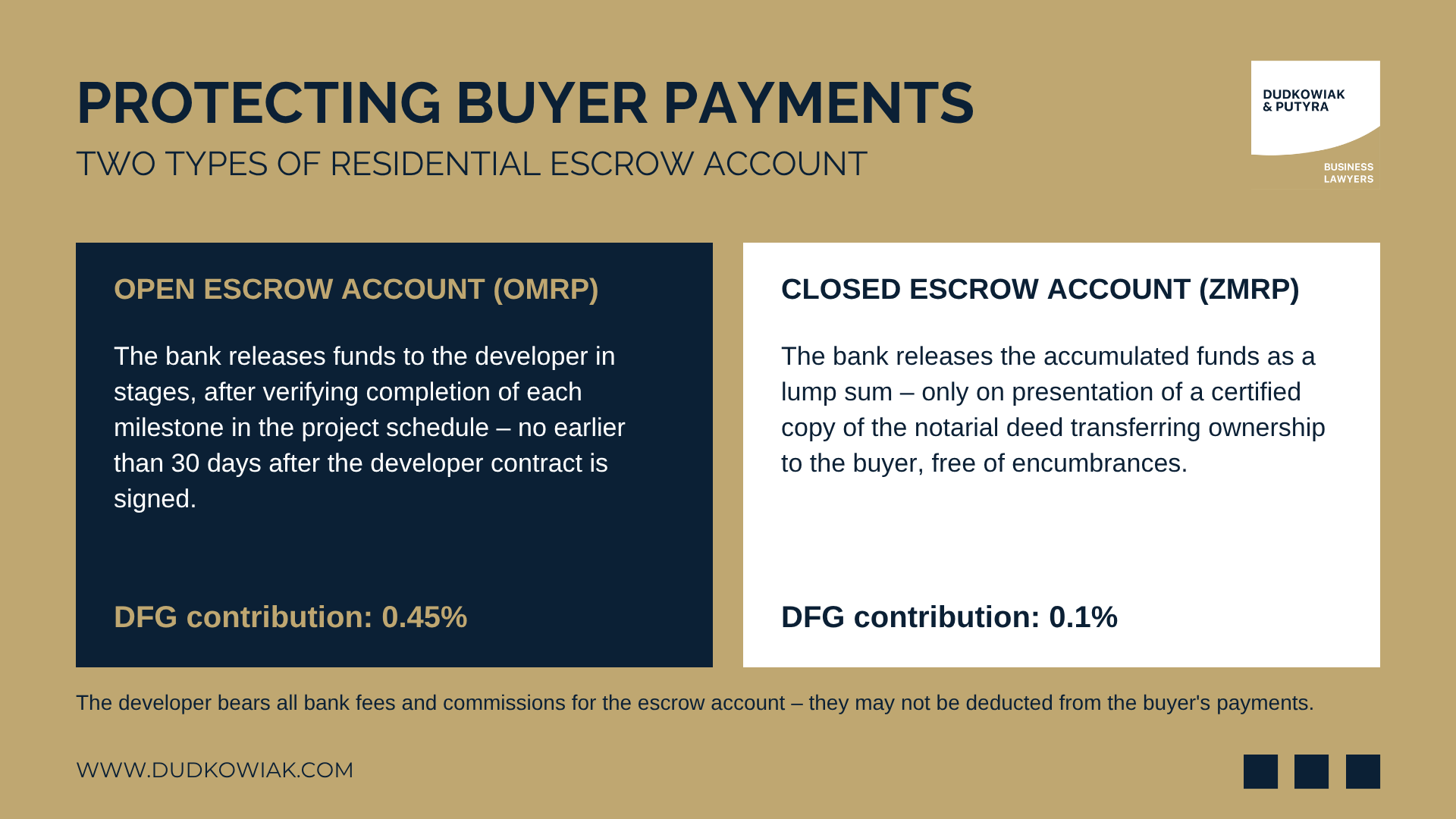
- Open Residential Escrow Account (OMRP): The bank releases funds to the developer in stages after verifying the completion of each milestone specified in the project schedule (no earlier than 30 days after the execution of the developer contract).
- Closed Residential Escrow Account (ZMRP): The bank releases the accumulated funds as a lump sum only upon presentation of a certified copy of the notarial deed transferring ownership to the buyer, free of encumbrances.
The developer is responsible for all bank fees and commissions associated with maintaining the escrow account, which may not be deducted from the buyer’s payments.
Developer Guarantee Fund: When can a buyer claim payment?
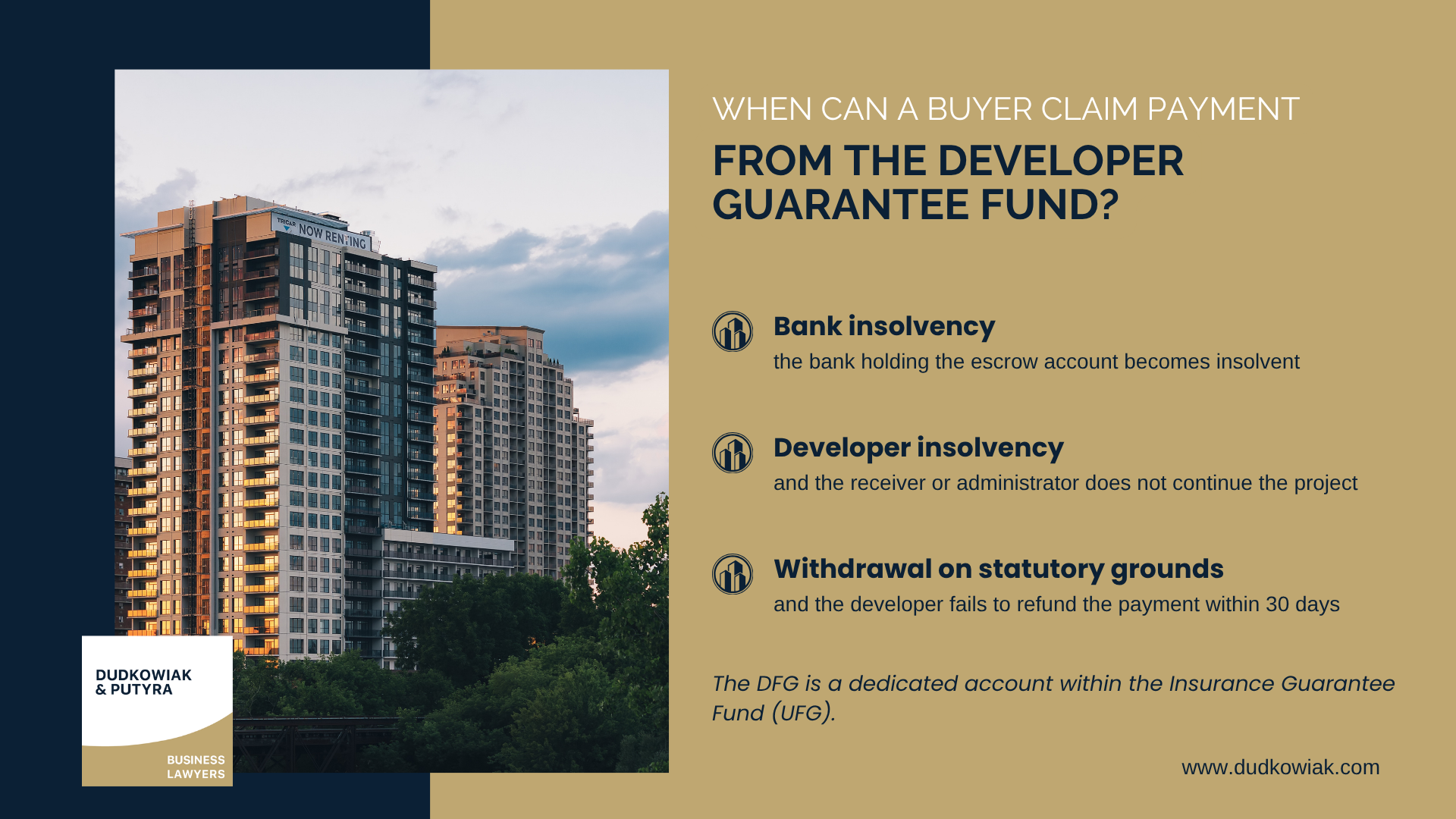
The DFG is a dedicated account within the Insurance Guarantee Fund (UFG). Developers pay a contribution on every buyer payment into the escrow account; the statutory cap is 1% for OMRP and 0.1% for ZMRP, though the current implementing regulation sets the actual rates at 0.45% for OMRP and 0.1% for ZMRP.
A buyer can claim payment from the DFG if:
- the bank holding the escrow account becomes insolvent;
- the developer becomes insolvent and the receiver or administrator does not continue the project; or
- the buyer withdraws from the contract on statutory grounds and the developer fails to refund the payment within 30 days.
Information prospectus and pre-contract disclosure requirements
The developer is required to provide, free of charge, an information prospectus along with all mandatory attachments (including the floor plan and a template agreement) prior to entering into a reservation agreement or developer contract.
Furthermore, the developer must make the following documents available to an interested party:
- the current status of the Land and Mortgage Register (Księga Wieczysta);
- an extract from the National Court Register (KRS) or the Central Registration and Information on Business (CEIDG);
- the building permit;
- financial statements for the last two years; and
- the building design.
Reservation agreements: fee limits and refund rules
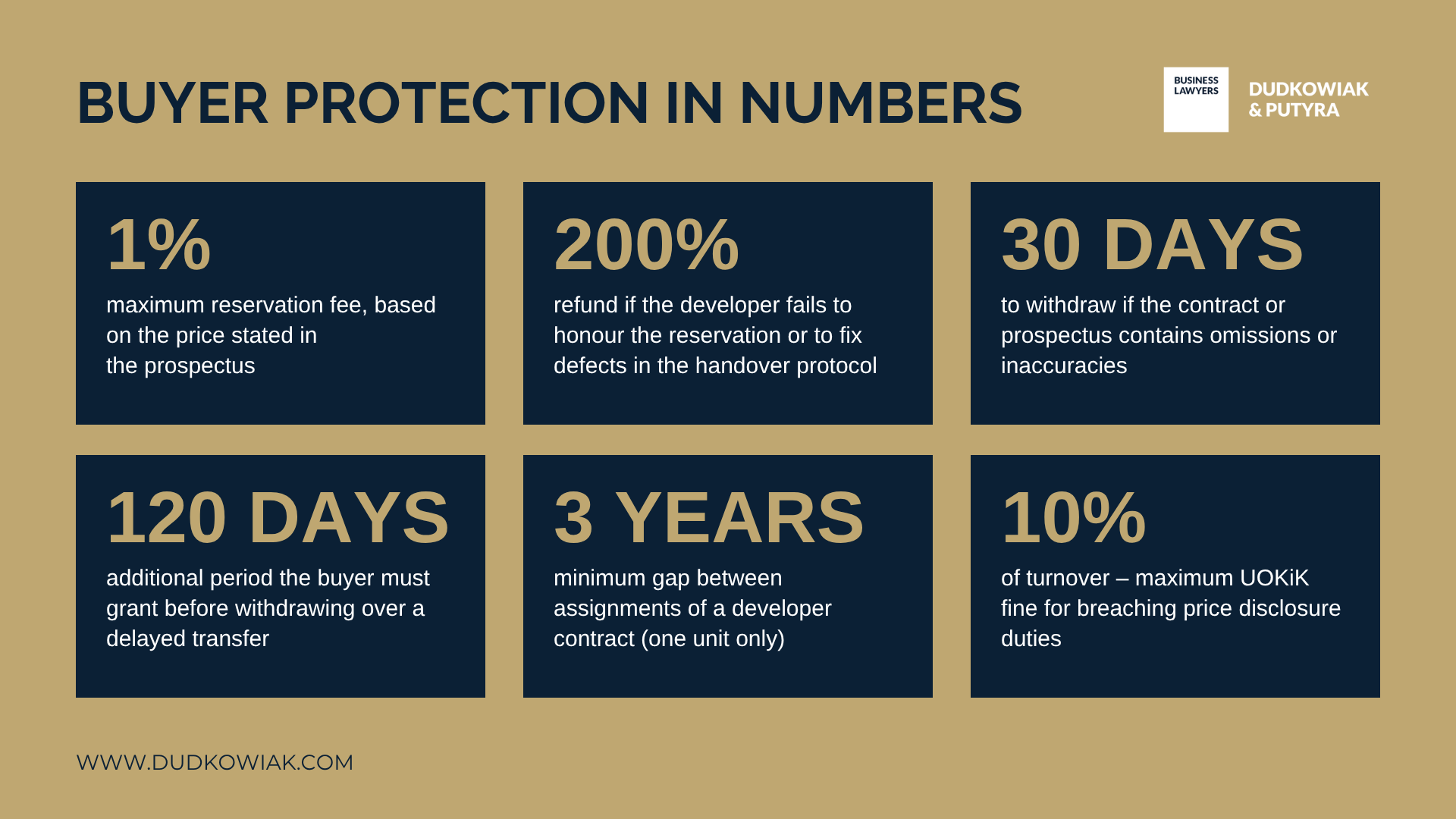
A reservation agreement constitutes an obligation to temporarily withdraw a specific unit from the sales offer. The reservation fee may not exceed 1% of the price of the residential unit or house as specified in the prospectus. This fee is subsequently credited towards the final purchase price.
The buyer is entitled to a full refund of the reservation fee in the event of a mortgage loan denial, or if the developer modifies the prospectus without notifying the reserving party.
The buyer is entitled to a double refund (200%) of the fee if the developer fails to fulfill the reservation commitment, or if the developer fails to rectify defects recorded in the handover protocol.
Developer contracts: form, assignment and withdrawal rights
The developer contract, ownership transfer agreements, and assignment agreements must be executed in the form of a notarial deed under pain of nullity. A buyer may assign their rights under a developer contract only if the agreement pertains to no more than one unit, provided that the buyer has not executed another assignment within the preceding three years.
Furthermore, the buyer holds the right to withdraw from the contract within 30 days of its execution if the contract or the information prospectus contains omissions or inaccuracies. In the event of a developer’s delay in transferring ownership, the buyer is required to grant an additional 120-day period before they can formally withdraw from the agreement.
Price transparency and the DOM Portal
Under the amendment of 21 May 2025, developers are required to disclose the prices of properties offered for sale. Developers must maintain their own website and publish, among other information, the price per square metre of usable floor area of each residential unit or single-family house offered for sale, the total price of the property or part thereof, prices of appurtenant premises, and other monetary payments required from the buyer. Any price changes must be updated while maintaining a record of previous prices.
The information subject to the disclosure requirements must also be submitted once a day to the minister responsible for digital affairs and made available through Poland’s public data portal. Failure to comply with these obligations constitutes a practice infringing the collective interests of consumers and may result in a fine imposed by the President of the Office of Competition and Consumer Protection (UOKiK) of up to 10% of the developer’s turnover generated in the financial year preceding the year in which the fine is imposed.
A separate initiative is the Housing Transactions Data Portal (Portal Danych o Obrocie Mieszkaniami – Portal DOM), established under the Act of 17 October 2025. The Portal, which is scheduled to become operational on 2 April 2027, is intended to provide public access to reliable statistical information on actual transaction prices of residential units and single-family houses on both the primary and secondary markets, including average prices, median prices and transaction volumes for selected locations and property characteristics.
Security instruments and agreements in commercial real estate (B2B)
Commercial developers are not subject to any equivalent consumer protection regime. Commercial development is governed by ordinary civil law, chiefly the freedom-of-contract principle under Article 353¹ of the Civil Code, together with the Building Law.

In B2B transactions, companies developing offices, logistics facilities, warehouses, and retail assets do not use statutory escrow accounts, do not pay into the Developer Guarantee Fund, and are not required to issue a standardized prospectus. Payment security, including escrow arrangements or bank/insurance guarantees, is instead a matter of individual contractual negotiation, typically under forward purchase or forward funding structures.
The core planning and building process is otherwise the same as for residential projects. Where no MPZP is in place, a building permit application relies on a WZ decision, and industrial or logistics projects may additionally require an environmental impact assessment. As with residential buildings, most commercial facilities (offices, retail, and warehouses) require an occupancy permit from the PINB before use.
Ready to build? Legal support for developers in Poland
Real estate development in Poland requires legal support across the full investment process, from property acquisition and due diligence to planning, permitting, construction and commercialisation.
Our Real Estate Team supports investors and developers with transaction structuring, real estate due diligence, financing, administrative proceedings, construction contracts, leasing and disputes.
If you are planning a residential or commercial project in Poland, we can help you identify legal risks, secure the required approvals and structure the investment effectively.
Contact our Real Estate Team to discuss your project in Poland.

FAQ – Real estate development in Poland
What legal approvals are required for real estate development in Poland?
A real estate development in Poland generally requires an applicable planning basis, such as an MPZP, WZ decision or ZPI, followed by a compliant building design and building permit. After construction, the project may require either a completion notification or an occupancy permit before the building can be used.
What is the difference between residential and commercial real estate development in Poland?
Both residential and commercial projects generally follow the same planning, building permit and construction process. Residential developments are additionally subject to statutory buyer protection under the Developer Act, while commercial projects rely primarily on general civil law and contractual arrangements between the parties.
What planning options are available after the expiry of Lex Deweloper?
Lex Deweloper expired on September 1, 2026, while proceedings initiated and resolutions adopted before that date remain valid. New projects may use the Integrated Investment Plan (ZPI), which is available for both residential and commercial developments, as well as other applicable planning routes such as an MPZP or WZ decision.
How are buyers protected in residential development projects in Poland?
The Polish Developer Act requires developers to protect buyer payments through an open or closed residential escrow account and to contribute to the Developer Guarantee Fund. Developers must also comply with statutory disclosure, reservation agreement and contract requirements.
Is an occupancy permit required for real estate developments in Poland?
An occupancy permit is required for multi-family residential buildings and most commercial facilities, including offices, retail and service centres, and warehouses. Other projects may be completed through a completion notification, depending on the type of development.


