
Quick answer
What is VAT OSS in Poland?
VAT OSS (One Stop Shop) is a simplified EU system for businesses making cross-border sales to consumers (B2C) within the European Union. It allows a business to centralise certain EU VAT compliance obligations relating to sales to EU consumers, without having to maintain multiple VAT registrations in other EU countries.
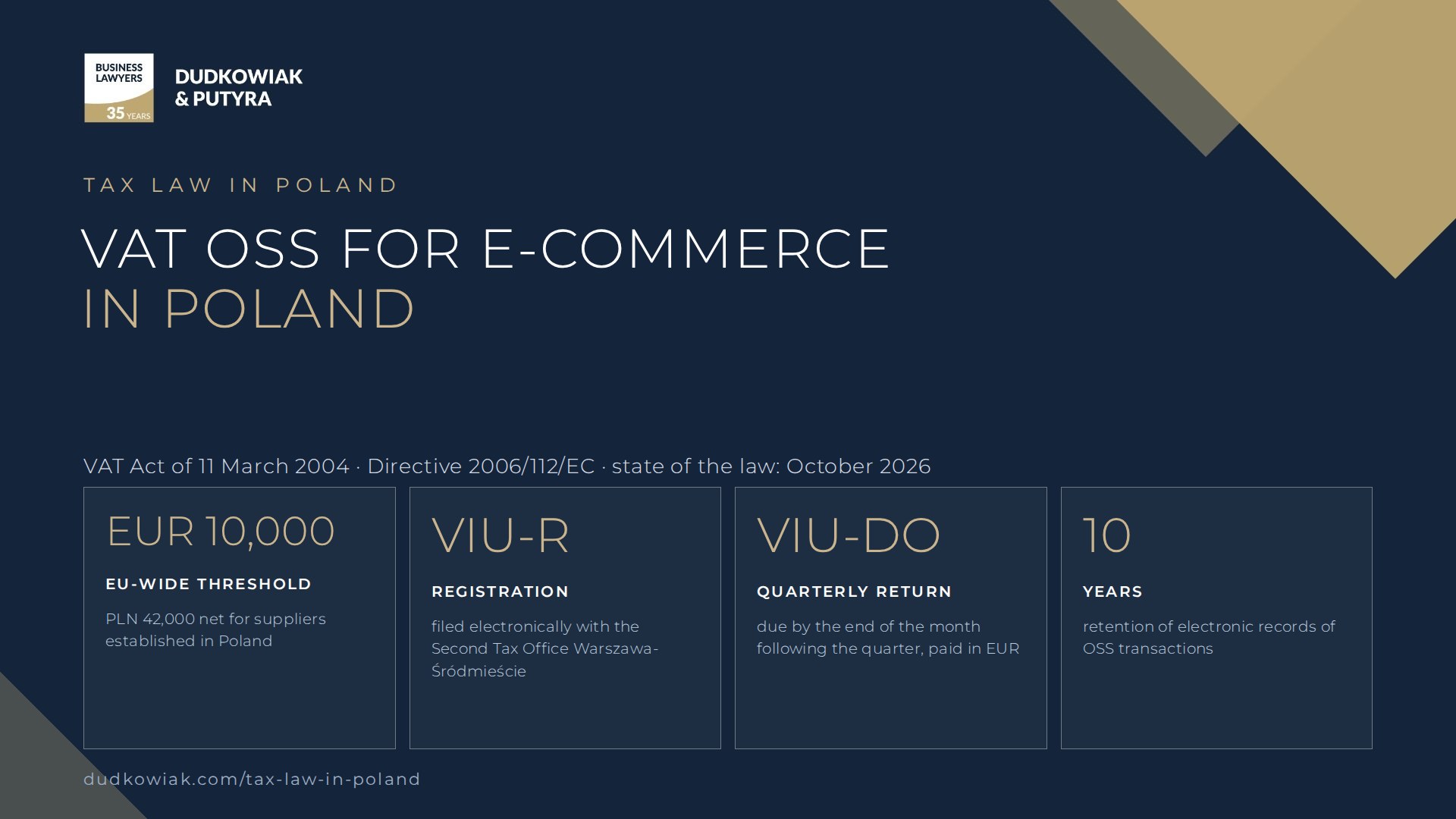
For businesses established in Poland, Poland is the Member State of identification. Registration is voluntary and is made electronically on the VIU-R form. A registered business then files one quarterly OSS VAT return (VIU-DO) and pays, in euro, the VAT due on all transactions covered by the relevant OSS scheme.
EUR 10,000EU-wide threshold – PLN 42,000 net for suppliers established in Poland
VIU-Rregistration form – VAT OSS registration is filed electronically
QuarterlyVIU-DO return, due by the end of the month following the quarter, in EUR
10 yearsrecord retention from the end of the year in which the transaction was carried out
How does the VAT One Stop Shop (OSS) work?
VAT OSS, or the One Stop Shop (OSS), is an electronic system designed to simplify VAT compliance for businesses making certain cross-border supplies to consumers within the European Union.
It replaced and substantially extended the former MOSS (Mini One Stop Shop) system, which applied only to telecommunications, broadcasting and electronically supplied services, commonly referred to as TBE services.
The OSS VAT scheme is intended to reduce the administrative barriers connected with cross-border e-commerce. For transactions covered by the scheme, a business can avoid VAT registration in each Member State of consumption and account for VAT through one EU country acting as its Member State of identification. Through that Member State, the business files one electronic OSS VAT return and pays the VAT due on all transactions covered by the relevant OSS scheme.
Who can use VAT OSS? Union and non-Union schemes
VAT OSS is primarily relevant to businesses supplying goods or services to persons who are not taxable persons for VAT purposes, which in practice means EU customers acting as final consumers (B2C). The EU OSS framework includes two principal schemes: the Union OSS scheme and the non-Union OSS scheme for non-EU businesses.
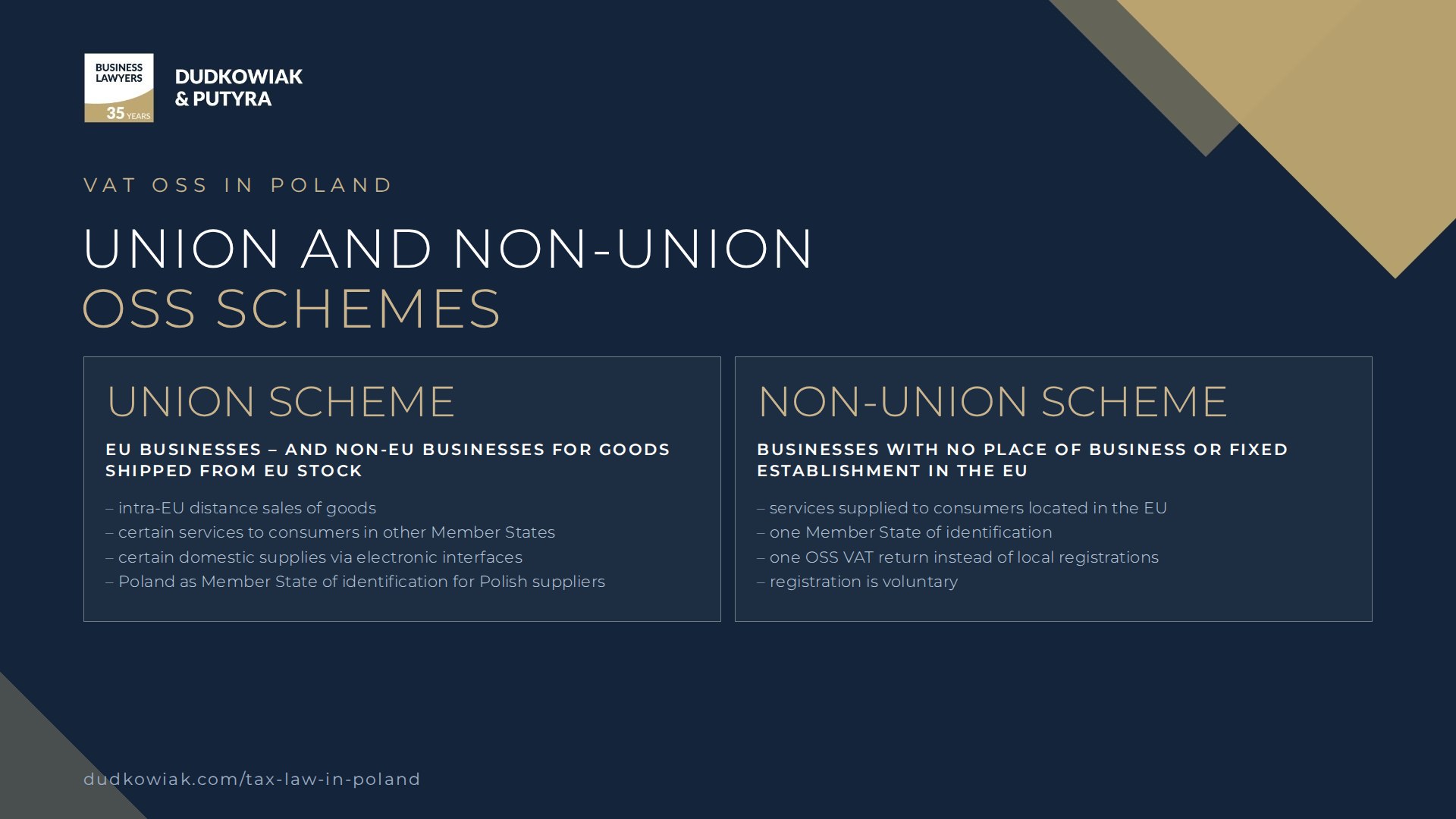
| Criterion | Union scheme | Non-Union scheme |
|---|---|---|
| Who can use it | Businesses established or having a fixed establishment in the European Union; businesses established outside the EU only for intra-Community distance sales of goods dispatched from stock held in the EU | Non-EU businesses that have neither their place of business nor a fixed establishment in the EU |
| Transactions covered | In particular: intra-Community distance sales of goods (intra-EU distance sales), i.e. goods dispatched or transported from one EU Member State to a consumer in another Member State; certain services supplied to consumers in Member States in which the supplier is not established, for example certain IT services or the hiring of means of transport; certain domestic supplies of goods facilitated by electronic interfaces, such as online marketplaces | Services supplied to consumers located in the European Union |
VAT OSS and the Polish small-business VAT exemption
VAT OSS may be used both by businesses registered as active VAT taxpayers and, where the relevant conditions are met, by businesses benefiting from the Polish small-business VAT exemption.
The domestic exemption is retained. Registering for OSS does not in itself deprive a Polish business of its domestic VAT exemption, as sales accounted for under OSS are not included in the annual turnover threshold applicable to that exemption.
VAT OSS and e-commerce: EU sales threshold and VAT rates
The VAT e-commerce package introduced a single EU-wide threshold for certain cross-border B2C transactions. The threshold is EUR 10,000, which corresponds to PLN 42,000 net for suppliers established in Poland.
When do you charge VAT in the customer’s EU country?
For the purposes of the threshold, the relevant turnover includes both intra-Community distance sales of goods and telecommunications, broadcasting and electronically supplied services provided to customers in other EU Member States.
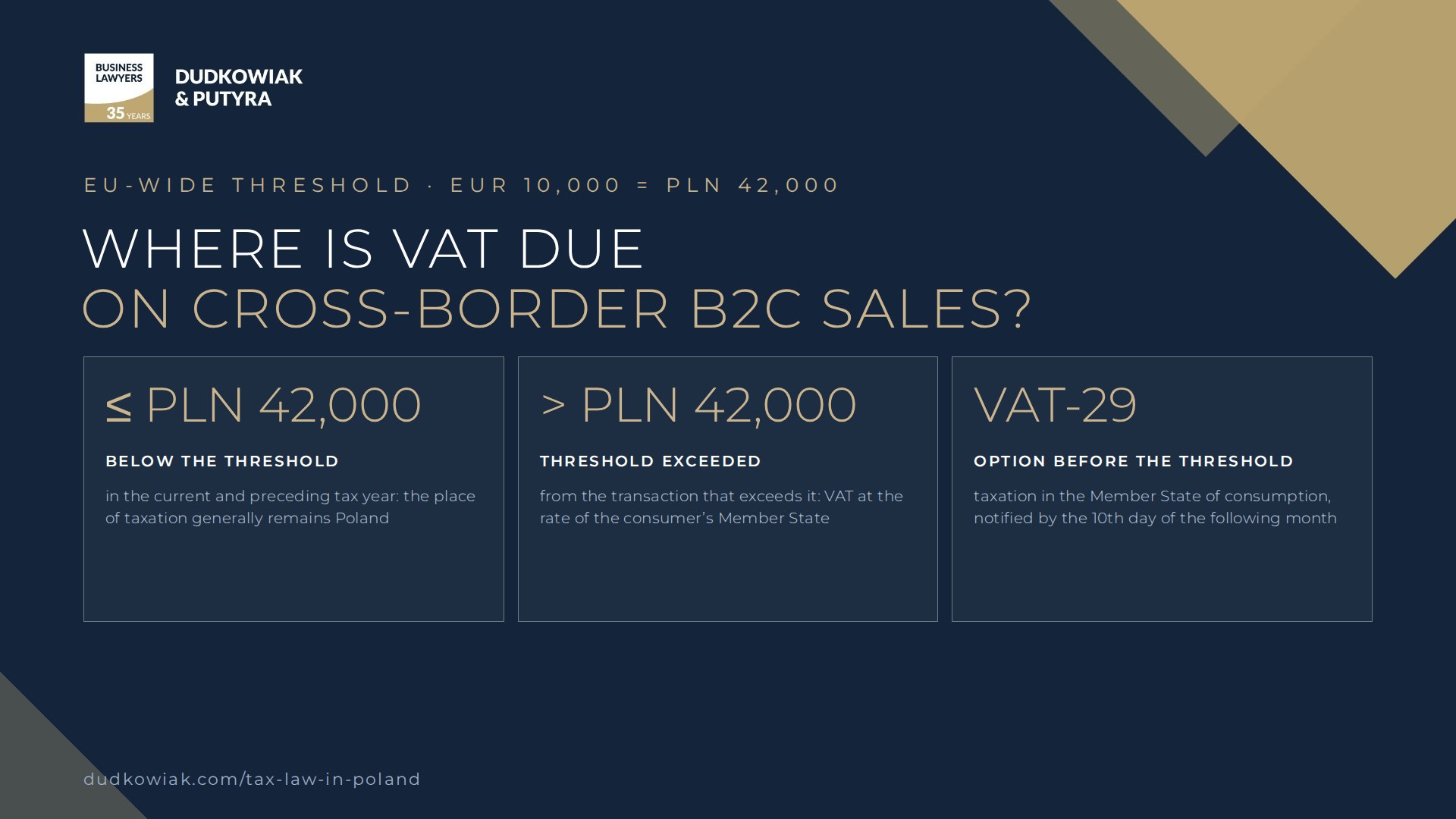
As long as the total value of these transactions does not exceed PLN 42,000 in either the current or the preceding tax year, the place of taxation generally remains the Member State from which the goods are dispatched or in which the service provider is established.
Once a transaction causes the threshold to be exceeded, the VAT treatment changes. The relevant supplies become taxable in the Member State in which the consumer is located, and the supplier must charge VAT at the rate applicable in the customer’s EU country.
A taxpayer may also opt to tax the relevant supplies in the Member State of consumption before exceeding the PLN 42,000 threshold. Where a Polish taxpayer exercises this option, a VAT-29 notification must be submitted to the competent head of the tax office by the 10th day of the month following the month in which the option was exercised.
Threshold scenarios · supplier established in Poland
| Scenario | If | Then |
|---|---|---|
| Below the threshold | Intra-EU distance sales and TBE services to other Member States do not exceed PLN 42,000 in the current or the preceding tax year | The place of taxation generally remains the Member State of dispatch or of the service provider’s establishment |
| Threshold exceeded | A transaction causes the threshold to be exceeded | The supplies become taxable in the consumer’s Member State, at the VAT rate applicable in that country |
| Option before the threshold | The taxpayer opts for taxation in the Member State of consumption before exceeding the threshold | VAT-29 notification to the competent head of the tax office by the 10th day of the month following the month in which the option was exercised |
VAT OSS registration in Poland: rules, deadlines and the VIU-R form
Registration for VAT OSS is voluntary. However, where the relevant transactions become taxable in other EU Member States and the taxpayer does not use OSS, the business may instead have to register and account for VAT locally in the Member States in which its supplies are taxable.
How to register for VAT OSS in Poland
Procedure · three steps
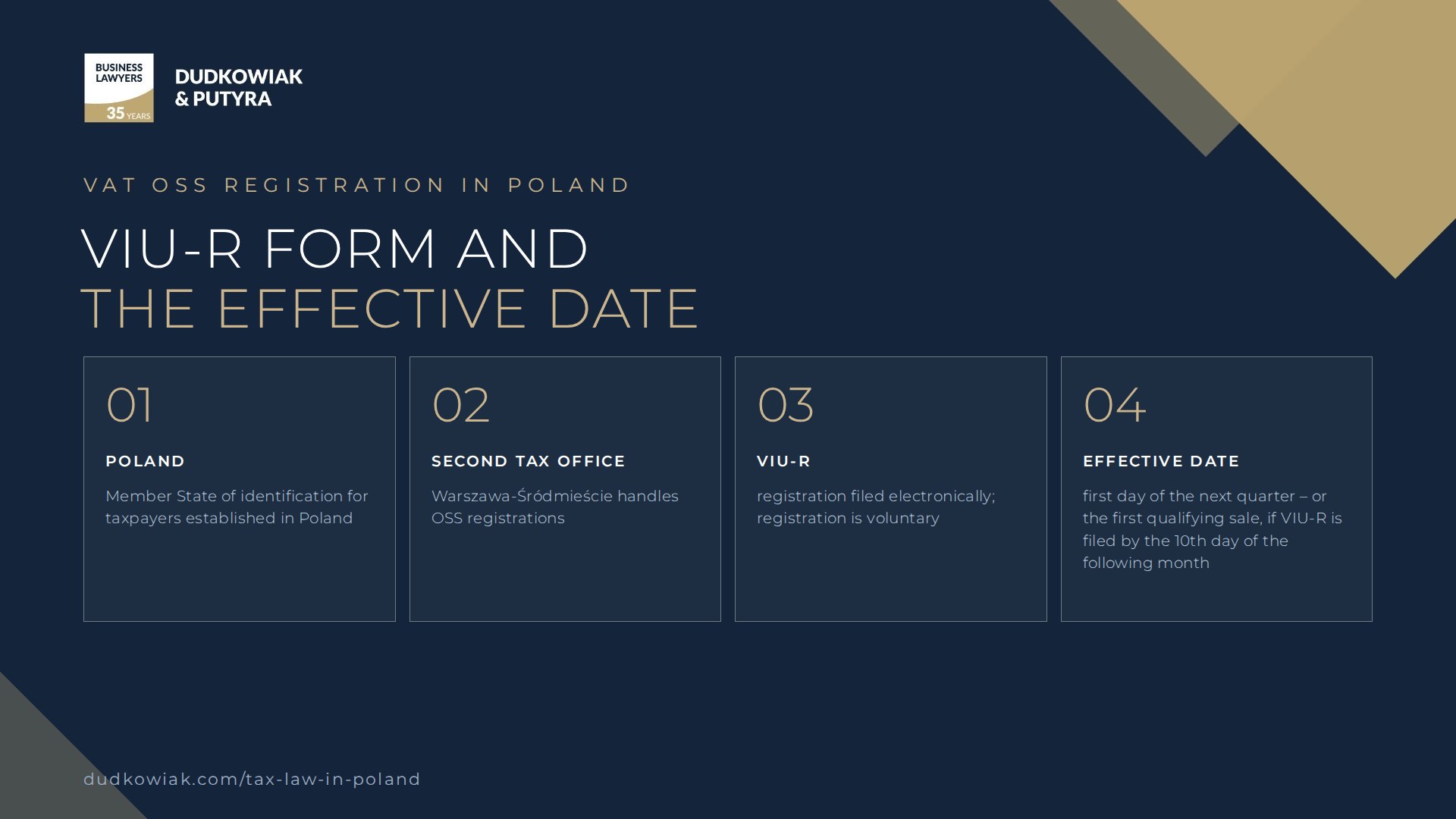
- Member State of identification. For taxpayers established in Poland, Poland is the Member State of identification.
- Competent authority. OSS registrations are handled by the Head of the Second Tax Office Warszawa-Śródmieście (Naczelnik Drugiego Urzędu Skarbowego Warszawa-Śródmieście).
- VIU-R form. Registration is carried out electronically using the VIU-R form. Its effective date depends on when the form is filed (see the table below).
VAT OSS and local VAT registrations: the “all or nothing” rule
Once a business opts to use OSS, all transactions that fall within the scope of the relevant OSS scheme must be reported through that scheme.
A taxpayer cannot selectively use OSS for some qualifying transactions while accounting for comparable transactions through separate local VAT registrations in different EU countries. For example, a business cannot account for qualifying sales to Germany through OSS while choosing to account for equivalent qualifying sales to France through a separate French VAT registration.
When does VAT OSS registration take effect?
As a general rule, registration under the OSS procedure takes effect from the first day of the calendar quarter following the quarter in which the registration documents were submitted. A business may, however, start using OSS from the date of its first qualifying transaction where it begins making such supplies earlier.
| Situation | Deadline for registration documents | Registered from |
|---|---|---|
| General rule | Submitted in a given calendar quarter | The first day of the following calendar quarter |
| Qualifying supplies start before registration | By the 10th day of the month following the month in which the first qualifying transaction took place | The date of the first qualifying transaction, if the deadline is met |
Calculator · VIU-R deadline and OSS effective date
VAT OSS registration deadline calculator
For businesses established in Poland, with Poland as the Member State of identification.
Enter the dates to see your VIU-R deadline, the date from which OSS applies and your first VIU-DO return.
Deadlines follow the rules described on this page. The VIU-DO deadline is not postponed when it falls on a Saturday, Sunday or public holiday. The result is an indication, not legal advice.
OSS VAT returns, payments and input VAT
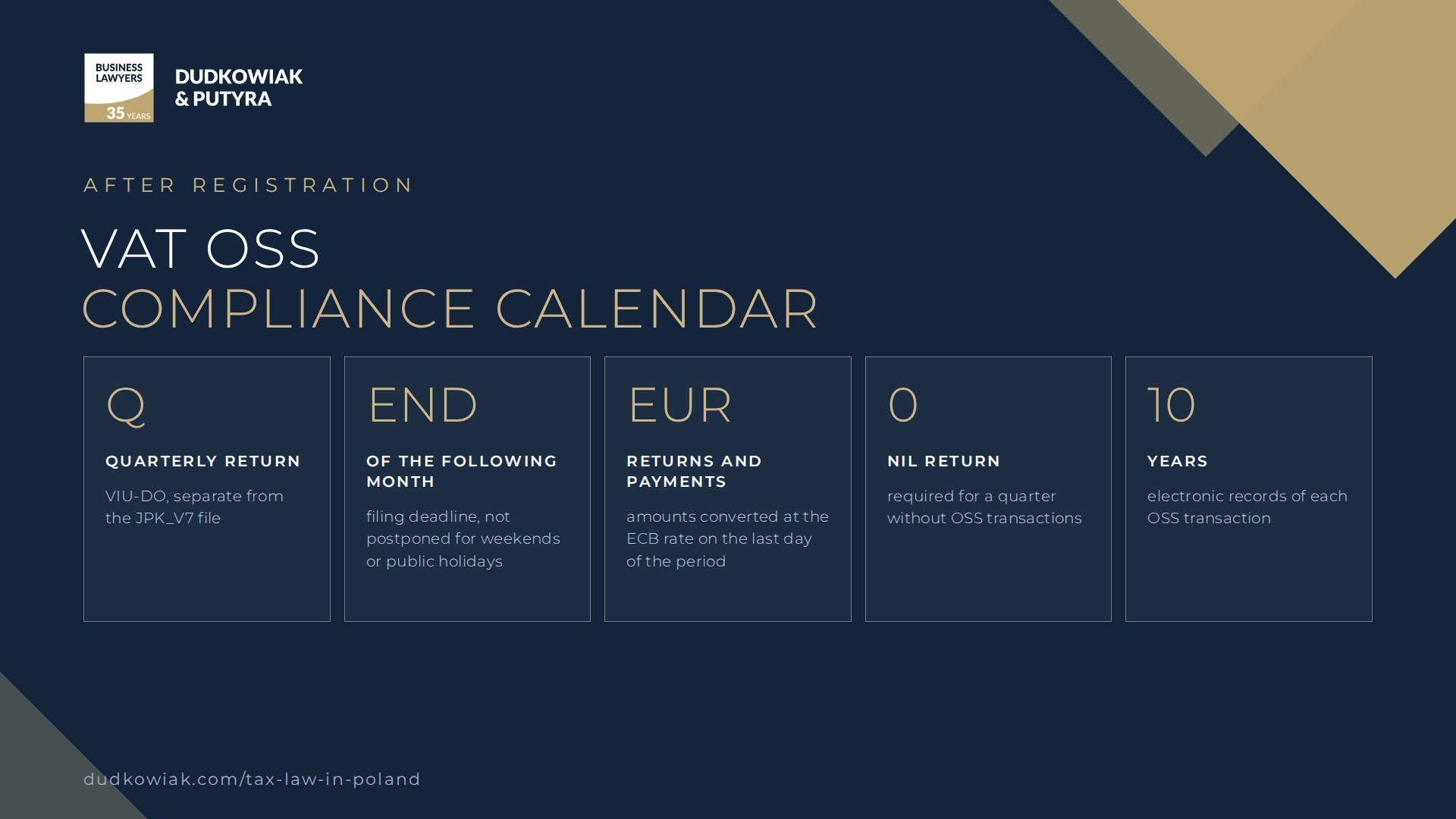
A taxpayer using VAT OSS does not report transactions covered by the scheme in its standard Polish JPK_V7 file. Instead, it must submit a separate OSS VAT return (VIU-DO).
| VIU-DO return | Rule |
|---|---|
| Filing frequency | Quarterly |
| Filing deadline | The end of the month following the end of the relevant calendar quarter. The deadline is fixed and is not postponed merely because it falls on a Saturday, Sunday or public holiday. |
| Currency | Returns and VAT payments are made in euro (EUR). Amounts in another currency are converted at the official European Central Bank exchange rate applicable on the last day of the relevant reporting period. |
| Payment | The total VAT due under OSS is paid to the designated account of the Second Tax Office Warszawa-Śródmieście. The Polish tax administration then distributes the relevant amounts to the respective Member States of consumption. |
| Input VAT | Cannot be deducted in the VIU-DO return. It must generally be recovered through the domestic VAT return or the applicable VAT refund procedure. |
Businesses using OSS should also be aware of the requirement to file so-called nil returns.
An OSS return must still be submitted for a quarter in which no transactions covered by the scheme were carried out.
Invoicing, VAT rates and fiscal cash registers under VAT OSS
VAT OSS may also simplify certain invoicing and sales-recording obligations.
For intra-Community distance sales of goods accounted for under the Union scheme where Poland is the Member State of identification, the supplier is not required to issue an invoice, even if the consumer asks for one. A business may nevertheless choose to issue an invoice. In that case, the invoicing rules of the Member State of identification apply (for a Polish supplier, the Polish VAT Act), while the invoice must reflect the VAT rate applicable in the Member State of consumption.
Intra-Community distance sales accounted for through OSS are not recorded on a Polish fiscal cash register, because they do not constitute domestic supplies in Poland. Specific domestic supplies facilitated through an electronic interface and accounted for under OSS may also benefit from an exemption from Polish fiscal cash register requirements.
How should VAT OSS transactions be documented?
Businesses must still retain evidence confirming that the goods were actually delivered to the consumer in another EU Member State. Such evidence may include transport documents or formal confirmation of receipt.
If the taxpayer does not obtain appropriate evidence by the relevant tax return deadline, the sale may have to be reported as a domestic supply taxable in Poland until the required documentation is subsequently obtained.
VAT OSS record-keeping: what records must be retained?
The OSS rules impose additional record-keeping obligations. Records relating to transactions reported under VAT OSS must be maintained electronically and contain detailed information on each transaction.
Checklist · OSS transaction records
- the Member State of consumption;
- the description and quantity of the goods supplied;
- the date of supply;
- the taxable amount;
- the VAT rate applied;
- the amount of VAT due in the relevant currency;
- information on payments received;
- evidence relating to any returns or refunds made to customers.
The records must be retained for 10 years from the end of the year in which the transaction was carried out and made available electronically to the competent tax authorities upon request.
VAT OSS registrations handled by Dudkowiak & Putyra
Two recent matters from the firm’s tax practice, both anonymised.
Case study · VAT OSS from the first sale · 2026
VAT OSS in place before the first cross-border sale of an online health-products seller
The Polish subsidiary of a European group was preparing to sell consumer health devices online, mainly to consumers in Poland and other EU Member States, with the goods sourced from outside the EU. Dudkowiak & Putyra handled the newly incorporated company’s VAT registration, including for intra-Community transactions; the process took about a month.
Rather than wait for its sales to other Member States to reach the PLN 42,000 threshold, the company opted to tax its distance sales in the consumers’ Member States from early August 2026. Before the first sale, our tax team filed the VAT-29 notification and the VIU-R registration for the Union OSS scheme, indicating the start of the supplies.
What it shows: a business that intends to sell across the EU from day one can combine the VAT-29 option with the early-start rule. With VIU-R filed before the first qualifying sale, OSS covers the supplies from that sale rather than from the first day of the following quarter, and no separate VAT registration is needed in the Member States of consumption.
Case study · VAT, customs and OSS set-up for an importer · 2026
VAT, customs and OSS set-up for a non-EU-owned furniture brand selling to EU consumers
A group from outside the EU established a company in Poland to sell furniture of its own manufacture to consumers in Poland and other EU countries, importing the goods from Asia.
Dudkowiak & Putyra set up the company’s tax compliance in the summer of 2026: the VAT registration (VAT-R), the EORI number required for imports, the update of the company’s tax identification data and bank account, and the powers of attorney for filing returns electronically on its behalf. We then filed the VAT-29 notification and the VIU-R registration for the Union OSS scheme with the Second Tax Office Warszawa-Śródmieście. The whole set-up, from the VAT-R filing to the OSS registration, took under three weeks.
What it shows: for a non-EU group selling to EU consumers through a Polish company, VAT OSS is one element of a wider set-up. The customs identification for imports, the domestic VAT registration and the OSS registration have to be in place, in the right order, before the goods are imported and the first order ships.
Does VAT OSS apply to your business? A short test
Five questions, one answer: whether your cross-border sales fall under VAT OSS, which scheme fits, and what to do next under the rules described on this page.
Test · five questions
Answer the five questions and press Check.
The test indicates the likely VAT OSS position under the rules described on this page. Whether a specific supply is covered, and where it is taxable, depends on the facts and is not legal advice.
How we help with VAT OSS
VAT OSS registration
Assessing VAT obligations and handling VAT OSS registration.
VAT treatment review
Reviewing the applicable VAT treatment and VAT liabilities.
Documentation and risk
Preparing documentation and identifying risks connected with cross-border VAT settlements in different EU Member States.
Ongoing support
Ongoing tax advice, review of VAT returns and settlements, tax audits and representation before the Polish tax authorities.
Accounting and OSS returns
Our accounting team keeps the books, the electronic records of OSS sales and files the quarterly VIU-DO returns, so the tax advice and the day-to-day compliance stay in one place.
Who you work with
The people below are the main contacts for VAT OSS at Dudkowiak & Putyra. The whole Tax Advisory team has around ten people, and the operational side – bookkeeping, OSS sales records and quarterly returns – can be handled by our accounting team of more than 20 people.
Tax advisers

Associate
Author of this guide
Works on VAT in the Tax Advisory practice of Dudkowiak & Putyra, including VAT OSS registrations, cross-border B2C sales to EU consumers and OSS reporting.

Barrister (adwokat), Partner, Head of Tax
Reviewer of this guide
Admitted to the Bar in 2016 (Poznań Bar Association); Master of Law, Adam Mickiewicz University in Poznań. Head of Tax at Dudkowiak & Putyra since 2025 and head of DPG. Leads the Tax Advisory practice and advises foreign businesses on VAT, corporate income tax, withholding tax, transfer pricing and customs.

Tax Advisor (doradca podatkowy), Senior Counsel
VAT
Senior Counsel in the Tax Advisory practice of Dudkowiak & Putyra, specialising in VAT: VAT registrations and settlements, cross-border transactions, VAT audits and representation before the Polish tax authorities.

Tax Advisor (doradca podatkowy), Counsel
Tax advisor in the Tax Advisory practice of Dudkowiak & Putyra.
Accounting team (DPG Tax)

Senior Accounting Expert
Keeps the books of foreign-owned companies in Poland and maintains their VAT records, including the electronic records of OSS sales required for VAT OSS reporting.

Senior Accounting Expert
Prepares VAT returns for the accounting team’s clients, from the monthly JPK_V7 file to the quarterly VIU-DO return under OSS, and reconciles OSS sales with the books.
Sources and methodology
Legal basis. Act of 11 March 2004 on goods and services tax (ustawa o podatku od towarów i usług; consolidated text Journal of Laws 2025, item 775, as amended; ISAP) – in particular Article 2(22a) (intra-Community distance sales of goods), Article 22(1)(1a) (place of supply of distance sales), Article 22a (EUR 10,000 / PLN 42,000 threshold and the option, notified on VAT-29, to tax supplies in the Member State of consumption), Article 28k (telecommunications, broadcasting and electronically supplied services), Division XII, Chapter 6a, Articles 130a–130d (Union scheme) and Chapter 7, Articles 131–138 (non-Union scheme); Council Directive 2006/112/EC of 28 November 2006 on the common system of value added tax (EUR-Lex), Title XII, Chapter 6 (special schemes for taxable persons supplying services to non-taxable persons or making distance sales of goods), in particular Article 369b (scope of the Union scheme); Council Implementing Regulation (EU) No 282/2011 (EUR-Lex), Article 63c (records kept under the special schemes). Official information: podatki.gov.pl (One Stop Shop and Import One Stop Shop, Ministry of Finance).
Own data. The case studies come from the matter files of Dudkowiak & Putyra: two VAT OSS registrations handled for two clients in 2026. They are anonymised and describe the steps taken, not the clients’ sales figures.
State of the law: October 2026. This page is general information, not legal advice; whether VAT OSS applies to a specific business depends on the goods or services supplied, the place of establishment and the Member States of consumption.
Corrections: none since publication.
FAQ – VAT OSS in Poland
Is VAT OSS mandatory?
No. VAT OSS registration is voluntary, but a business making supplies that are taxable in other EU Member States without using OSS may need to register and account for VAT locally in the countries where those supplies are taxable.
Can VAT OSS help avoid VAT registrations in other EU countries?
Yes. VAT OSS allows a business to report and pay VAT on qualifying transactions through a single Member State of identification, instead of maintaining separate VAT registrations in each Member State of consumption, and to file one OSS VAT return covering the transactions included in the scheme.
Which businesses can use VAT OSS?
Businesses making certain B2C supplies to consumers in the EU: the Union scheme is available to businesses established or having a fixed establishment in the EU and, for intra-Community distance sales of goods dispatched from stock in the EU, also to non-EU businesses; the non-Union scheme to non-EU businesses supplying services to EU consumers, and in Poland businesses benefiting from the small-business VAT exemption may also use OSS where the relevant conditions are met.
What is the VAT OSS threshold and what happens when it is exceeded?
The EU-wide threshold for certain cross-border B2C transactions is EUR 10,000, corresponding to PLN 42,000 net for suppliers established in Poland; once it is exceeded, the relevant supplies become taxable in the Member State where the consumer is located, at the VAT rate applicable in that country.
How do you register for VAT OSS in Poland and when does registration take effect?
Electronically, on the VIU-R form filed with the Head of the Second Tax Office Warszawa-Śródmieście; registration generally takes effect from the first day of the following calendar quarter, or from the date of the first qualifying transaction if the documents are submitted by the 10th day of the following month.
Can I use VAT OSS for some EU countries and local VAT registrations for others?
No. Once a business opts to use OSS, all transactions within the scope of the relevant OSS scheme must be reported through that scheme, so qualifying sales to one Member State cannot be reported through OSS while equivalent sales to another are reported through a local VAT registration.
Are OSS transactions reported in the JPK_V7 file?
No. Transactions covered by VAT OSS are reported in a separate OSS VAT return (VIU-DO), not in the standard Polish JPK_V7 file.
When is the OSS VAT return due?
The VIU-DO return is filed quarterly, by the end of the month following the end of the calendar quarter, and the deadline is not postponed when it falls on a Saturday, Sunday or public holiday.
Do I have to file an OSS return if I made no OSS sales in a quarter?
Yes. A nil OSS return must be submitted for a quarter in which no transactions covered by the scheme were carried out.
Can input VAT be deducted in the OSS return?
No. Input VAT cannot be deducted in the VIU-DO return and must generally be recovered through the domestic VAT return or the applicable VAT refund procedure.
Do I have to issue an invoice for distance sales reported under OSS?
No. For intra-Community distance sales of goods under the Union scheme with Poland as the Member State of identification, the supplier is not required to issue an invoice, even at the consumer’s request; if it chooses to issue one, Polish invoicing rules apply and the invoice shows the VAT rate of the Member State of consumption.
How long must VAT OSS records be kept?
For 10 years from the end of the year in which the transaction was carried out, in electronic form, and they must be made available electronically to the competent tax authorities upon request.