



Written by Marta Oleśkowska, Barrister (adwokat), Head of Inheritance Practice · First published: 20 August 2025
Reviewed by Marcin Kręglewski, Barrister (adwokat), Partner – Head of Tax · Last updated: 11 November 2026
In the practice of inheritance law, it is increasingly common to encounter situations in which a testator who is a foreign citizen or a foreign resident leaves a will or trust, and some or all of the beneficiaries reside in Poland.
Although the inheritance procedure is carried out in accordance with the laws of the deceased’s country, the distribution of foreign assets to Poland requires the fulfilment of certain formalities under Polish law – above all the Polish inheritance tax return, even where no tax is finally due. This guide is written for heirs and beneficiaries who live in Poland and receive an inheritance from the United States, the United Kingdom, Canada, Australia, Germany or another country, and for the foreign executors and administrators who pay them out.
Living abroad and inheriting in Poland – with a European Certificate of Succession, a UK grant of probate or US letters testamentary? See our guide to foreign probate documents in Poland.
Inheritance management and the international legal context
In most cases, when a will or trust is executed outside Poland, the process is administered by the local estate administrator, executor or trustee. These persons are responsible for carrying out the deceased’s will and properly transferring the assets to the designated beneficiaries – including those who live in Poland. Which country’s courts deal with the estate and which law governs it depends on the deceased’s last habitual residence, nationality and the location of the assets; within the EU (except Denmark and Ireland) this is decided by Regulation (EU) No 650/2012 for deaths on or after 17 August 2015.
For individuals residing in Poland who receive cash, foreign real estate, securities or other financial assets as part of a foreign inheritance, it is crucial to understand that the acquisition of an inheritance is taxable in Poland under the Inheritance and Gift Tax Act, regardless of whether tax has already been paid abroad. One exception matters in practice: a distribution from a foreign trust is, in the current practice of the Polish tax authorities, neither an inheritance nor a gift – it is taxed as the beneficiary’s income under the Personal Income Tax Act. See our guide on foreign trusts in Polish inheritance law.
Obligations of beneficiaries living in Poland

According to Polish law, a person who was a Polish citizen or had their permanent place of residence in Poland on the date of the deceased’s death is obliged to report the acquisition of property located abroad by inheritance – even if the whole process takes place abroad and the assets never leave the foreign bank (Article 2 of the Inheritance and Gift Tax Act). The obligation covers cash, bank and investment accounts, shares, securities, foreign real estate and other assets received as an heir or legatee.
The Polish tax obligation does not arise on the date of death but when the acquisition is confirmed: when a court decision confirming the inheritance becomes final, when a notarial deed of succession is registered, when a European Certificate of Succession is issued or – since 7 January 2026 – when a foreign authority other than a court issues a document confirming the acquisition, such as a grant of probate or letters of administration (Article 6(1) and (1c) of the Act). If the acquisition is never reported, the obligation arises on the date the heir first invokes the inheritance in a document or before the tax office. From that date two deadlines run: 6 months for the close-family exemption (form SD-Z2) and 1 month for the tax return (form SD-3) – see the tax section below.
Failure to report can result in tax sanctions and, for close family, the loss of the exemption, which is why, in practice, many people use legal or tax advisers to handle the process properly when they receive assets from abroad. For tax purposes the assets are valued according to their condition on the date of acquisition and market prices on the date the tax obligation arises, converted into Polish zloty.
In practice, it happens that all estate and inheritance tax liabilities abroad are paid directly from the inheritance funds before they are disbursed to the beneficiaries. Such a practice may be in line with the local regulations of the country where the inheritance procedure is conducted, but it does not preclude tax liability in Poland: the Polish tax is assessed on the beneficiary, not on the estate.
Therefore, before settling and distributing the foreign estate, it is worth verifying whether the taxes due in Poland have been taken into account, or whether the beneficiaries should complete the tax formalities themselves in Poland. This is an important element of advance planning that can prevent later misunderstandings or financial liability on the part of those receiving the inheritance.
Verification of identity and data when transferring money to Poland – practical issues
When the subject of the inheritance is money transferred to beneficiaries living in Poland, the administrators of the inheritance must also take into account the requirements for proof of identity and verification of the recipients’ bank details.
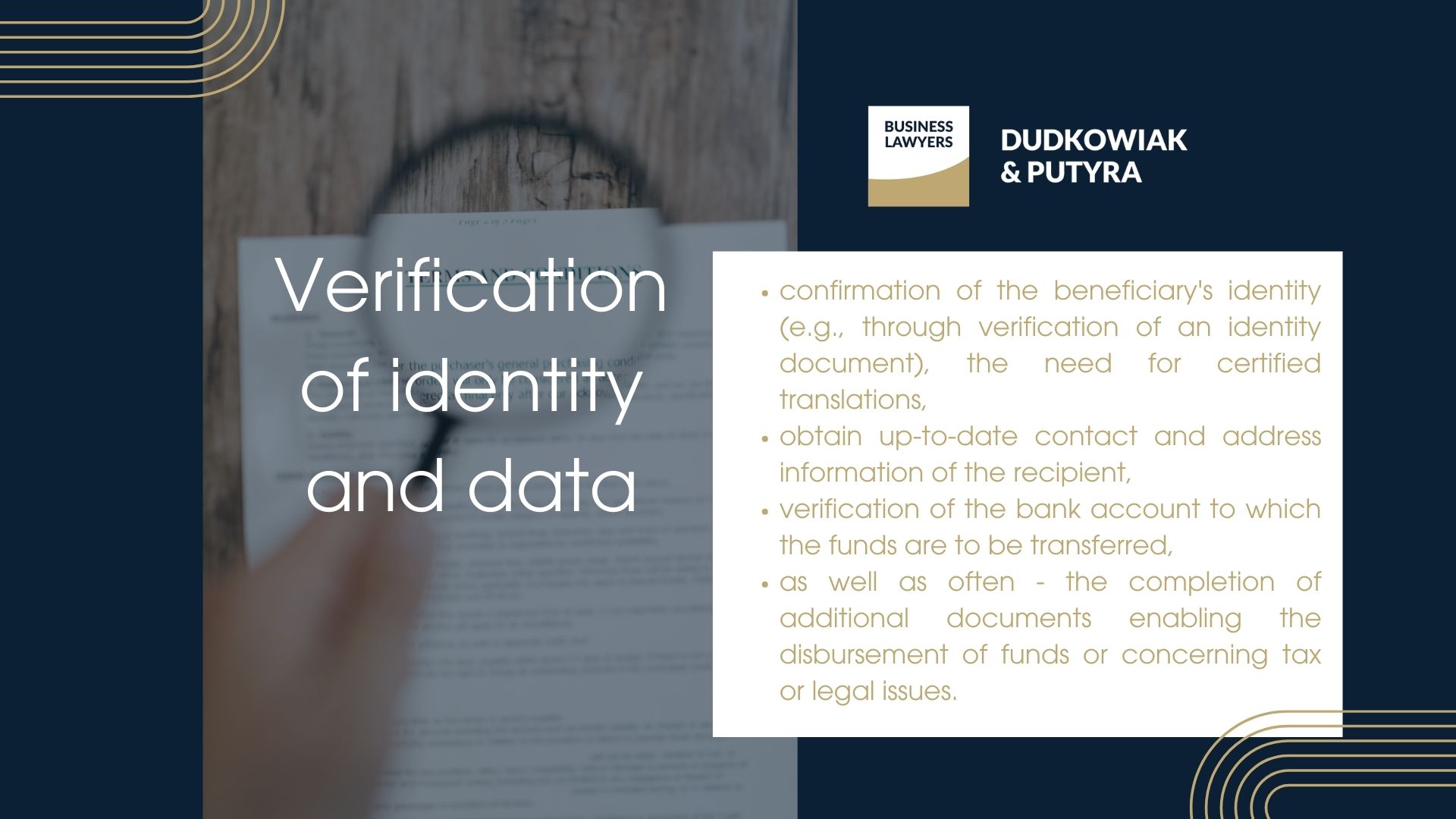
In practice, this means the need for:
- confirmation of the beneficiary’s identity (for example by verification of an identity document) and, where the foreign estate requires it, certified translations,
- up-to-date contact and address information of the recipient,
- verification of the bank account to which the funds are to be transferred,
- often also the completion of additional documents enabling the disbursement of funds (release and indemnity forms, tax forms of the foreign estate such as the Canadian NR4 slip) or concerning tax or legal issues.
On the Polish side, a bank receiving a larger transfer from abroad will usually ask the beneficiary, under the anti-money-laundering rules, to document the source of the funds: the death certificate, the grant of probate or equivalent document, the executor’s distribution statement and, if requested, a Polish translation. The same documents are later needed for the Polish inheritance tax return, so it is worth collecting them before the money is sent.
For this reason, the complete preparation of data and documents at an early stage of the proceedings is crucial for the smooth and safe execution of the distribution of the inheritance in Poland. For foreign executors and administrators of estates, it is particularly important to take into account Polish procedures and practices, because only then is it possible to effectively and legally transfer the estate to beneficiaries living in Poland.
Inheritance and gift tax – is property acquired abroad subject to tax?
The acquisition of an inheritance comprising property abroad is subject to taxation in Poland if, at the time of the deceased’s death, the beneficiary was a Polish citizen or had their permanent residence in Poland (Article 2 of the Inheritance and Gift Tax Act). A beneficiary who is neither – for example a foreign citizen staying in Poland temporarily – does not pay Polish inheritance tax on assets located abroad.
Polish tax regulations require that such foreign assets be valued at their market value on the date the tax liability arises, even if they are ultimately sold many years later. The value is reduced by the debts and burdens of the estate attributable to the beneficiary, such as documented funeral costs. All figures below apply to acquisitions since 1 July 2023 and are current for 2026; the full tables, the close-family rules and our inheritance tax calculator are on our page on inheritance tax in Poland.
Close family: exemption on form SD-Z2
A spouse, descendant (child, grandchild), ascendant (parent, grandparent), stepchild, sibling, stepfather or stepmother of the deceased is fully exempt from Polish inheritance tax, whatever the value of the foreign estate, on two conditions. First, the beneficiary must have held Polish, EU or EEA citizenship, or have lived in Poland or in an EU/EEA state, on the date of acquisition; a beneficiary with only US, UK, Canadian, Australian or Swiss citizenship who lives in Poland on a temporary permit does not qualify. Second, the acquisition must be reported to the tax office on form SD-Z2 within 6 months from the date the tax obligation arose (see above). No report is needed if the total value received from the same person within 5 years does not exceed PLN 36,120. A beneficiary who learns about the inheritance later has 6 months from the date they learned of it, and since 7 January 2026 a missed deadline can be restored on application if the delay was not the beneficiary’s fault. If the deadline is missed and not restored, the inheritance is taxed as for group I.
Amount of tax on inheritance from abroad – tax groups and rates
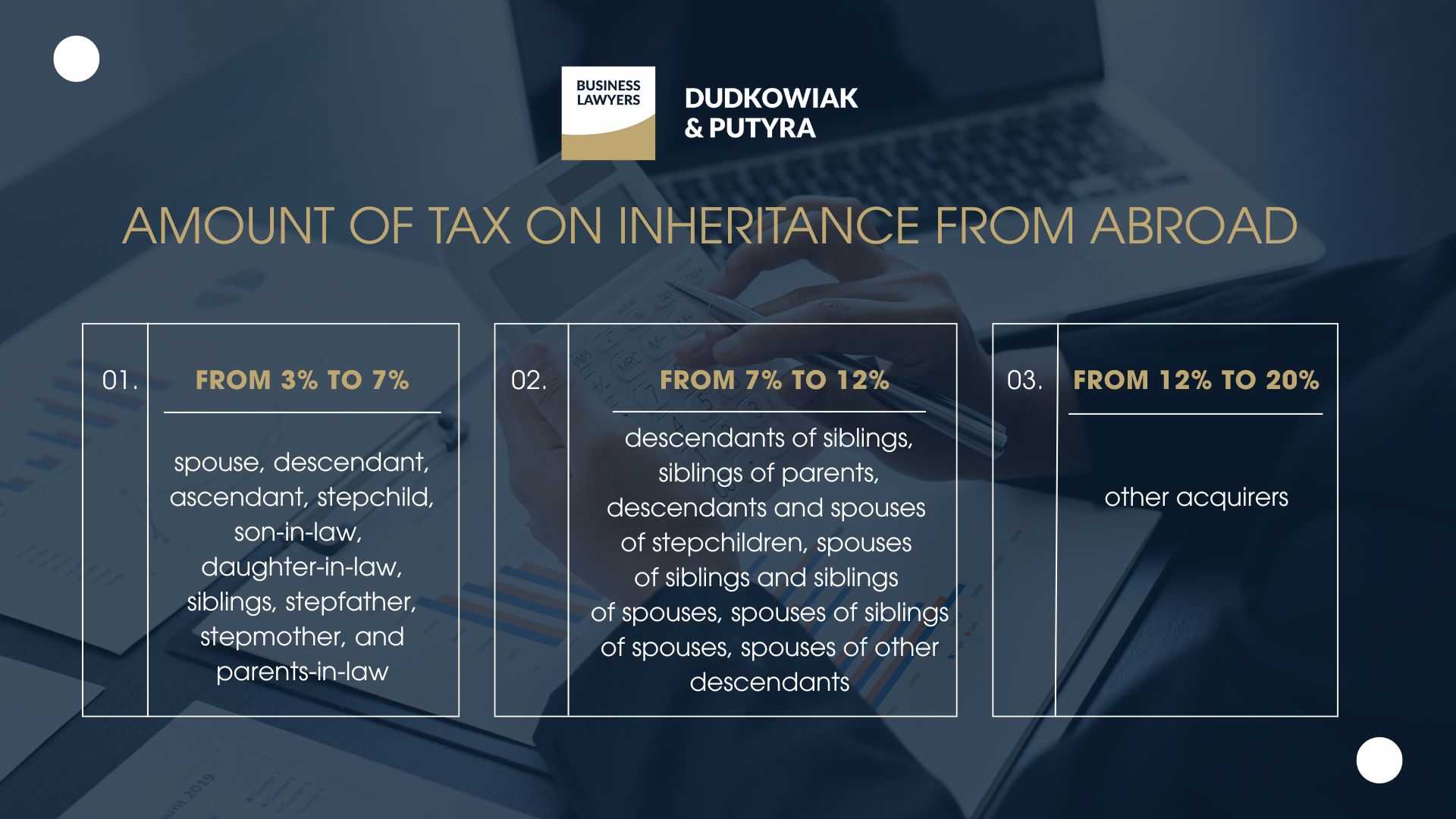
Where the exemption does not apply, the amount of tax depends on the tax group to which the heir belongs and on the value of the inheritance above the tax-free amount:
- Group I (spouse, descendants, ascendants, stepchild, son-in-law, daughter-in-law, siblings, stepfather, stepmother and parents-in-law) – tax-free amount PLN 36,120: 3% up to PLN 11,833 of the taxable surplus; PLN 355 plus 5% between PLN 11,833 and PLN 23,665; PLN 946.60 plus 7% above PLN 23,665 – from 3% to 7%
- Group II (descendants of siblings, siblings of parents, descendants and spouses of stepchildren, spouses of siblings and siblings of spouses, spouses of siblings of spouses, spouses of other descendants) – tax-free amount PLN 27,090: 7%; PLN 828.40 plus 9%; PLN 1,893.30 plus 12% above PLN 23,665 – from 7% to 12%
- Group III (all other acquirers, including unmarried partners and friends) – tax-free amount PLN 5,733: 12%; PLN 1,420 plus 16%; PLN 3,313.20 plus 20% above PLN 23,665 – from 12% to 20%
The tax-free amounts and the brackets are set by the Act and the Minister of Finance’s regulation in force since 1 July 2023 (Journal of Laws 2023, items 1059 and 1226). Acquisitions from the same person within the preceding 5 years are added together.
Filing: SD-3 within one month and payment within 14 days
If the exemption for close family does not apply, the heir must file a tax return on form SD-3 within one month from the date the tax obligation arose – that is, within one month of the final court decision, the registered notarial deed, the European Certificate of Succession or, since 7 January 2026, the foreign non-court document confirming the acquisition. The return is filed even if the value is below the tax-free amount and no tax is due. The tax office then issues a decision and the tax must be paid within 14 days of receiving it. A close relative who missed the SD-Z2 deadline files SD-3 within one month of the end of that deadline. Foreign documents are attached with a certified Polish translation; a lawyer acting under a power of attorney can file the return and correspond with the tax office on the heir’s behalf.
Double taxation of inheritance – what can and cannot be avoided
One of the common problems with foreign inheritances is double taxation, when the same assets are taxed both in the country where the estate is administered and in Poland. The Polish Inheritance and Gift Tax Act does not provide for a credit for inheritance or estate tax paid abroad, and Poland’s double-taxation treaties on income (with the United States, the United Kingdom, Canada, Germany and others) do not cover inheritance tax. Poland has separate inheritance tax treaties only with Austria, Hungary and the Czech Republic.
In practice the outcome depends on the country. The United States and the United Kingdom tax the estate, not the heir, so the foreign tax is paid out of the estate before distribution and the Polish tax is assessed separately on what the beneficiary receives; Canada and Australia have no inheritance tax (Canada taxes the deceased’s deemed disposition in the final return), so in most cases the Polish tax is the only inheritance tax. Whether a foreign estate tax borne by the estate reduces the value taxed in Poland is assessed case by case. The close-family exemption, where available, removes the Polish tax entirely. Country-by-country notes for the US, UK, Canada and Australia are in the double taxation section of our inheritance tax guide.
Selling inherited foreign property later
If a Polish tax resident later sells inherited real estate located abroad, the sale is subject to Polish income tax (19%) when it takes place within 5 years from the end of the year in which the deceased acquired the property, with relief for tax paid abroad under the relevant double-taxation treaty; after that period the sale is tax-free in Poland. The same rules apply to inherited property in Poland – see our guide on inheriting property in Poland.
Inheritance from abroad – what should heirs in Poland keep in mind?
The international nature of inheritances is becoming an increasingly common phenomenon, especially in the context of the mobility of citizens and the globalisation of property structures. In such cases, the distribution of an inheritance to beneficiaries living in Poland involves certain activities – both on the part of the administrator of the inheritance abroad and on the part of the beneficiaries in Poland.
Knowledge of local regulations, the tax system and the practices of financial institutions is key to avoiding formal problems and tax liability. Therefore, it is worthwhile to plan the distribution at an appropriate stage, verify recipients’ data, keep the foreign probate and distribution documents, and check the Polish tax position – the SD-Z2 or SD-3 deadlines and the citizenship condition of the exemption – before the final distribution of assets takes place. Dudkowiak & Putyra advises beneficiaries in Poland on the Polish tax return and coordinates with the foreign executor or adviser, and acts as Polish counsel for foreign executors, trust companies and law firms distributing estates to Poland.
FAQ – Cross border inheritance in Poland
Do heirs in Poland need to report inherited foreign assets, such as foreign bank accounts or mutual funds?
Yes. A Polish citizen or permanent resident of Poland who inherits abroad reports the acquisition to the Polish tax office – foreign bank accounts, mutual funds, shares, real estate and other assets included – even if the assets are never transferred to Poland. Close family report on form SD-Z2 within 6 months and pay nothing if the citizenship or residence condition is met; other heirs file form SD-3 within one month and pay tax on the value above the tax-free amount (PLN 36,120, 27,090 or 5,733 depending on the group). Failure to report may lead to tax assessed with interest, penalties and, for close family, the loss of the exemption.
What documents are needed from a foreign country for the Polish tax formalities?
You will usually need the death certificate, the document confirming your entitlement (the will with the grant of probate, letters of administration, a court decision or a European Certificate of Succession), the executor’s statement of the assets or the amount distributed to you, and certified translations into Polish of the documents you attach to the Polish return. Evidence of funeral costs and debts of the estate paid by you can reduce the taxable value.
Tax was already paid abroad on the estate – do I still pay in Poland?
Often yes. A US federal estate tax or UK inheritance tax is charged on the estate and paid by the executor before distribution; the Polish inheritance tax is charged on the beneficiary and Polish law gives no credit for the foreign tax, except under the inheritance tax treaties with Austria, Hungary and the Czech Republic. The practical protection for most families is the close-family exemption (SD-Z2), which requires Polish, EU or EEA citizenship or residence in Poland or the EEA. Whether the foreign tax reduces the value taxed in Poland should be checked for each estate.
What is the European Certificate of Succession?
The European Certificate of Succession (ECS) is issued under Regulation (EU) No 650/2012 by the courts or notaries of EU Member States (except Denmark and Ireland) and confirms the status of heirs, legatees, executors or administrators of an estate. It can be used in another Member State – before a bank, a court, a land register or a tax office – without separate recognition proceedings, and its issue is one of the events that start the Polish tax deadlines. Details, including what a UK grant of probate or US letters testamentary are worth in Poland, are in our guide on foreign probate documents in Poland.

How long does the distribution of a foreign inheritance to Poland usually take?
The time needed depends on several factors, such as the country where the estate is administered, the number of heirs, and whether all required documents (wills, court decisions, translations) are complete. The Polish part – the SD-Z2 report or the SD-3 return and the tax decision – usually takes a few weeks to a few months, but the foreign administration of the estate often takes from six months to over a year, especially when court proceedings or additional formalities are involved.
Do I need a lawyer in Poland for an inheritance received from abroad?
Hiring a lawyer is not mandatory, but it is advisable when the exemption is in doubt (citizenship or residence condition, missed deadline), when the estate includes real estate or a business abroad, or when the foreign executor needs Polish documents from the beneficiaries. A lawyer can check the tax position before the money is distributed, prepare the SD-Z2 or SD-3 with translations, represent you before the tax office under a power of attorney and coordinate with the foreign executor or tax adviser. Dudkowiak & Putyra’s inheritance and tax lawyers handle such matters for beneficiaries in Poland and for foreign executors.
Cross-border inheritance – where is the case heard and which law applies?
In cross-border inheritance cases, it is necessary to determine the jurisdiction of the court and the applicable law. Pursuant to Article 4 of Regulation (EU) No 650/2012, as a rule the courts of the Member State in which the deceased had their habitual residence at the time of death have jurisdiction, and the law of that state applies unless the deceased chose the law of their nationality in the will. The Regulation applies to deaths on or after 17 August 2015 in all EU Member States except Denmark and Ireland; for estates administered in the United States, the United Kingdom, Canada or Australia, the local probate rules apply and Polish law decides only the Polish tax consequences.
In practice, this means that a Polish court may be required to apply foreign law and that a decision issued in one Member State can be relied on in another. If the case is heard in Poland and Polish law applies, the provisions of the Polish Civil Code govern the inheritance process and property rights.