


Written by Natalia Sarna, Barrister (adwokat), Counsel
Reviewed by Michał Puk, Barrister (adwokat), Supervising Partner (Commercial and Regulatory)
First published: 4 November 2026
Last updated: 4 November 2026
Quick answer
How does a renewable energy project connect to the grid in Poland?
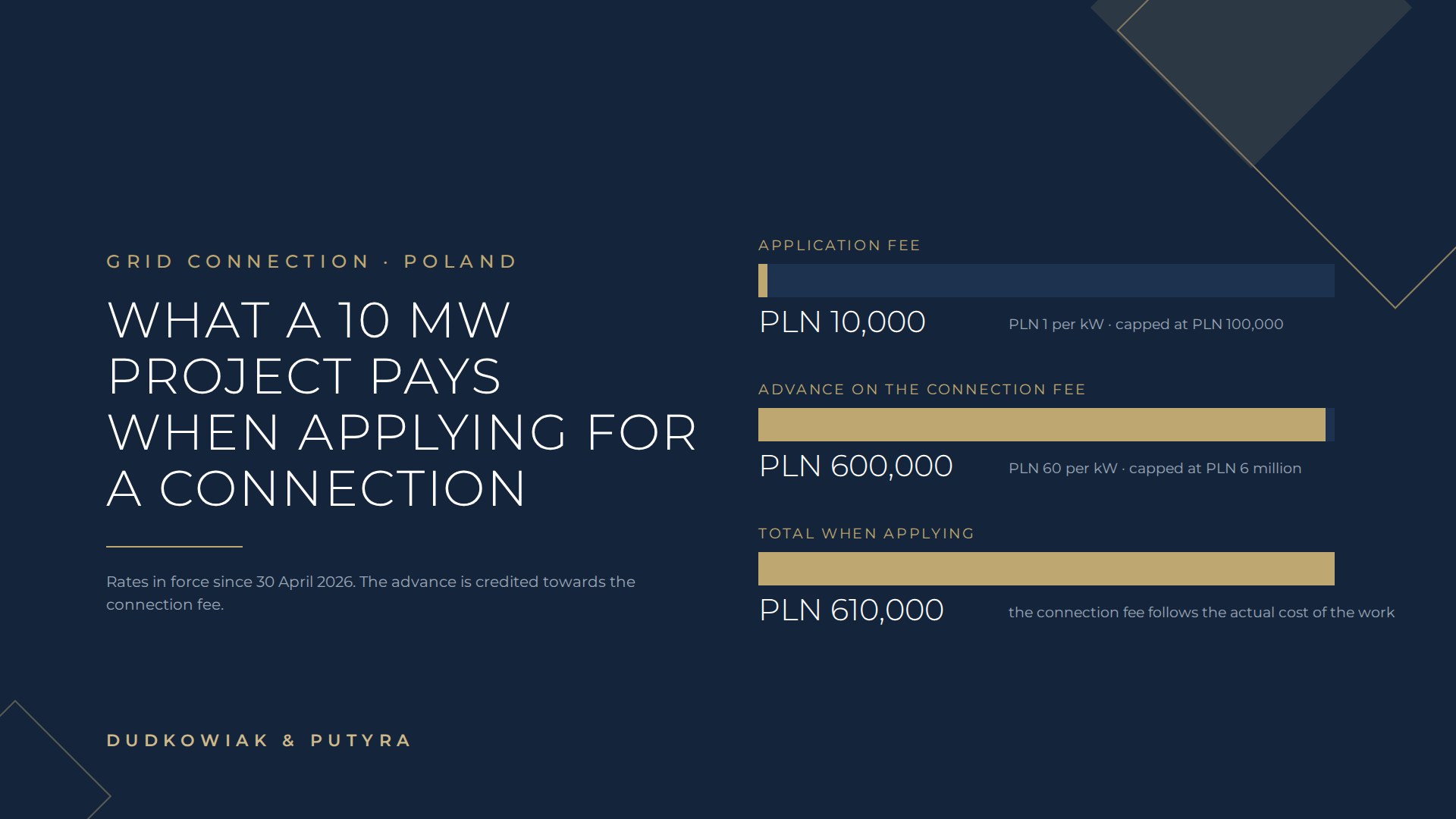
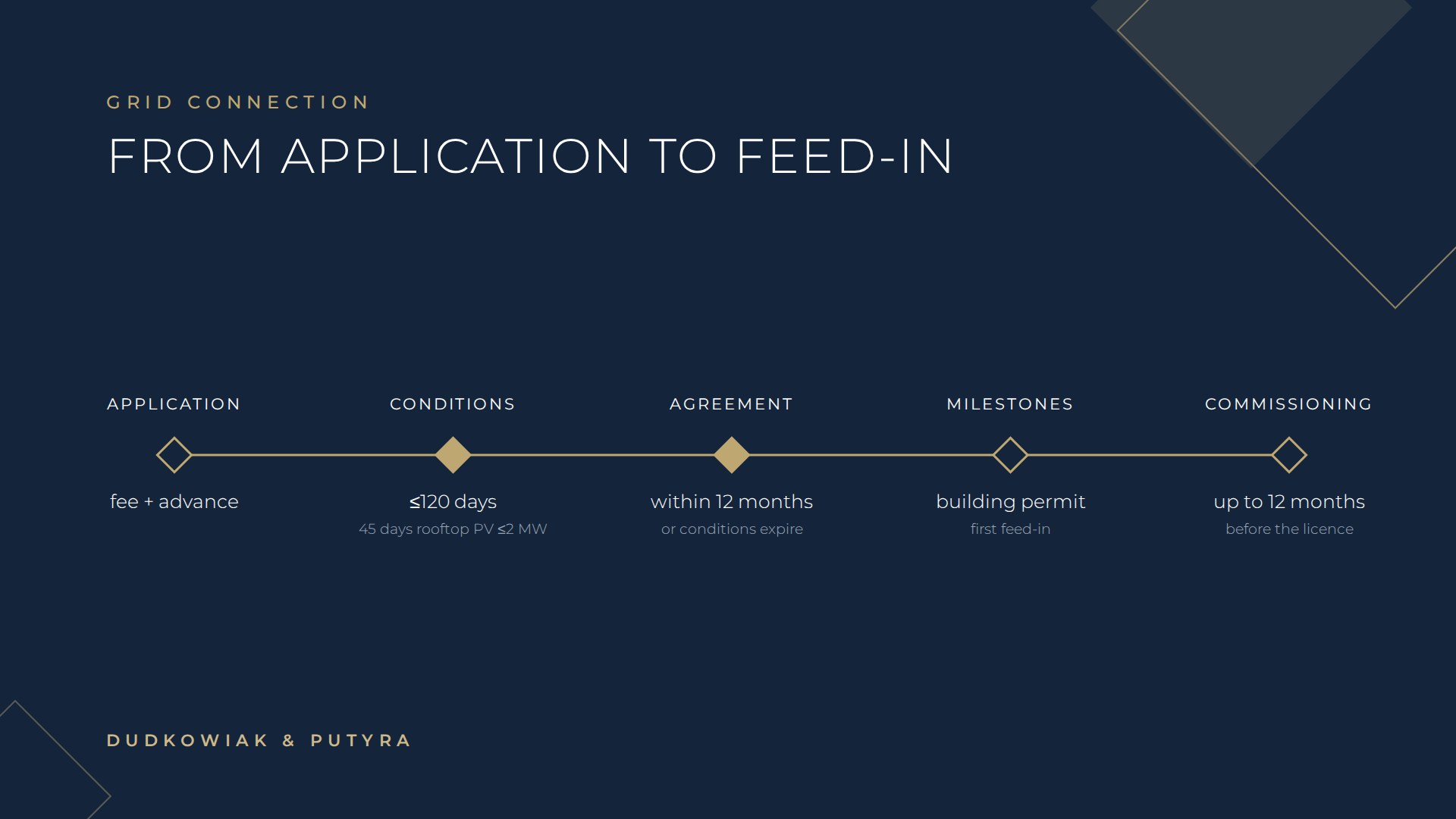
The grid operator issues connection conditions within 120 days for sources connected to grids above 1 kV (45 days for rooftop PV up to 2 MW); since 30 April 2026 the conditions are valid for 12 months and expire if no connection agreement is signed in that time. The application costs PLN 1 per kW of capacity (maximum PLN 100,000) plus an advance on the connection fee of PLN 60 per kW (maximum PLN 6 million).
The process runs in three stages – connection conditions, a connection agreement with milestones and an agreement for distribution services – and in practice comes before the building permit. After a refusal, the investor can ask the President of the Energy Regulatory Office (URE) to resolve the dispute.
120 days
for the operator to issue connection conditions for grids above 1 kV
45 days
for rooftop PV up to 2 MW
PLN 1 / kW
application fee, capped at PLN 100,000
12 months
validity of connection conditions issued from 30 April 2026
How grid connection works for renewable energy projects in Poland
Apart from projects operating entirely off-grid, connection to the grid is an essential requirement for generating, storing and selling electricity. The procedure runs in three main stages: obtaining connection conditions, signing a connection agreement and signing an agreement for distribution services. Formally it can run before or in parallel with the building permit; in practice, the design and the building permit application follow the connection conditions. The full investment path is set out in our legal guide to renewable energy investments in Poland.
GRID CONNECTION OF A RENEWABLE PROJECT · FIVE STEPS
1
Check available capacity and file the application
Operators publish available connection capacity for grids above 1 kV. The application is filed electronically on the operator’s platform, with the application fee and the advance on the connection fee; without the advance the application is returned.
2
Operator’s analysis
The operator checks the technical and economic conditions for connecting the source. For PV and wind installations above 2 MW it must prepare an expert assessment of the impact on the power system.
3
Connection conditions
Issued within up to 120 days for grids above 1 kV (45 days for rooftop PV up to 2 MW). They are a conditional commitment by the operator to sign a connection agreement and are valid for 12 months.
4
Connection agreement
Signed within the validity of the conditions. It sets the scope of work, the connection fee and milestones, including a deadline for the building permit and the date of first feed-in.
5
Distribution services and commissioning
An agreement for distribution services follows. During technical commissioning, energy may be sold, stored and offered on the balancing market for up to 12 months before the generation licence is granted.
A lack of available connection capacity at the planned connection point means a refusal from the grid operator or a requirement to finance grid expansion – which is why capacity is checked before land is secured.
Grid connection fees, security and advance payment
Two payments arise when the investor applies, the connection fee follows when the connection is built, and a security can be required for some connection agreements. The amounts below apply to sources connected to the electricity grid.
Application fee
PLN 1 / kW
of connection capacity, maximum PLN 100,000
Non-refundable; paid with the application.
Advance on the connection fee
PLN 60 / kW
maximum PLN 6 million per connection
Paid with the application; without it the application is returned. Raised by the 2026 reform from PLN 30 per kW (maximum PLN 3 million).
Connection fee
Actual costs
actual expenditure on the connection work
Charged for commercial installations regardless of capacity; the advance is credited towards it; prosumer micro-installations up to 50 kW pay no fee.
Security for the agreement
Agreements
signed before 30 April 2026 with connection after 30 April 2029
Had to be provided by 30 October 2026 as a cash deposit, bank or insurance guarantee or parent-company surety; otherwise the agreement expired.
In practice: sources connected through an existing connection – for example under cable pooling – are exempt from the application fee and the advance.
Grid connection cost calculator
Enter the capacity, choose the technology and the type of connection, and say whether the project uses cable pooling. The calculator applies the rates on this page and shows the application fee and the advance, with the deadline for connection conditions.
The calculator needs JavaScript. The rates are listed in the cards above.
Grid connection deadlines and validity of connection conditions
The time limit for issuing connection conditions depends on the connection group and the type of investment; for selected renewable installations the law provides shorter deadlines.
| Situation | Deadline or validity |
|---|---|
| Conditions for a source connected to a grid above 1 kV (e.g. medium voltage) | Issued within up to 120 days |
| Rooftop PV installation up to 2 MW | Issued within 45 days |
| Conditions issued from 30 April 2026 | Valid for 12 months; they expire if no connection agreement is signed in that time |
| Conditions issued before 30 April 2026 | Keep their two-year validity, provided the advance was paid or topped up under the transitional rules |
| Offshore wind with support: preliminary connection conditions | Valid for 2 years, extendable once by another 2 years |
| Technical commissioning before the licence | Energy may be sold, stored and offered on the balancing market for up to 12 months |
The shorter validity of connection conditions is meant to stop speculative projects from tying up grid capacity – once the year passes without a connection agreement, the conditions expire.
The 2026 Energy Law reform: what changed for grid connection
The amendment to the Energy Law of 13 March 2026, in force since 30 April 2026, changed the connection rules for every project in the queue – including those that had applied or received conditions earlier.
| Situation on 30 April 2026 | What the reform required |
|---|---|
| New application filed from 30 April 2026 | Conditions valid for 12 months; advance of PLN 60 per kW (maximum PLN 6 million). |
| Conditions received before 30 April 2026, valid until at least 30 October 2026, no agreement signed | Advance paid or topped up to PLN 60 per kW by 30 October 2026 – otherwise the conditions lost validity. |
| Application filed before 30 April 2026 but decided later | Conditions issued with the shorter validity; an advance paid at PLN 30 per kW had to be topped up within 30 days of receiving the conditions. |
| Agreement signed before 30 April 2026 with connection planned after 30 April 2029 | Security had to be provided by 30 October 2026 – otherwise the agreement expired by law. |
In practice: an amendment meant to clarify the transitional provisions was vetoed by the President in August 2026. For conditions or agreements obtained before the reform, check with the operator whether the advance and the security were recorded in time.
Grid connection requirements by renewable technology
The general path is the same for every technology; the application data and some deadlines differ.
SOLAR
Ground-mounted and rooftop PV
Number and types of inverters and PV modules in the application
Rooftop PV up to 2 MW: conditions within 45 days. Above 2 MW the operator must prepare an expert assessment of the impact on the power system.
PV micro-installation up to 50 kW
Notice to the operator
If the installation fits within the existing connection capacity, no connection conditions are needed; prosumer micro-installations pay no connection fee.
WIND
Onshore wind farm
Operating models of the generators, electrical characteristics, active and apparent power, compliance certificates
Above 2 MW the operator assesses the impact on the stability and operational safety of the system. Without an agreement within 12 months the investor loses the reserved capacity.
Offshore wind farm – without support
PSZW permit, statement waiving support, advance of PLN 60 per kW
The investor applies directly for connection conditions under the general rules.
Offshore wind farm – with support
Preliminary conditions → right to cover the negative balance → conditions → agreement
Preliminary conditions are valid for 2 years (extendable once by 2) and become binding connection conditions by law once the right to cover the negative balance is granted.
SHARED CONNECTION
Cable pooling and hybrid projects
New source connected through an existing connection
Exempt from the application fee and the advance.
Refusal of grid connection: disputes before the President of URE
Energy law gives renewable sources priority: operators must sign connection agreements with renewable installations first, provided the technical and economic conditions for the connection exist. When the operator refuses to issue connection conditions, the investor has two routes.
- Dispute before the President of URE. The investor can ask the President of the Energy Regulatory Office to resolve the dispute. An appeal against the decision goes to the Court of Competition and Consumer Protection at the Regional Court in Warsaw.
- Agreement for grid expansion. Where the refusal results from a lack of technical or economic conditions, the parties can sign an agreement for the necessary expansion or modernisation of the grid at the investor’s expense.
Generation licences, and the trading and distribution licences that sit alongside them, are covered in our guide to energy law in Poland.
The connection line and the cable route
If the connection point lies outside the boundaries of the investor’s property, the investor remains responsible for building the connection line and for obtaining rights to every plot it crosses – in particular by establishing a transmission easement on private land and obtaining road-authority decisions on public roads. The connection line itself does not need a full building permit; it is built under the simpler notification procedure.
Securing land and the cable route is covered in site selection and land rights for renewable energy projects, and the zoning basis in zoning for renewable energy projects in Poland.
What to check before signing a grid connection agreement
The connection agreement often decides whether a project survives to construction. Before signing it – or before buying a project that already has one – check:
- Milestones. The deadline for the building permit and the date of first feed-in; missing key deadlines without justification may end the agreement.
- Advance and security. Whether the advance was paid in the right amount and on time and, for older agreements, whether the security was provided, including under the 2026 transitional rules.
- Connection fee. The scope of work and the costs charged to the investor, which follow the actual documented cost.
- Operator’s obligations. Which work depends on the operator – for example securing land for its part of the route – and what happens if it is delayed.
- Land. Whether the lease and the cable-route rights last at least as long as the milestones require.
Failure to meet key contractual deadlines without justification may result in the termination of the connection agreement, so the milestones have to be built into the permitting schedule from day one.
Before an acquisition, these points are part of the due diligence of renewable energy projects in our real estate practice.
Case study: a grid connection agreement in a solar farm acquisition
One matter from our files. Client details are generalised.
CASE · SOLAR FARM ACQUISITION · 2024
Reviewing the grid connection agreement of a ready-to-build solar farm of about 20 MW
In 2024 Dudkowiak & Putyra tested a ready-to-build PV project of about 20 MW in western Poland for a foreign investor before it committed to full due diligence. The project company held a 110 kV grid connection agreement. Our report set out the investor’s exposure under that agreement – the bank guarantee, the termination penalty and the connection costs – and flagged that the connection depended on the operator securing land for the route and that the landlord could terminate the lease if no building permit was issued by a set date.
What it shows. In a ready-to-build project the connection agreement carries much of the value and much of the risk: its guarantees, termination rights and the operator’s own obligations decide whether the project reaches construction.

Barrister (adwokat), Counsel
Author
Counsel in the real estate practice. At Dudkowiak & Putyra she advises on land for renewable energy projects, including green-lease clauses, and on financing, mortgages and land-register work for foreign investors.

Barrister (adwokat), Supervising Partner (Commercial and Regulatory)
Reviewer
Supervising Partner of Dudkowiak & Putyra’s commercial and regulatory practices. He leads the firm’s work on licences, permits and administrative proceedings, including cases before the provincial administrative courts and the Supreme Administrative Court. Admitted to the Bar in 2018; member of the Poznań Bar Association; law graduate of Adam Mickiewicz University in Poznań.
Sources and methodology
Legal basis. Act of 10 April 1997 – Energy Law (Prawo energetyczne), as amended by the Act of 13 March 2026 amending the Energy Law and certain other acts (Journal of Laws 2026, item 516; in force from 30 April 2026, with some provisions from 15–16 October 2026); Act of 20 February 2015 on Renewable Energy Sources; Act of 17 December 2020 on the Promotion of Electricity Generation in Offshore Wind Farms; Act of 7 July 1994 – Construction Law. A clarifying amendment of 31 July 2026 (Sejm print 2750) was vetoed by the President. Texts: ISAP. Official information: ure.gov.pl (disputes and licences), pse.pl (transmission system operator).
Own data. Dudkowiak & Putyra’s real estate practice as of 25 September 2026: 60 matters in construction law and the investment process (including PV and energy), planning and environment opened in the four years to that date, counted by the subject of each matter, with matters for the same client counted separately; over 450 clients from 44 countries since 2014, over 75% of them foreign (country of the client as shown in the matter files).
State of the law: November 2026. This page is general information, not legal advice; the connection rules for a specific project depend on its capacity, the voltage level, the operator and the date on which the application was filed.
Corrections: none since publication.
FAQ – grid connection for renewable energy projects in Poland
How long does it take to get grid connection conditions in Poland?
Up to 120 days for sources connected to grids above 1 kV, and 45 days for rooftop PV installations up to 2 MW; above 2 MW the operator also prepares an expert assessment of the impact on the power system.
How long are grid connection conditions valid?
Conditions issued from 30 April 2026 are valid for 12 months and expire if no connection agreement is signed in that time; conditions issued earlier keep their two-year validity if the advance was paid or topped up under the transitional rules.
How much does it cost to apply for connection conditions?
A non-refundable fee of PLN 1 per kW of capacity, capped at PLN 100,000, plus an advance on the connection fee of PLN 60 per kW, capped at PLN 6 million; without the advance the application is returned.
What is the advance on the connection fee?
Since 30 April 2026 it is PLN 60 per kW of connection capacity, capped at PLN 6 million per connection, up from PLN 30 per kW and PLN 3 million before the reform.
Who pays for the grid connection works?
The connection fee for commercial renewable installations is set on the basis of the actual expenditure on the connection work, regardless of capacity; prosumer micro-installations up to 50 kW pay no connection fee.
Is cable pooling exempt from connection fees?
Yes, sources connected through an existing connection, for example under cable pooling, are exempt from the application fee and the advance.
What can I do if the operator refuses to connect my project?
Ask the President of URE to resolve the dispute, with an appeal to the Court of Competition and Consumer Protection in Warsaw; where the refusal is due to a lack of technical or economic conditions, an agreement for grid expansion at the investor’s expense is possible.
Do renewable energy sources have priority in grid connection?
Yes, operators must sign connection agreements with renewable installations first, provided the technical and economic conditions for the connection exist.
Can a solar or wind farm sell electricity before it has a licence?
During technical commissioning energy may be sold, stored and offered on the balancing market for a period of up to 12 months before the generation licence is granted.
What happens if I miss a milestone in the connection agreement?
Failure to meet key contractual deadlines, such as the building-permit deadline or the date of first feed-in, without justification may result in the termination of the connection agreement.
Who builds the connection line if the connection point is outside my site?
The investor builds it and must obtain rights to every plot it crosses, usually a transmission easement on private land and road-authority decisions on public roads; the line is built under the simpler notification procedure.
How does grid connection work for offshore wind farms?
Without support the investor applies directly, attaching the PSZW permit, a waiver of support and an advance of PLN 60 per kW; with support it first obtains preliminary conditions valid for 2 years, which become binding once the right to cover the negative balance is granted.


