


Written by Natalia Sarna, Barrister (adwokat), Counsel
Reviewed by Michał Puk, Barrister (adwokat), Supervising Partner, Commercial and Regulatory
First published: 10 November 2026
Last updated: 10 November 2026
Quick answer
What does a biomass power plant or CHP unit need in Poland?
A biomass plant is a combustion installation, so the key thresholds are expressed in thermal input – the energy fed in with the fuel. Plants burning solid fuel such as wood chips or pellets need an environmental decision from 10 MW of thermal input, with a full report always required from 300 MW; from 50 MW they also need an integrated permit.
Selling electricity requires a licence from the President of the Energy Regulatory Office (URE) above 1 MW, or an entry in the register of small installations from 50 kW; heat generation needs a separate licence once the sources exceed 5 MW of installed thermal capacity. Support comes from two separate schemes: the renewable energy scheme (auctions, and fixed tariffs or premiums up to 1 MW) and the high-efficiency cogeneration scheme, which pays a premium per MWh of electricity sold.
In practice, the fuel decides more than the technology. The type of biomass, its origin and the way it is stored determine whether the plant counts as renewable, which emission standards apply and whether the project qualifies for support. Biomass plants are also industrial buildings: once built, they generally need an occupancy permit after an inspection rather than a simple notification of completion.
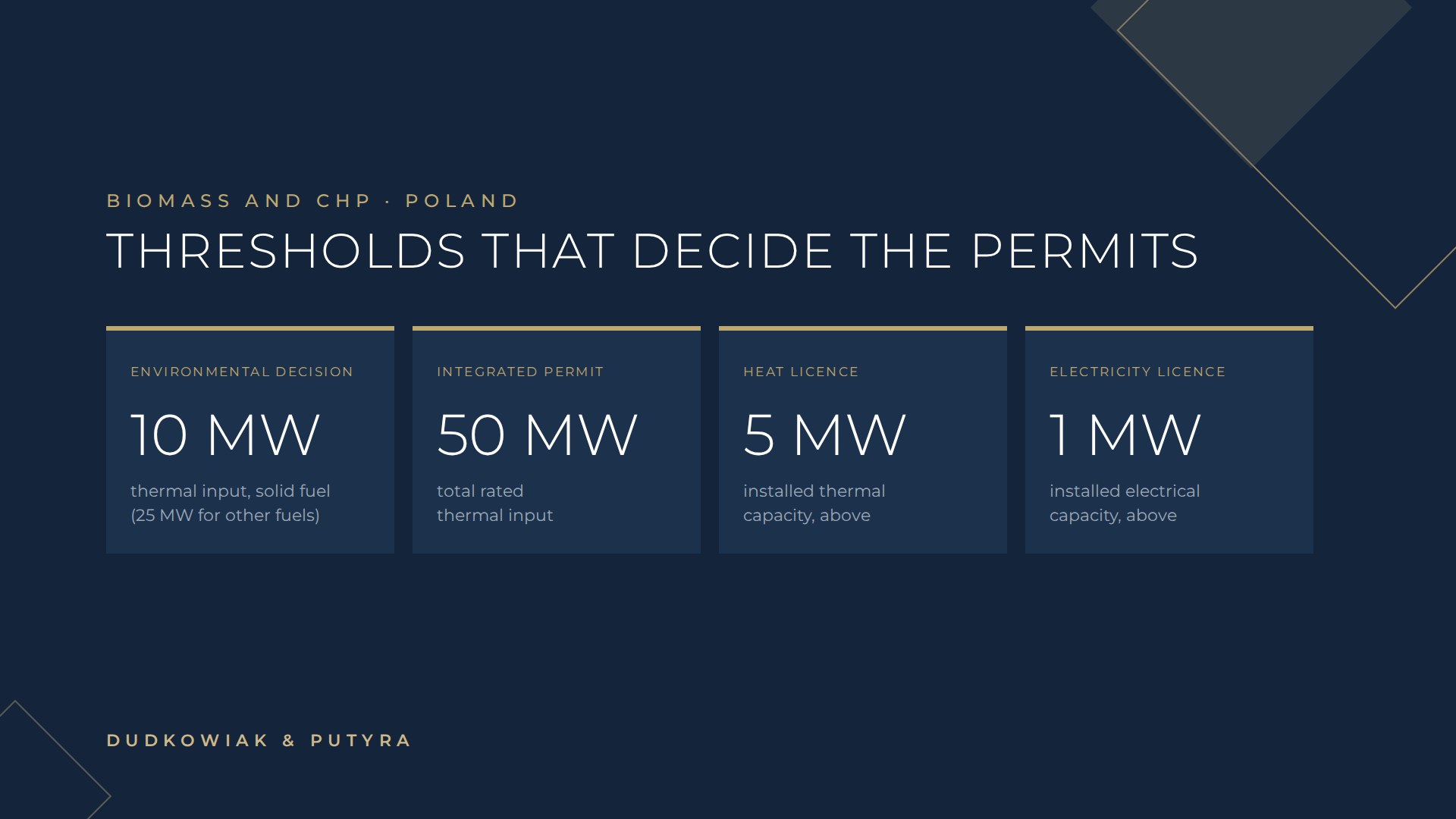
10 MW
thermal input from which a solid-fuel plant needs an environmental decision
50 MW
thermal input from which an integrated permit is required
5 MW
installed thermal capacity above which a heat licence is needed
1 MW
electrical capacity above which a generation licence is needed
The path for a biomass or CHP plant in Poland in seven stages
Biomass and combined heat and power (CHP) plants differ from solar and wind in one fundamental way: they burn fuel. That brings them under emission rules for combustion installations and, where they also supply heat, under a second licensing regime and a separate support scheme. The full renewable investment path is set out in our legal guide to renewable energy investments in Poland.
A BIOMASS OR CHP PLANT IN POLAND · SEVEN STAGES
1
Site and fuel logistics
Besides title to the land, a biomass plant needs room for fuel deliveries and storage, a heat offtaker if it works in cogeneration, and distance from homes. How to secure the land is explained in our guide to site selection and land rights for renewable projects.
2
Environmental decision
Required for solid-fuel plants from 10 MW of thermal input, and for other fuels from 25 MW; a full report is mandatory from 300 MW. The procedure is covered in the environmental decision for renewable energy projects.
3
Zoning
An industrial plant needs a local zoning plan or a WZ decision that allows it. Which route is open in a given municipality is set out in zoning for renewable energy projects in Poland.
4
Emissions permit
Depending on the fuel input, a notification, an emissions permit or – from 50 MW – an integrated permit under the Environmental Protection Law.
5
Grid connection
For electricity and, in cogeneration, often also for the district heating network. The electricity side is described in our guide to grid connection for renewable energy projects.
6
Building and occupancy permit
A building permit, and after construction usually an occupancy permit, because biomass plants are typically industrial buildings. The rules are described in building permits for renewable energy projects in Poland.
7
Licences and support
An electricity licence above 1 MW, a heat licence above 5 MW, and an application to the renewable or cogeneration support scheme. The licence procedure is outlined in the licence section of our renewable energy guide.
Biogas, biomethane and biomass are particularly well suited wherever reliability and continuity of energy supply are critical – unlike weather-dependent sources such as wind or solar power.
Site selection: fuel logistics, heat offtake and neighbours
For a combustion plant the site decides more than the plot price: it has to take in regular fuel deliveries, store the fuel, sell the heat and keep its neighbours on side.
- Fuel supply and storage. The location should allow efficient and economically viable fuel deliveries, usually from forestry, sawmills, farms or food processors within a short distance, and enough room to store the fuel safely.
- Heat offtake. Proximity to a district heating network or an industrial heat user is a major advantage, because it allows the heat from cogeneration to be sold rather than wasted.
- Distance from homes. Plants that may cause noise, dust or odour nuisance should stand at a sufficient distance from residential areas, with buffer zones of greenery and measures to limit their impact.
- Protected areas. A site within or next to a national park, nature reserve, landscape park or Natura 2000 site can significantly hinder or prevent the project.
- Lease terms. If the land is leased, the agreement should state that the plant was erected for temporary use and remains the lessee’s property, and should carry a certified date or be entered in the land and mortgage register.
If the investor uses the land under a lease agreement, the agreement should adequately protect the investor’s interests, in particular by specifying that the facility has been erected for temporary use and remains the property of the lessee.
Biomass as fuel: what counts and what changes the regime
Biomass is defined in the Renewable Energy Sources Act as the biodegradable part of products, waste and residues of biological origin from agriculture, forestry and related industries, including fisheries and aquaculture, as well as the biodegradable part of industrial and municipal waste.
- Typical fuels. Wood chips, pellets and briquettes, straw, energy crops, residues from forestry, sawmills and the food industry.
- Waste is a separate regime. Burning waste that is not biomass under the emission standards regulation moves the plant into the waste incineration rules, with stricter permits and standards.
- Biofuels and biogas. Liquid biofuels and biomethane follow their own rules, described in our guide to the alternative fuels market in Poland; biogas plants have a separate page in this section.
Environmental decision for biomass and CHP plants
For combustion installations producing electricity or heat, the Council of Ministers regulation on projects likely to have a significant impact on the environment sets the thresholds by thermal input – the energy fed into the installation with the fuel at nominal load.
| Thermal input | Category | Consequence |
|---|---|---|
| Below 10 MW (solid fuel) or below 25 MW (other fuels) | Not listed | No environmental decision for the combustion installation itself |
| From 10 MW (solid fuel) or from 25 MW (other fuels) to under 300 MW | Potentially significant impact | Environmental decision; project information sheet (KIP), with a report only if the authority requires it |
| 300 MW or more | Always significant impact | Environmental decision with a full environmental impact report |
Expansions are added up: if a new unit together with existing ones on the same site reaches a threshold, the project is assessed as a whole.
Facilities that may generate noise or odour nuisances, such as biogas plants or biomass heating plants, require proper planning of buffer zones and measures to mitigate their impact on the surrounding area.
Environmental decisions are part of our wider environmental law in Poland practice.
Emissions permits for biomass plants
Combustion produces dust, nitrogen oxides and other emissions, so a biomass plant needs an air emissions title under the Environmental Protection Law before it starts operating.
- Smaller installations. Depending on the fuel, thermal input and emission levels, either a notification to the environmental authority or a permit to release gases or dust into the air.
- Integrated permit from 50 MW. Combustion installations with a total rated thermal input of 50 MW or more fall under the Industrial Emissions Directive and need an integrated permit setting emission limits and best available techniques.
- Emission standards. Limit values depend on the fuel and the size of the installation; medium combustion plants of 1 to 50 MW have their own standards under EU rules.
Emission rules for energy installations are covered in our guide to gas emissions and energy efficiency in Poland.
Grid connection, building permit and occupancy permit
- Electricity grid. Connection follows the general rules, including the application fee and the advance; units above 2 MW also need an expert assessment of their impact on the system.
- District heating. A CHP plant selling heat must agree the connection with the operator of the local heating network; the heat price is regulated through a tariff approved by the President of URE once a licence is required.
- Building and occupancy permit. A biomass plant needs a building permit. If it is classified as an industrial and manufacturing building (category XVIII of the Construction Law annex), an occupancy permit after a mandatory inspection is required instead of a notification of completion.
Licences for electricity and heat
| Activity | Threshold | Title |
|---|---|---|
| Electricity from renewable sources | Above 1 MW installed electrical capacity | Generation licence from the President of URE |
| Electricity from renewable sources | Above 50 kW up to 1 MW | Entry in the register of small installations (MIOZE) |
| Electricity from renewable sources | Up to 50 kW (micro-installation) | Notification to the grid operator |
| Heat generation | Sources with total installed thermal capacity above 5 MW | Heat generation licence from the President of URE, and a heat tariff |
A CHP plant above both thresholds needs two licences – one for electricity and one for heat.
Renewable energy support for biomass plants
Biomass plants can use the renewable energy support scheme of the Renewable Energy Sources Act.
- Auctions. Larger installations compete in renewable auctions organised by the President of URE for a contract for difference.
- Fixed tariffs and premiums. Smaller installations can apply for a fixed purchase price (FIT) below 500 kW or a premium on top of the market price (FIP) from 500 kW to 1 MW; following the 2023 amendment, these schemes also cover biomass installations.
- Support for existing plants. Installations whose support period has ended may receive operating aid in the form of market-price premiums for up to 10 years.
Support for high-efficiency cogeneration (CHP)
Electricity from high-efficiency cogeneration is supported under the Act of 14 December 2018 on the promotion of electricity from high-efficiency cogeneration, which replaced the earlier certificate system. The mechanism depends on the size of the unit and whether it is new or existing.
| Unit | Mechanism | Award |
|---|---|---|
| New or significantly modernised, 1 MW to under 50 MW | Cogeneration premium | Auction run by the President of URE |
| New or significantly modernised, 50 MW or more | Individual cogeneration premium | Call for applications (nabór) |
| Existing or modernised, 1 MW to under 50 MW, and small units below 1 MW | Guaranteed premium | Application to the President of URE |
| Existing or modernised, 50 MW or more | Individual guaranteed premium | Application to the President of URE |
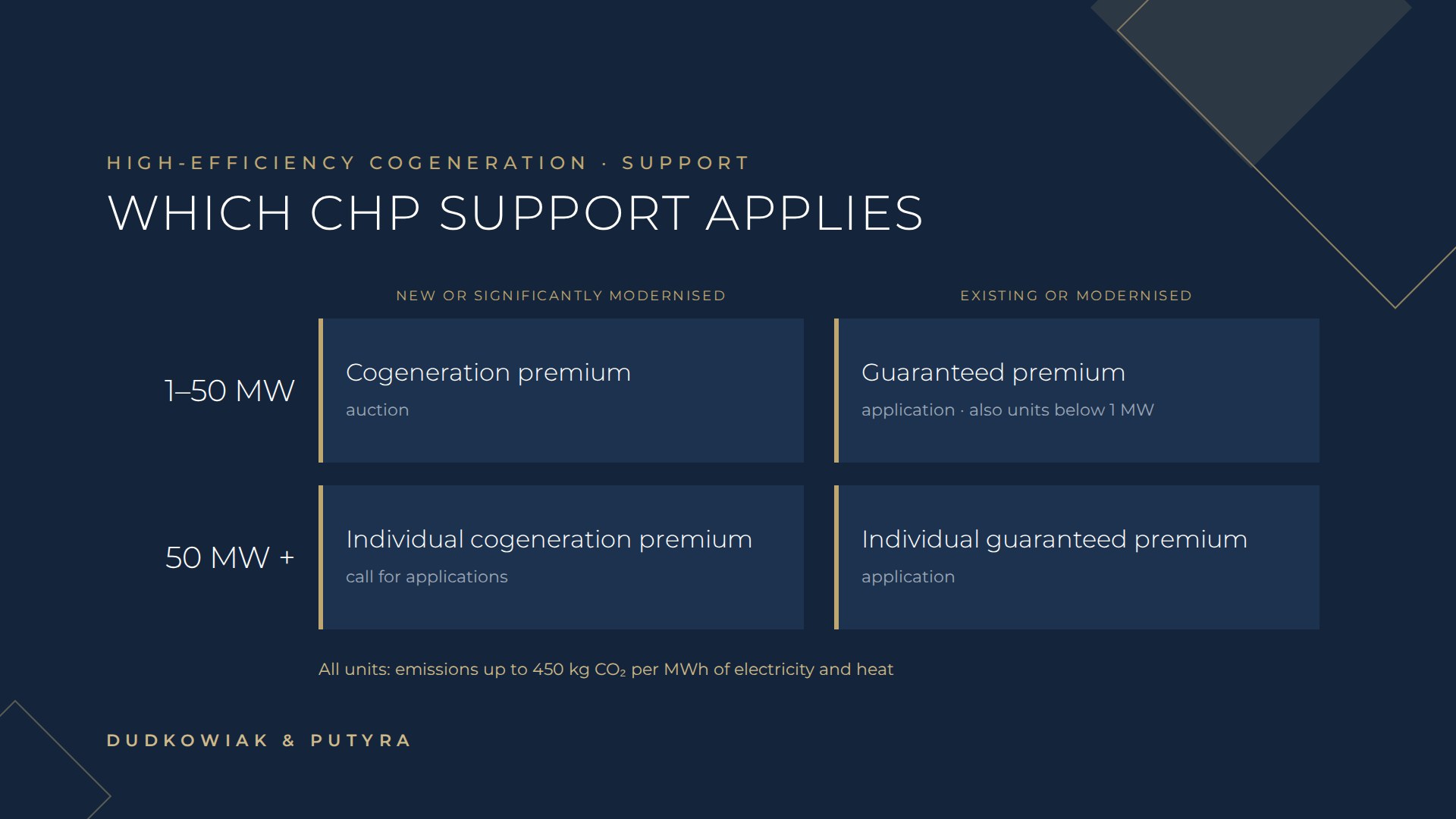
Units qualify only if their emissions do not exceed 450 kg of CO₂ per MWh of electricity and heat produced together.
Sustainability criteria for biomass
- EU criteria. Under the Renewable Energy Directive, solid biomass used in larger installations must meet sustainability and greenhouse gas saving criteria to count as renewable and to receive support; the 2023 revision of the directive lowered the threshold for solid biomass installations from 20 MW to 7.5 MW of total rated thermal input.
- Documentation. Operators prove compliance with the origin of the fuel through certification schemes and supply-chain documentation, which should be reflected in fuel supply contracts.
- Practical effect. Fuel contracts should allocate who bears the risk if a supplier cannot document the origin of the biomass – without that evidence, the electricity may not qualify for support.

Barrister (adwokat), Counsel
Author
Counsel in the real estate practice. For biomass and CHP plants she handles the property side: the plot for the plant and the fuel yard, leases that keep the installation the investor’s property, and easements for heat pipelines and grid connections across neighbouring land.

Barrister (adwokat), Supervising Partner, Commercial and Regulatory
Reviewer
Supervises Dudkowiak & Putyra’s commercial and regulatory practice, including energy regulation. For energy companies he deals with URE licences and the commercial contracts around generation, such as fuel supply and offtake agreements. Admitted to the Poznań Bar in 2018; law at Adam Mickiewicz University in Poznań.
Sources and methodology
Legal basis. Act of 20 February 2015 on Renewable Energy Sources (definition of biomass, support schemes, as amended in 2023); Act of 14 December 2018 on the promotion of electricity from high-efficiency cogeneration; Act of 10 April 1997 – Energy Law (licences for electricity and heat); Act of 27 April 2001 – Environmental Protection Law (emissions permits, integrated permits); Act of 3 October 2008 on environmental impact assessments; Regulation of the Council of Ministers of 10 September 2019 on projects likely to have a significant impact on the environment (§ 2(1)(3) and § 3(1)(4)); Act of 7 July 1994 – Construction Law; Directive (EU) 2018/2001 (RED II) as amended by Directive (EU) 2023/2413 (RED III); Directive 2010/75/EU on industrial emissions; Directive (EU) 2015/2193 on medium combustion plants. Texts: ISAP, EUR-Lex. Official information: ure.gov.pl (licences, auctions and cogeneration support).
Secondary sources. URE communication on the 2023 amendment of the Renewable Energy Sources Act; Gramwzielone.pl on the cogeneration support mechanisms and the first cogeneration auction.
State of the law: November 2026. This page is general information, not legal advice; the permits and support available to a specific plant depend on its fuel, thermal input, electrical capacity and whether it supplies heat.
Corrections: none since publication.
FAQ – biomass and CHP in Poland
Is burning biomass considered renewable energy in Poland?
Yes, electricity and heat from biomass count as renewable energy under the Renewable Energy Sources Act, provided the fuel meets the statutory definition of biomass and, for larger installations, the EU sustainability criteria.
Can a coal plant be converted to biomass?
Yes, but a conversion is usually treated as a change of the installation, which can require a new or amended environmental decision, a revised emissions permit and an amended licence.
Can a biomass plant co-fire biomass with coal?
Yes, but support under the renewable scheme covers only the share of energy attributable to biomass, which must be measured and documented.
How long is the environmental decision for a biomass plant valid?
It can be used for the next stages within six years of becoming final, extended to ten years if the authority confirms before the six years run out that its conditions remain valid.
What is high-efficiency cogeneration?
Combined production of electricity and heat that saves at least the amount of primary energy required by EU rules compared with separate production; only electricity from high-efficiency cogeneration qualifies for the cogeneration premium.
How long does cogeneration support last?
Support is granted for a fixed number of years set in the act and the auction or decision, counted from the first sale of electricity under the scheme, and is limited by the cap on supported volumes.
Do biomass plants pay for CO₂ emissions under the EU ETS?
Combustion installations above 20 MW of total rated thermal input are covered by the EU Emissions Trading System, but emissions from biomass that meets the sustainability criteria are counted as zero.
Does a biomass plant need a water-law permit?
It may: drawing water for cooling or discharging process wastewater generally requires a water-law permit from the State Water Management Authority (Wody Polskie).
Is ash from a biomass plant treated as waste?
Yes, combustion ash is waste, so the operator must register in the waste database (BDO), keep records and hand the ash to authorised recipients, or recover it where the rules allow.
Can a biomass CHP plant combine renewable and cogeneration support?
Not for the same electricity: public support for the same energy cannot be cumulated, so the operator has to choose the scheme that suits the project.


