


Written by Natalia Sarna, Barrister (adwokat), Counsel
Reviewed by Wojciech Kasprzak, Attorney (radca prawny), Senior Counsel, Head of Real Estate and German Desk
First published: 5 November 2026
Last updated: 5 November 2026
Quick answer
Which building procedure does a renewable energy project need in Poland?
The authority issues a building permit within 65 days of a complete application; solar farms above 150 kW, wind farms, biogas plants and most larger installations need one. After construction, a notification of completion allows operation after 14 days unless the authority objects; wind farms, hydropower and geothermal plants and some biogas and biomass plants instead need an occupancy permit, with a mandatory inspection within 21 days.
Photovoltaic installations up to 150 kW need neither a building permit nor a notification. Since 7 January 2026, energy storage facilities follow separate thresholds of 30, 300 and 2,000 kWh.
65 days
for the building permit decision after a complete application
14 days
for the authority to object to a notification of completion
21 days
for the mandatory inspection before an occupancy permit
150 kW
PV up to this capacity: no permit and no notification
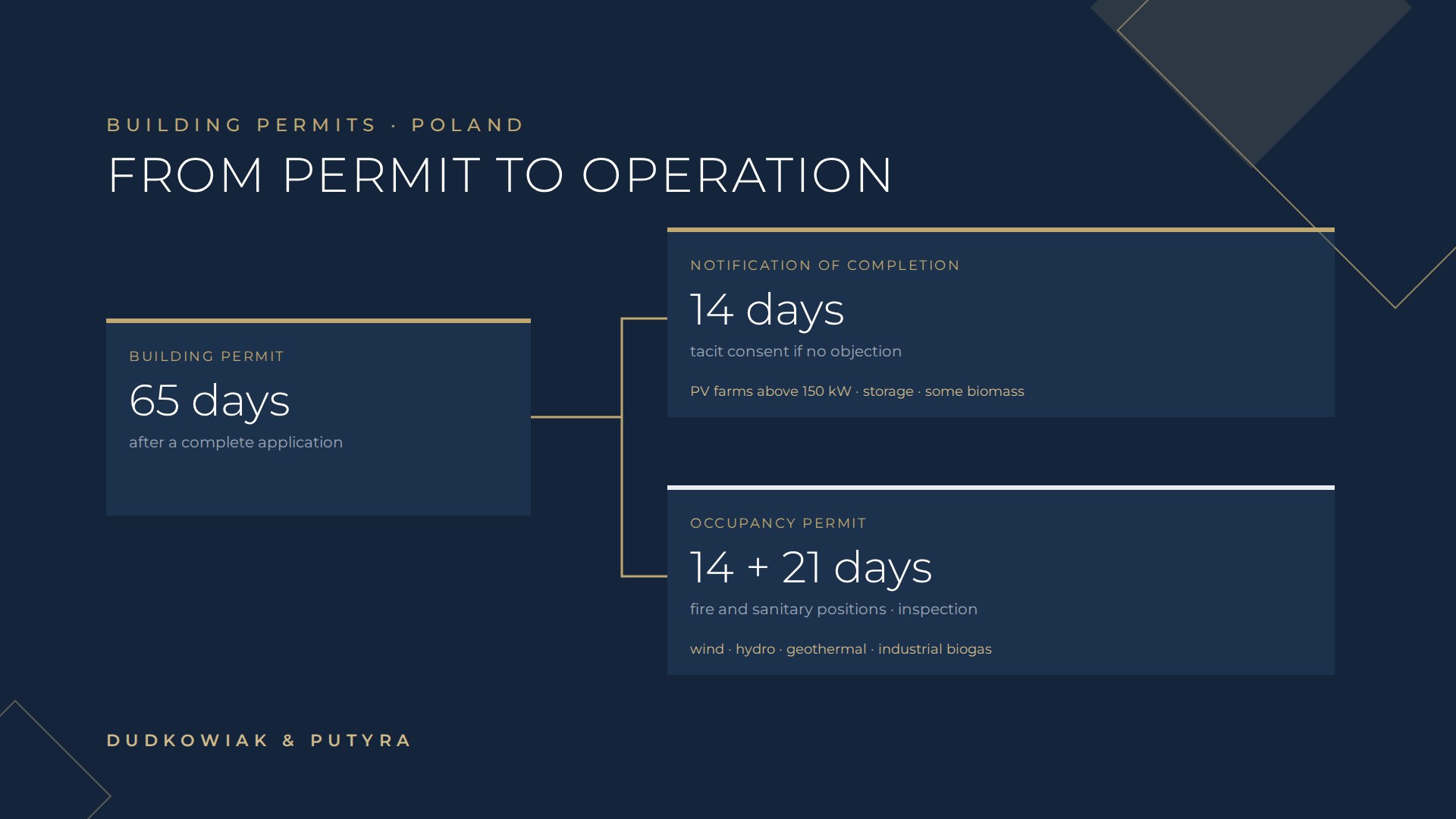
Building permit, notification and occupancy permit: three procedures
Every renewable project ends its preparatory phase with a building permit or a notification, and its construction phase with either a notification of completion or an occupancy permit. Which of the two completion paths applies depends on the technology and on the building permit itself. The full investment path is set out in our legal guide to renewable energy investments in Poland.
CONSTRUCTION AND COMPLETION · THREE PROCEDURES
1
Building permit – or notification of construction works
The building permit is the basis for legally starting construction, installation or reconstruction. Smaller installations need only a notification of construction works or no procedure at all. The permit is issued within 65 days of a complete application.
2
Notification of completion
For many renewable installations – freestanding PV farms above 150 kW, energy storage facilities, some biomass installations – operation starts after notifying the building supervision authority. Tacit consent applies after 14 days.
3
Occupancy permit
The stricter path for wind farms, hydropower and geothermal plants and biogas or biomass plants classified as industrial buildings, and always for partial use or legalisation. The authority inspects the facility within 21 days.
An occupancy permit is not mandatory for every renewable technology – standard freestanding solar farms and container-based storage usually start operating after a simple notification of completion.
Which building path applies to each renewable technology?
The table shows the general rule for each technology; the building permit can impose an occupancy permit even where the law does not require one.
SOLAR
PV up to 150 kW
No building permit and no notification
Above 6.5 kW the design must be approved by a fire safety expert and the installation notified to the State Fire Service.
PV above 150 kW
Building permit → notification of completion
No occupancy permit, unless the building permit requires one.
WIND
Onshore wind farm
Building permit → occupancy permit
Issued by the county governor; the occupancy permit follows a mandatory inspection by the county building supervision inspector (PINB).
Micro wind on a building
Up to 3 m: no procedure · 3–12 m: notification
Heights include the mast; the notification needs an architectural and construction design and a technical design by a licensed designer.
Micro wind on the ground
Building permit
A foundation and permanent anchoring are needed, so a building permit is required as a rule.
Offshore wind farm
Building permit (provincial governor) → occupancy permit (WINB)
The building permit expires if work does not start within 3 years of becoming final.
ENERGY STORAGE
Up to 30 kWh
No procedure
Freestanding or on a building.
30–300 kWh
Notification
Freestanding: with a land-use plan approved for fire safety. On or in a building: with technical documentation approved for fire safety.
Above 300 kWh
Freestanding up to 2,000 kWh: notification · on or in a building: building permit
Freestanding 300–2,000 kWh also requires notifying the State Fire Service of completion and of the start of use.
BIOGAS, BIOMASS, HYDRO AND GEOTHERMAL
Biogas and biomass plants
Building permit → notification of completion or occupancy permit
An occupancy permit is required if the plant is classified as an industrial and manufacturing building (category XVIII).
Hydropower and geothermal plants
Building permit → occupancy permit
Both are listed among the technologies that always need an occupancy permit.
ANY TECHNOLOGY
Partial use or legalisation
Occupancy permit
Always required when only part of a facility is to be used before all work is finished, and when unauthorised construction is legalised.
Connection line
Notification
The cable section connecting the plant to the grid does not need a full building permit.
Building permit path finder
Choose the technology and answer up to three questions. The path finder applies the rules on this page and shows what is needed before and after construction, with the deadlines.
The path finder needs JavaScript. The table above shows the same rules.
Building rules for energy storage since 7 January 2026
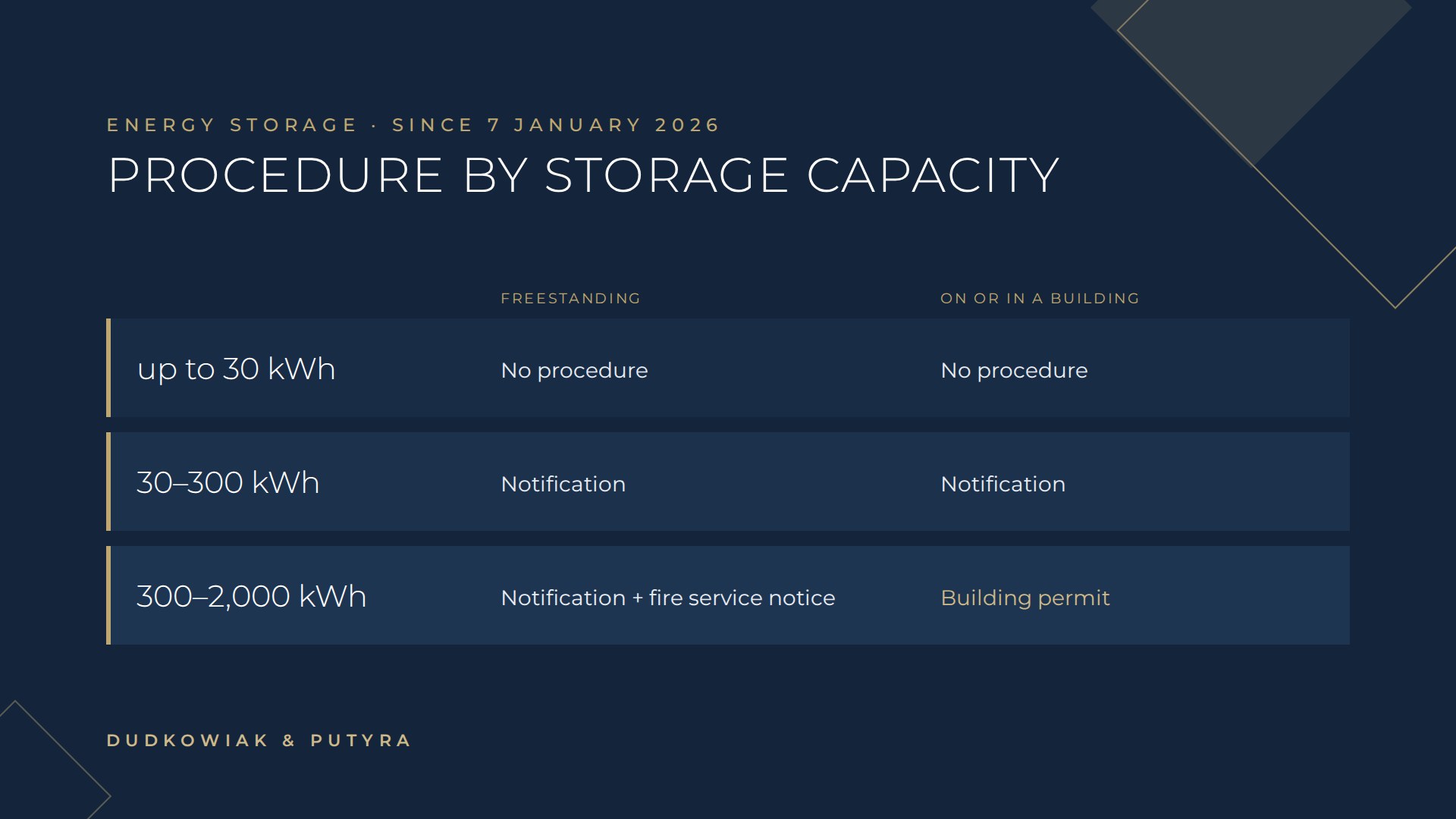
The amendment to the Construction Law of 4 December 2025, in force since 7 January 2026, introduced separate rules for electricity storage facilities. The procedure depends on the nominal capacity and on whether the storage is freestanding or installed on or in a building.
| Nominal capacity | Freestanding storage | Storage on or in a building |
|---|---|---|
| Up to 30 kWh | No procedure | No procedure |
| 30–300 kWh | Notification with a land-use plan approved for fire safety | Notification with technical documentation by a licensed designer, approved for fire safety |
| 300–2,000 kWh | Notification with a land-use plan and an architectural and construction design approved for fire safety; notice to the State Fire Service of completion and start of use | Building permit |
In practice: for freestanding storage above 2,000 kWh the notification thresholds no longer apply, so the general building permit rules have to be checked for the specific facility.
Storage projects also need a grid connection; see grid connection for renewable energy projects in Poland.
Building permit for renewable energy projects
The building permit, or a notification, marks the end of the preparatory phase and is the basis for legally starting construction, installation or reconstruction. The law allows a project to be built in phases: the application may cover only selected structures, provided they can function independently.
- Prerequisites. The application usually follows the environmental decision (where required), a zoning basis – a local plan or a final WZ decision – and, on protected soil classes, a decision excluding the land from agricultural production. In practice the design follows the grid connection conditions.
- Application. On paper or electronically via e-Budownictwo, with the construction design, the land-use plan for the plot, the architectural and construction design, the PB-5 statement confirming the right to use the property for construction, a WZ decision where there is no local plan, and proof of stamp duty.
- Parties and deadline. The investor and the owners, perpetual usufructuaries or managers of property within the impact area. The authority must decide within 65 days of a complete application.
- Connection line. The cable section connecting the plant to the grid is built under the simpler notification procedure.
The environmental decision that comes first is covered in the environmental decision for renewable energy projects, and the zoning basis in zoning for renewable energy projects in Poland.
Notification of completion: operation after 14 days
If an installation is a structure but the building permit did not require an occupancy permit – freestanding PV farms above 150 kW, energy storage facilities, some biomass installations – legal operation starts after notifying the building supervision authority.
- Timing. Immediately after the works are finished, before the installation is put into operation and before the licence or the register entry.
- Where and how. To the county building supervision inspector (PINB), also entirely online via e-Budownictwo, with the original construction log, the technical design, the construction manager’s statement of compliance, the as-built survey and any decisions the technology requires.
- Tacit consent. Operation may start 14 days after the notification is delivered, unless the authority objects by decision. A certificate that there are no grounds for an objection allows operation to start at once.
- Objection and appeal. An objection usually follows a material deviation from the building permit. The investor can appeal within 14 days to the provincial building supervision inspector (WINB), then complain to the provincial administrative court and the Supreme Administrative Court.
The greatest simplification for the investor is tacit consent: if the authority does not object within 14 days, the installation may start operating – but a material deviation from the building permit takes that right away.
Occupancy permit: inspection within 21 days
The occupancy permit is the stricter procedure for structures of greater complexity or with a specific legal classification: onshore wind farms, hydropower plants, geothermal installations and biogas or biomass plants classified as industrial and manufacturing buildings (category XVIII). Whatever the technology, it is also needed for partial use and for legalisation.
OCCUPANCY PERMIT · FOUR STEPS
1
Notify the fire and sanitary authorities
Where the design required approval for fire safety or health, the investor notifies the State Fire Service and the State Sanitary Inspection of completion. They have 14 days; silence means no objection.
2
Apply to the building supervision authority
On paper or via e-Budownictwo, with the construction log, the technical design, the construction manager’s statement, the authorities’ positions, the as-built survey and any decisions the technology requires.
3
Mandatory inspection
Within 21 days of a complete application, with 7 days’ notice; the investor or a representative must attend. Inspectors check dimensions, distances, load-bearing elements and installations against the approved design.
4
Decision
Issued by the county building supervision inspector (PINB) – for offshore projects by the provincial inspector (WINB). It can impose conditions of use or minor works; it is valid indefinitely; an appeal is possible within 14 days.
The occupancy permit verifies that the completed facility is safe and fully compliant with the approved design – which makes the inspection within 21 days the most critical stage of the procedure.
The 2026 amendment to the Construction Law
The amendment of 4 December 2025 (Journal of Laws 2025, item 1847), mostly in force since 7 January 2026, did not change the 65-day deadline for the building permit or the competent authorities, but it changed several points that matter for renewable projects.
- Energy storage. New definition and thresholds of 30, 300 and 2,000 kWh – see the storage section above.
- Micro wind turbines on buildings. Up to 3 m with mast: no procedure; 3 to 12 m: notification with a design.
- Fire and sanitary positions. The State Fire Service and the Sanitary Inspection are notified of completion only where the design required their approval.
- Material deviations. Before opening corrective proceedings, the building supervision authority first instructs the investor to bring the works into line with the permit and checks after 60 days.
- Appeals. An appeal against a decision must state the objections, the scope of the request and the evidence supporting it.

Barrister (adwokat), Counsel
Author
Counsel in the real estate practice. For renewable energy investors she secures the property side of construction: leases and green-lease clauses that give the right to use the land for building – the basis of the PB-5 statement – together with land-register entries, mortgages and project financing.

Attorney (radca prawny), Senior Counsel, Head of Real Estate and German Desk
Reviewer
Heads Dudkowiak & Putyra’s real estate practice and reviews the permitting status of buildings and installations in asset and share deals and in acquisitions of property and project companies. Formerly in M&A at Grant Thornton, Deloitte and Baker Tilly; graduate of Adam Mickiewicz University in Poznań; member of the Poznań Chamber of Attorneys-at-Law; works in English, German and Spanish.
Sources and methodology
Legal basis. Act of 7 July 1994 – Construction Law (Prawo budowlane), as amended by the Act of 4 December 2025 amending the Construction Law and certain other acts (Journal of Laws 2025, item 1847; mostly in force from 7 January 2026, the definition of an electricity storage facility from 20 September 2026); Act of 20 February 2015 on Renewable Energy Sources; Act of 17 December 2020 on the Promotion of Electricity Generation in Offshore Wind Farms. Texts: ISAP. Official information: e-Budownictwo (applications and notifications), Chief Building Control Inspector (GUNB) – summary of the 2025 amendment.
State of the law: November 2026. This page is general information, not legal advice; the procedure for a specific project depends on its technology, capacity, mounting and the content of the building permit.
Corrections: none since publication.
FAQ – building permits for renewable energy projects in Poland
Does a solar farm in Poland need a building permit?
Yes, above 150 kW; photovoltaic installations up to 150 kW need neither a building permit nor a notification of construction works, although above 6.5 kW the design must be approved by a fire safety expert.
How long does it take to get a building permit in Poland?
The authority must issue the decision within 65 days of a complete application; the 2025 amendment to the Construction Law did not change this deadline.
Does a solar farm need an occupancy permit?
As a rule no; a freestanding PV farm above 150 kW starts operating after a notification of completion, unless the building permit requires an occupancy permit.
Which renewable projects need an occupancy permit?
Onshore wind farms, hydropower plants, geothermal installations and biogas or biomass plants classified as industrial and manufacturing buildings, and any facility that is to be used in part before all work is finished or is being legalised.
When can I start operating after a notification of completion?
After 14 days from delivery of the notification, unless the authority objects by decision, or immediately if it issues a certificate that there are no grounds for an objection.
How long does the occupancy permit procedure take?
The fire and sanitary authorities have 14 days for their position where the design required their approval, and the building supervision authority must inspect the facility within 21 days of a complete application.
Does an energy storage facility need a building permit?
Since 7 January 2026 storage up to 30 kWh needs no procedure, 30–300 kWh needs a notification, freestanding storage up to 2,000 kWh needs a notification and storage above 300 kWh on or in a building needs a building permit.
Does a small wind turbine need a building permit?
On a building, installations up to 3 m with mast need no procedure and from 3 to 12 m a notification; freestanding micro turbines on the ground generally need a building permit.
Does the grid connection line need a building permit?
No, the cable section connecting the plant to the grid is built under the simpler notification procedure.
Can a renewable project be built in phases?
Yes, the building permit application may cover only selected structures provided they can function independently, and an occupancy permit can then be obtained for each part.
Who issues building permits for offshore wind farms?
The provincial governor, after the PSZW, environmental, geological, PUUK and UUUK decisions and the connection conditions; the occupancy permit is issued by the provincial building supervision inspector.
What happens if construction deviates from the building permit?
A material deviation leads to an objection to the notification of completion and a requirement for an occupancy permit or corrective proceedings; since 2026 the authority first instructs the investor and checks again after 60 days.


