


Written by Natalia Sarna, Barrister (adwokat), Counsel
Reviewed by Wojciech Kasprzak, Attorney (radca prawny), Senior Counsel, Head of Real Estate and German Desk
First published: 9 November 2026
Last updated: 9 November 2026
Quick answer
Where can a wind farm be built in Poland, and which permits does it need?
A wind turbine must stand at least ten times its total height (10H) from homes; a local zoning plan may set a shorter distance, but never less than 700 m. Wind farms can be sited only on the basis of a local zoning plan – never on a WZ decision – and turbines of 30 m or more need an environmental decision, with a full report mandatory above 100 MW.
After construction a wind farm always needs an occupancy permit, and above 1 MW a generation licence from the President of URE. Turbines of 100 m or more are aviation obstacles registered with ULC, MON and MSWiA.
Three things set the schedule of a wind project long before construction. First, a local zoning plan that allows turbines – without one the project needs a new or amended plan, and the municipality is not bound by the investor’s request. Second, at least a year of bird and bat monitoring if the regional environmental directorate demands a full environmental report, which in practice it often does. Third, grid capacity: connection conditions are valid for 12 months, so the agreement has to be signed before the permits are complete.
Wind farms do not benefit from the simplified notification of completion that most other renewables use: the end of construction is a full occupancy permit procedure, with a mandatory inspection within 21 days.
10H / 700 m
minimum distance between a wind turbine and homes
30 m
turbines from this height need an environmental decision
100 m
from this height a turbine is an aviation obstacle
1 MW
above this a generation licence is needed

The path for an onshore wind farm in Poland in seven stages
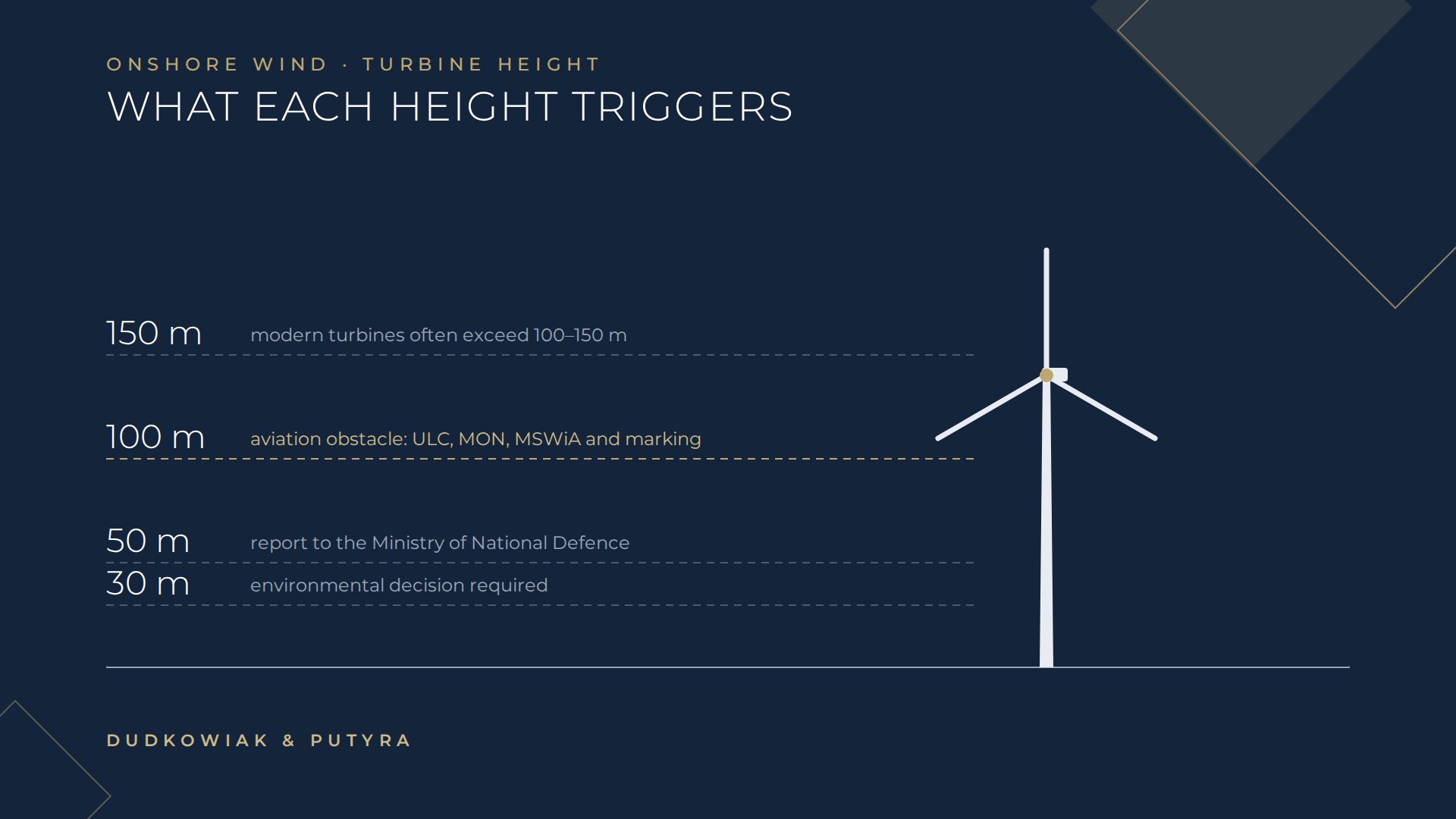
Onshore wind is, alongside solar, one of the most widespread renewable technologies in Poland – and the most formalised one to permit. Modern turbines often exceed 100–150 m in total height, which brings distance rules, aviation requirements and a full occupancy permit procedure. The full investment path is set out in our legal guide to renewable energy investments in Poland.
AN ONSHORE WIND FARM IN POLAND · SEVEN STAGES
1
Site and land rights
Wind potential, geotechnical conditions, the distance rules and protected areas decide the site; title is needed both to the land under each foundation and to the land over which the blades turn. How to secure leases and easements is explained in our guide to site selection and land rights for renewable projects.
2
Environmental decision
Required for turbines of 30 m or more: a KIP below 100 MW, a full report above it, with the regional environmental directorate often demanding a full report and a year of monitoring. The procedure is covered in the environmental decision for renewable energy projects.
3
Local zoning plan
Wind farms can be sited only on the basis of a local zoning plan, which also fixes the distance from homes. Why a WZ decision is never an option is set out in zoning for renewable energy projects in Poland.
4
Grid connection
The application needs operational models of the generators and compliance certificates; above 2 MW the operator assesses the impact on system stability. Fees, the advance and deadlines are in our guide to grid connection for renewable energy projects.
5
Building permit
Issued by the county governor after the final environmental decision and in line with the local plan, within 65 days of a complete application. The application and its attachments are described in building permits for renewable energy projects in Poland.
6
Occupancy permit
No simplified notification: the fire and sanitary authorities give their positions, then the county building inspector inspects the farm within 21 days. The procedure is explained in the section on the occupancy permit.
7
Licence or register
Above 1 MW a generation licence from the President of URE, with the local plan extract, the occupancy permit and the aviation-obstacle registration attached; from 50 kW to 1 MW the MIOZE register. Details are in the licence and MIOZE section of our renewable energy guide.
To check which of these steps a specific project needs, use the permit checker in our renewable energy guide.
The 10H rule and other distance requirements for wind turbines
The Act on Investments in Wind Power Plants sets the distances that decide where turbines can stand. They are checked at the site-selection stage, before any land is secured.
| Distance from | Rule |
|---|---|
| Residential and mixed-use buildings | At least 10 times the total height of the turbine (10H); a local zoning plan may set a shorter distance, but never less than 700 m |
| A new home planned near an existing turbine | At least 700 m, regardless of the turbine’s height |
| Overhead extra-high-voltage power lines | Three times the maximum rotor diameter or twice the total height (2H), whichever is greater |
| National park boundary | At least 10H |
| Nature reserve boundary | At least 500 m |
| National parks, nature reserves, landscape parks, Natura 2000 sites | No turbines inside them |
In practice 700 metres is always the absolute minimum, and with today’s turbine heights the 10H rule usually requires a considerably greater distance from homes.
Local zoning plan only: why a WZ decision is never enough for a wind farm
Wind power plants have a special status in the planning system: they can be sited only on the basis of a local zoning plan (MPZP). This removes the flexibility other renewables have.
- No WZ decision. A wind farm can never be built on a decision on development conditions, even where the municipality has adopted a general plan.
- New or amended plan. Where no plan allows turbines, the investor can ask the municipality to adopt or amend one, but the municipality is not bound by the request. Until the general plan was adopted (deadline 31 August 2026), plans for wind farms could be based on the existing study of land-use conditions.
- ZPI without simplifications. An integrated investment plan is available, but for wind farms none of the procedural simplifications that apply to other renewables: full coordination, consultation and public participation, including on distances.
Siting a wind farm exclusively on the basis of a local zoning plan removes the flexibility other renewable projects have – which is why the planning status of every plot has to be checked before a lease is signed.
Environmental decision for wind farms: monitoring of birds and bats
For onshore wind farms the environmental procedure is particularly extensive, above all because of bird and bat studies.
- 30 m threshold. Regardless of capacity, wind farms with turbines of 30 m or more are projects that may have a significant impact on the environment.
- Below and above 100 MW. Below 100 MW the investor files a project information sheet (KIP) and a full report is prepared only if the authority requires it; above 100 MW a full report is mandatory, or a KIP with a request to set its scope.
- Authority. The commune head, mayor or city president issues the decision after agreeing the conditions with the regional director for environmental protection (RDOŚ).
- Monitoring in practice. At the screening stage the RDOŚ very often requires a full report, with at least a year of pre-construction bird and bat monitoring and noise and shadow-flicker analyses.
Environmental decisions are part of our wider environmental law in Poland practice.
Grid connection for onshore wind farms
Wind farms need detailed technical documentation for the grid connection.
- Application data. Operational models of the generators, their electrical characteristics, active and apparent power, and certificates confirming compliance with Polish and European requirements.
- Impact assessment. Above 2 MW the distribution or transmission system operator assesses the impact of the connection on the stability and operational safety of the system.
- 12 months. Connection conditions are valid for 12 months; without a connection agreement in that time, the reserved capacity is lost.
Wind turbines as aviation obstacles: ULC, MON and MSWiA
Because of their height, wind turbines must be reported to military and civil aviation safety registers.
| Turbine height above ground | Obligation |
|---|---|
| 30 m or more | Environmental decision required (see above) |
| 50 m to under 100 m | Electronic report to the Ministry of National Defence (MON) register at least 2 months before the turbine reaches 50 m |
| 100 m or more | Aviation obstacle: registration with the President of the Civil Aviation Authority (ULC), MON and the Ministry of the Interior and Administration (MSWiA), and certified day and night obstacle marking |
Building permit and occupancy permit for wind farms
Most renewable technologies end construction with a simple notification. Wind farms do not: because of their complexity and scale, they always need an occupancy permit.
- Building permit. Issued by the county governor once the environmental decision is final, compliance with the local plan is established and, where needed, the land has been excluded from agricultural production.
- Occupancy permit. There is no notification of completion. The investor applies to the county building inspector (PINB), which inspects the farm within 21 days of a complete application; the State Fire Service and the State Sanitary Inspection give their positions first where the design required their approval.
Safe operation of wind farms: UDT and URE
Operating a wind farm comes with technical supervision obligations, in particular for turbines above 50 kW.
- UDT-registered service providers. Periodic inspections, maintenance and repairs must be carried out by entities with the appropriate licences listed in the register of the Office of Technical Inspection (UDT).
- URE penalties. Using unauthorised service providers or missing inspection deadlines can lead to a fine imposed by the President of URE.
- Contracts for operation. Service, control and monitoring contracts decide who bears the cost of a turbine standstill – including lost generation – and should be negotiated with that risk in mind.
A breach of the turbine-servicing obligations – using unauthorised entities or missing inspection deadlines – may lead to a financial penalty imposed by the President of the Energy Regulatory Office.
Small and micro wind installations
Smaller wind units follow a lighter regime, depending on their capacity.
| Micro-installation up to 50 kW | Small installation above 50 kW up to 1 MW | |
|---|---|---|
| Distance rule | Does not apply | Applies: at least 700 m from homes, sited in a local zoning plan |
| Environmental decision | As a rule not required up to 30 m total height | As for wind farms (from 30 m) |
| Construction | On a building: up to 3 m with mast no procedure, 3–12 m notification; on the ground as a rule a building permit | Building permit and occupancy permit |
| Generation | No licence and no MIOZE entry; notice to the grid operator | MIOZE register instead of a licence |
Case study: liability for turbine control failures
One matter from our files. Client details are generalised.
CASE · WIND FARM OPERATION · 2025–2026
Defending a wind-farm control system supplier against a lost-profits claim
Dudkowiak & Putyra is defending the Polish company of a Danish group that supplies control and monitoring (SCADA) systems for wind farms against a claim by a state-owned energy group following control failures at a wind farm. The claim covers materials, lost generation profits and reactive-power charges. Our position is that the exclusion of liability for lost profits set out in the supplier’s offer binds the parties; we also handled the withdrawal from the contract with the subcontractor and the settlement talks. The dispute is ongoing.
What it shows. Once a wind farm is running, the biggest legal exposure often sits in the contracts for its control, monitoring and service: how they allocate liability for lost generation decides who pays when turbines stop.

Barrister (adwokat), Counsel
Author
Counsel in the real estate practice. On wind projects she secures the land a turbine actually needs – the foundation plot, the land easement over the rotor envelope reaching neighbouring plots and the transmission easement for the cable – and the land-register entries and mortgages that the project’s lenders will check.

Attorney (radca prawny), Senior Counsel, Head of Real Estate and German Desk
Reviewer
Heads the real estate practice of Dudkowiak & Putyra. When energy assets change hands, he reviews whether the leases, easements and permits will survive the transaction, and runs the asset or share deal and its bank financing. A transactional lawyer formerly in M&A at Grant Thornton, Deloitte and Baker Tilly; works in English, German and Spanish.
Sources and methodology
Legal basis. Act of 20 May 2016 on Investments in Wind Power Plants (ustawa o inwestycjach w zakresie elektrowni wiatrowych), as amended in 2023 and 2025; Act of 20 February 2015 on Renewable Energy Sources; Act of 10 April 1997 – Energy Law, as amended by the Act of 13 March 2026; Act of 7 July 1994 – Construction Law, as amended by the Act of 4 December 2025; Act of 27 March 2003 on Spatial Planning and Development, as amended in 2023 and 2026; Act of 3 October 2008 on environmental impact assessments; Act of 3 July 2002 – Aviation Law; Act of 21 December 2000 on Technical Inspection. Texts: ISAP. Official information: ure.gov.pl (licences), ulc.gov.pl (aviation obstacles), udt.gov.pl (technical inspection).
Own data. Dudkowiak & Putyra’s real estate practice as of 25 September 2026: 60 matters in construction law and the investment process (including PV and energy), planning and environment opened in the four years to that date, counted by the subject of each matter, with matters for the same client counted separately; over 450 clients from 44 countries since 2014, over 75% of them foreign.
State of the law: November 2026. This page is general information, not legal advice; the requirements for a specific wind project depend on the turbine height, capacity, site and the local zoning plan.
Corrections: none since publication.
FAQ – onshore wind farms in Poland
How is the total height of a wind turbine measured for the 10H rule?
From ground level to the highest point of the structure, including its technical elements – in particular the rotor with the blades, so in practice to the tip of a blade at its highest position.
Which regions of Poland have the best wind conditions?
Among others the Baltic coast, including the island of Wolin and the north of the Pomeranian Voivodeship, the northern Suwałki region and Podlasie, central Greater Poland, southern Kuyavia, Mazovia, the Beskids and the Bieszczady Mountains.
Can a foreign company buy land for a wind farm in Poland?
Wind farms are usually built on leased land secured with easements; buying agricultural land is restricted by the Act on Shaping the Agricultural System, and investors from outside the EEA and Switzerland generally need a permit from the Minister of the Interior to acquire real estate.
How long is the environmental decision for a wind farm valid?
It can be used for the next stages within six years of becoming final, extended to ten years if the authority confirms before the six years run out that its conditions remain valid.
How long does the environmental procedure for a wind farm take?
The statutory 1–2 months exclude opinions, consultations and the time to prepare a report; where a full report with a year of bird and bat monitoring is required, the procedure takes well over a year.
Can a wind farm sell electricity before it receives a licence?
Yes, during technical commissioning energy may be sold, stored and offered on the balancing market for up to 12 months before the generation licence is granted.
Can a wind farm share a grid connection with a solar farm?
Yes, under cable pooling a new source can be connected through an existing connection, and sources connected this way are exempt from the application fee and the advance on the connection fee.
Does the municipality’s general plan matter for a wind farm?
Yes, since the planning reform a new or amended local zoning plan must be consistent with the municipality’s general plan, so the general plan has to allow the use first.
Can a building permit for a wind farm be transferred to a buyer?
Yes, with the consent of the party it was issued to, provided the buyer accepts all its conditions and shows the right to use the land for construction purposes.
How long is the occupancy permit for a wind farm valid?
Indefinitely; the building supervision authority may, however, set conditions of use or make use dependent on completing specific works by a set date.


