


Written by Natalia Sarna, Barrister (adwokat), Counsel
Reviewed by Michał Puk, Barrister (adwokat), Supervising Partner (Commercial and Regulatory)
First published: 30 October 2026
Last updated: 30 October 2026
In short
When a renewable energy project in Poland needs an environmental decision
As of October 2026, a renewable energy project in Poland needs an environmental decision (DŚU) when it crosses the thresholds in the 2019 regulation on projects affecting the environment: a ground-mounted solar farm from 1 ha of built-up area (0.5 ha in or near protected areas), wind turbines from 30 m in total height, an agricultural biogas plant above 0.5 MW and a battery storage site of the same area as solar. Onshore wind farms of 100 MW or more and every offshore wind farm always need a full environmental impact report.
Below the report threshold, the authority decides on the basis of a project information sheet (KIP) whether a full assessment is needed. The decision costs PLN 205 in stamp duty, must be obtained before the building permit and can be used for six years. Since 13 June 2026, repowering an existing wind farm by up to 30% of its capacity can go ahead without a new decision.
Below: the thresholds by technology, KIP or full report, the procedure and its real length, surveys for wind farms, repowering, the main refusal risks and what happens after the decision. The whole investment path is in our guide to renewable energy in Poland.
1 ha
built-up area from which a solar farm or storage site needs a decision (0.5 ha in protected areas)
100 MW
from this capacity an onshore wind farm always needs a full report
6 years
to use the final decision for the next permits; up to 10 if confirmed
+30%
repowering of a wind farm without a new decision, since June 2026
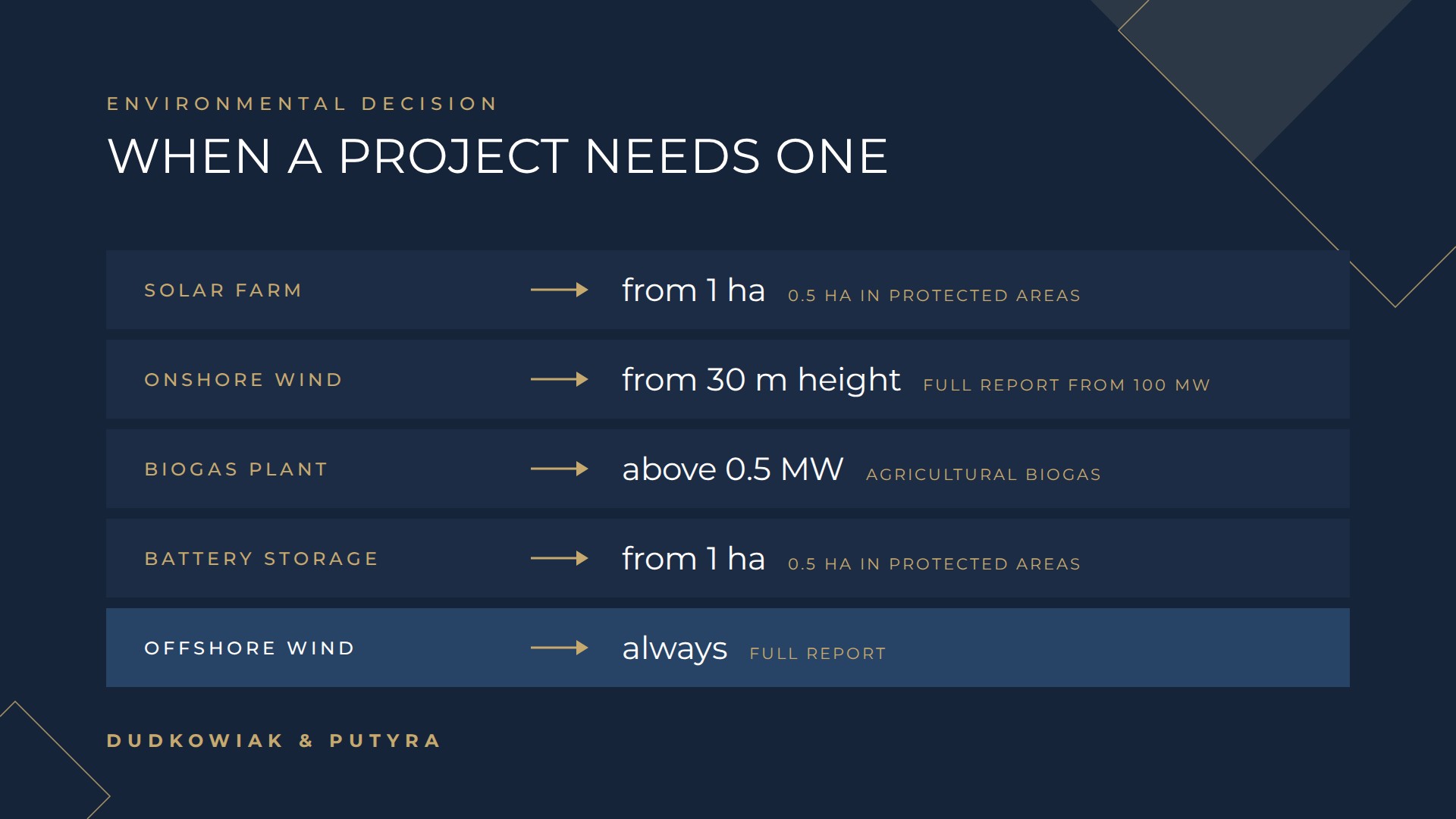
Environmental decision thresholds for renewable energy projects in Poland
The 2019 regulation on projects that may have a significant impact on the environment sorts projects into two groups. Group I projects always have a significant impact and always need a full environmental impact report. Group II projects may have one, so the authority screens them. Below the group II thresholds no environmental decision is needed at all.
| Project | No decision needed | Group II: KIP and screening | Group I: full report |
|---|---|---|---|
| Ground-mounted solar farm | Built-up area under 1 ha (under 0.5 ha in or near protected areas); rooftop and facade systems of any size | From 1 ha (0.5 ha), measured around the outermost modules with roads and stations | – |
| Onshore wind farm | Turbines under 30 m in total height | Turbines of 30 m or more, below 100 MW | 100 MW or more |
| Offshore wind farm | – | – | Always |
| Agricultural biogas plant | Up to 0.5 MW | Above 0.5 MW | Large waste-processing plants |
| Battery energy storage | Built-up area under 1 ha (under 0.5 ha in protected areas) | From 1 ha (0.5 ha) as industrial or storage development, with the accompanying infrastructure | – |
| Hydropower and geothermal | Depends on the plant, the damming structures and the drilling depth | Classified case by case | Large hydropower plants |
ENVIRONMENTAL DECISION CHECKER
Does your renewable energy project need an environmental decision in Poland?
What type of renewable energy project are you developing?
What is the total built-up area (ha)?
For solar, measured around the outermost modules; include internal roads, transformer stations and other infrastructure.
Is the project located in or near a protected area?
For example a national park, nature reserve, landscape park, protected landscape area or Natura 2000 site.
What is the installed capacity (MW)?
What is the turbine height (total height with the blade, m)?
For repowering: which of these apply? Select all that are true.
Suggested next steps
A preliminary classification under the 2019 regulation on projects affecting the environment, as of October 2026. It is not legal advice; the final classification depends on the full project parameters and location. Ask us to confirm it.
The area of a solar farm is measured around the outermost modules and includes internal roads and transformer stations, so the layout drawn for the KIP decides the classification. Where a project falls close to a threshold, check the classification before the land agreements are signed; the site checks are covered in our guide to site selection and land rights for renewable projects in Poland.
KIP or full report: how the environmental assessment works
For a group II project the investor files a project information sheet (KIP) with the application. The authority asks the RDOŚ, the sanitary inspection and, where water is affected, Wody Polskie for their opinions, and then decides by order whether a full assessment is needed. For a group I project, and for a group II project where the authority orders one, the investor prepares an environmental impact report.
- What the KIP contains. The type, scale and location of the project, its land take, the technology, expected emissions and noise, and its relation to protected areas; it is short, but its data decide the classification and the scope of the report.
- What the report contains. Field surveys of the site and its surroundings, alternatives including the most environmentally favourable one, direct, indirect, cumulative and transboundary impacts, mitigation and compensation measures and a non-technical summary.
- Time to prepare the report. The proceedings are suspended while the report is prepared; the investor has up to three years to file it, otherwise the application is treated as withdrawn.
- Agreement of the RDOŚ. Where a full assessment is carried out, the RDOŚ agrees the conditions of the project before the decision is issued; without that agreement there is no decision.

Environmental decision procedure and timing in Poland
The commune head, mayor or city president issues the decision for most renewable projects; the RDOŚ issues it for projects at sea and in closed areas. The statutory deadline is one month, or two months for complex cases, but it does not run while opinions and agreements are being obtained, during public participation or while the investor completes documents.
| Step | Who | What to expect |
|---|---|---|
| Application with KIP or report | Investor | Stamp duty PLN 205; certified cadastral map of the site and its impact area; extract from the local zoning plan or confirmation that there is none; land-register data identifying the parties |
| Opinions on the need for a report | RDOŚ, sanitary inspection, Wody Polskie | Screening order on whether a full assessment is needed and on the scope of the report |
| Public participation | Authority | Where a full assessment is carried out: public notice and at least 30 days for comments; environmental organisations may join the proceedings |
| Agreement of conditions | RDOŚ | Conditions of construction and operation agreed before the decision |
| Decision | Commune head or RDOŚ | Becomes final if no appeal is filed within 14 days |

The statutory one or two months do not include the time needed for opinions, consultations and public participation, so in practice these proceedings take much longer.
Surveys and monitoring for wind farms
Wind farms are the renewable projects most often sent for a full assessment. In practice the RDOŚ expects the report to rest on field data collected over a full annual cycle, so the surveys have to start long before the application.
- Birds and bats. Survey through at least a full year, covering migration, breeding and wintering; the results decide turbine positions and any curtailment periods.
- Noise and shadow flicker. Modelling for the nearest homes, with limits that can shape the turbine type and the operating modes.
- Landscape and cumulative impact. Visual impact and the combined effect with existing and planned wind farms nearby, which the authority must take into account.
- Distance from homes. The 10H rule and the minimum of 700 m sit in the local zoning plan, but the environmental decision checks them again through the noise analysis.
Repowering wind farms without a new environmental decision
Since 13 June 2026 replacing turbines on an existing onshore wind farm no longer counts as a project that may have a significant impact on the environment, provided that four conditions are met together.
ALL FOUR CONDITIONS MUST BE MET
Capacity – grows by no more than 30% of the capacity stated in the environmental decision.
Number of turbines – does not increase.
Location – no turbine moves more than 150 m from the axis of the existing tower.
Forest – the tower axis is, or will be, at least 250 m from the edge of a forest.
Where one of the conditions is not met, the modernisation needs a new environmental decision under the general rules. The distance rules for homes and protected areas still apply in every case.
When the authority refuses an environmental decision
The decision is not discretionary: the authority must issue it if the statutory conditions are met and must refuse it if they are not. Most refusals for renewable projects come from four sources, and each can be checked before the application.
| Refusal ground | What the authority finds | How to check it before applying |
|---|---|---|
| Planning documents | The project is inconsistent with the local zoning plan in force for the site. | Read the plan for every plot of the site and the cable route; for solar on class I–III land, confirm the plan allows it. |
| Natura 2000 | A significant adverse effect on the integrity or conservation objectives of a Natura 2000 site. | Map the distance to Natura 2000 sites and their protected species and habitats; start surveys early. |
| Water bodies | The project would prevent the environmental objectives for surface or groundwater bodies from being met. | Check which water bodies are affected and plan drainage and watercourse crossings early. |
| Missing agreements | The RDOŚ or another cooperating authority refuses to agree the conditions. | Consult the RDOŚ on the scope of surveys and the key conditions before filing. |
In practice: most of these risks show up in the site analysis. A protected area or an inconsistent local plan found before the land agreements are signed costs a change of site; found after the application, it costs the time already spent on surveys.
After the decision: validity, transfer and changes to the project
- Validity. The final decision can be used to apply for the building permit within six years; this extends to ten years if the project is built in stages and, before the six years run out, the authority confirms that the conditions remain valid.
- Transfer to another investor. With the consent of the holder, the authority transfers the decision to a new investor who accepts its conditions, for stamp duty of PLN 105; this matters when a project company or a project is sold.
- Changes to the project. A layout or technology change may require the decision to be amended (stamp duty PLN 205) or a new one, depending on whether the change alters the environmental impact.
- Re-assessment at the building permit stage. Where the decision orders it, where the investor requests it or where the design differs from what was assessed, the environmental impact is assessed again before the building permit.
How the decision fits into the zoning basis and the grid connection is explained in our guide to renewable energy in Poland.
Appeals against an environmental decision
Parties can appeal within 14 days to the Local Government Appeals Board (SKO) or, where the RDOŚ issued the decision, to the General Director for Environmental Protection (GDOŚ). Afterwards a complaint can be filed with the provincial administrative court and a cassation appeal with the Supreme Administrative Court. Environmental organisations that took part in the proceedings may appeal as well.
Appeals and administrative court proceedings can significantly extend the timeline of a project, especially where it attracts public interest or affects protected areas.
What most often goes wrong with environmental decisions
These are the issues that most often delay a renewable project at the environmental stage, and how to avoid each of them.
Layout drawn too large. Roads and stations push a solar farm over the 1 ha threshold.
Measure the built-up area with all infrastructure before the KIP is drafted.
Surveys started too late. The RDOŚ asks for a full year of bird and bat data that has not been collected.
Start surveys as soon as the site is secured, before the application.
Wrong group. The project is filed as group II when the capacity makes it group I.
Confirm the classification against the final capacity and turbine height.
Decision past its use-by date. The six years run out before the building permit application.
Diarise the deadline and apply for the ten-year confirmation in time.
Project changed after the decision. A new turbine model or layout triggers an amendment or a re-assessment.
Describe the project in the application with parameter ranges, not a single model.
Sale without transfer. A project is sold but the decision stays with the old investor.
Make the transfer of the decision a condition of the sale.
How we help
Dudkowiak & Putyra prepares and conducts environmental proceedings for renewable energy projects in Poland: classification of the project, coordination of the KIP and the report with environmental consultants, proceedings before the commune and the RDOŚ, transfers and amendments of decisions, and appeals. See our environmental decisions and permits in Poland.
Who you work with

Barrister (adwokat), Counsel
Author of this guide
Counsel in the real estate practice and author of our renewable energy guide. She checks sites for solar and wind projects, including the planning and environmental constraints that decide whether an environmental decision can be obtained.

Barrister (adwokat), Supervising Partner (Commercial and Regulatory)
Reviewer of this guide
Leads the regulatory, concessions and permits and administrative law practices of Dudkowiak & Putyra, alongside commercial contracts and M&A. Advises on administrative proceedings and appeals before authorities and administrative courts. Law graduate of Adam Mickiewicz University in Poznań; member of the Poznań Bar since 2018.
Sources and methodology
Legal basis. Act of 3 October 2008 on Access to Information on the Environment and its Protection, Public Participation in Environmental Protection and Environmental Impact Assessments (ustawa o udostępnianiu informacji o środowisku…), consolidated text Journal of Laws 2026, item 670; Regulation of the Council of Ministers of 10 September 2019 on projects likely to have a significant impact on the environment, as amended, including by the regulations of 10 August 2023 (Journal of Laws 2023, item 1724) and of 26 May 2026 (Journal of Laws 2026, item 706, in force from 13 June 2026); Act of 16 April 2004 on Nature Conservation; Act of 20 July 2017 – Water Law; Act of 14 June 1960 – Code of Administrative Procedure; Act of 16 November 2006 on Stamp Duty. Texts: ISAP. Official information: RDOŚ Warszawa – fees, Chancellery of the Prime Minister – repowering regulation.
State of the law: October 2026. This page is general information, not legal advice; the classification of a specific project depends on its parameters and location.
Corrections: none since publication.
FAQ – environmental decisions for renewable energy projects in Poland
Does a solar farm in Poland need an environmental decision?
Not if its built-up area, measured around the outermost modules with roads and stations, is under 1 ha, or under 0.5 ha in or near protected areas, and never for rooftop or facade systems; above these thresholds the authority screens it on the basis of a KIP.
When does a wind farm need a full environmental impact report?
Always from 100 MW of capacity; below that, turbines of 30 m or more are screened, and in practice the RDOŚ often asks for a full report with a year of bird and bat surveys.
Does battery energy storage need an environmental decision?
Where the storage site with its accompanying infrastructure covers at least 1 ha, or 0.5 ha in protected areas, it is screened as industrial or storage development.
How long does an environmental decision take in Poland?
The statutory deadline is one or two months, but opinions, agreements, public participation and the report are not counted, so with a full assessment the procedure usually takes many months.
How long is an environmental decision valid?
It can be used to apply for the building permit within six years of becoming final, extended to ten years for projects built in stages if the authority confirms the conditions before the six years run out.
Can an environmental decision be transferred to a buyer of the project?
Yes, with the consent of the holder the authority transfers it to a new investor who accepts its conditions, for stamp duty of PLN 105.


