


Written by Natalia Sarna, Barrister (adwokat), Counsel
Reviewed by Wojciech Kasprzak, Attorney (radca prawny), Senior Counsel, Head of Real Estate and German Desk
First published: 9 November 2026
Last updated: 9 November 2026
Quick answer
How does an offshore wind farm get built in Poland?
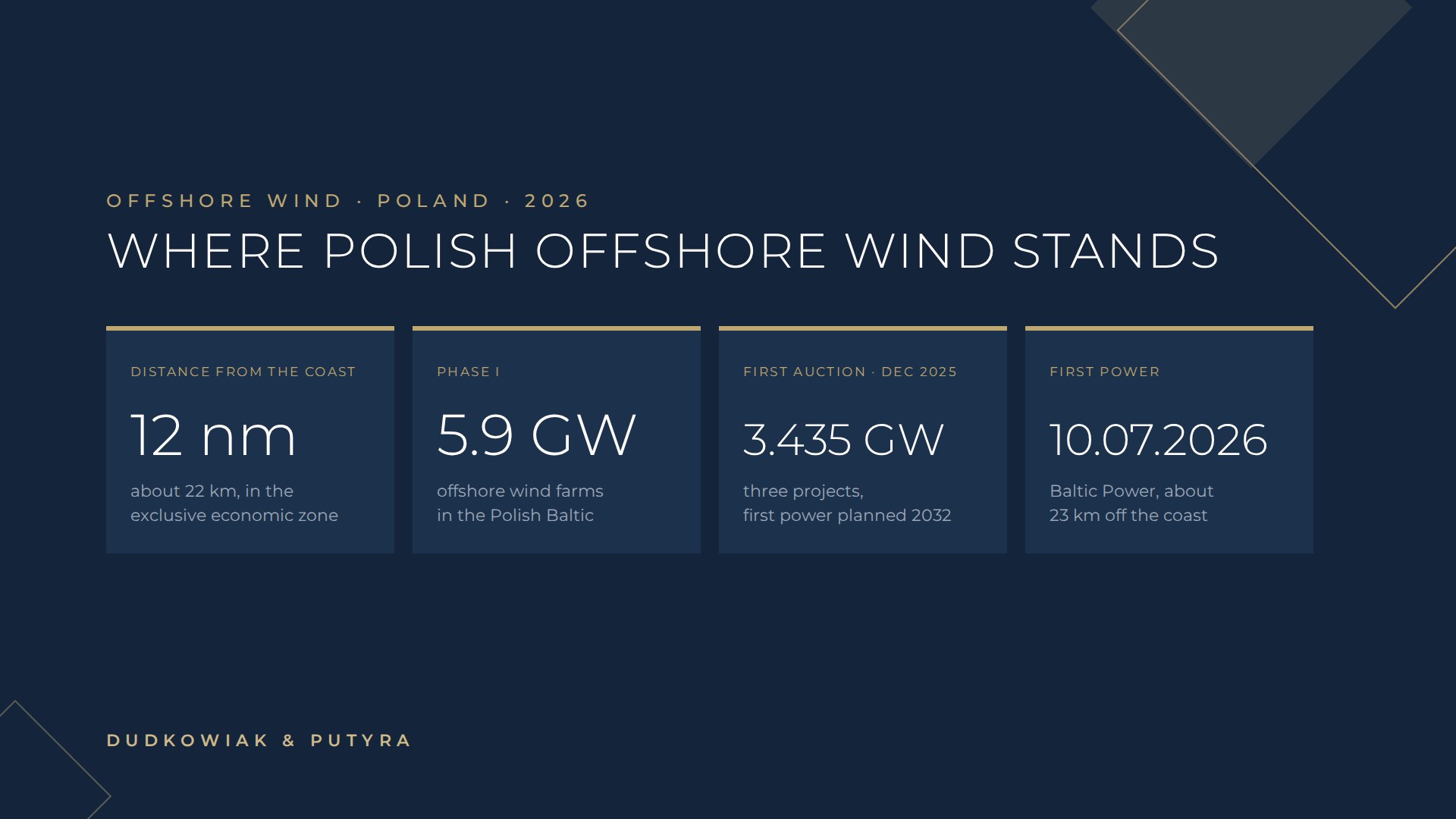
Polish offshore wind farms may be located only in the exclusive economic zone, at least 12 nautical miles (about 22 km) from the coast, and only in areas designated for wind energy in the maritime spatial plan. In place of a right to land, the investor needs a permit for the construction and use of artificial islands, structures and installations in Polish maritime areas (PSZW) from the minister responsible for maritime affairs, followed by an environmental decision from the regional environmental directorate, cable permits, geological decisions and safety approvals.
The building permit is issued by the provincial governor, the occupancy permit by the provincial building inspector, and the generation licence – for 10 to 50 years – by the President of the Energy Regulatory Office (URE). Support takes the form of a two-way contract for difference awarded in auctions; the first auction, held on 17 December 2025, awarded 3.435 GW.
The practical bottlenecks sit before construction. The PSZW permit is the gateway to everything else, and competing applications for the same area are decided in a scored procedure. Under the support scheme, preliminary connection conditions are valid for two years, extendable once, and become binding only after the project wins the right to offset a negative balance. And the building permit cannot be applied for until the full set of offshore decisions – environmental, geological, cable and safety – is in place.
The first Polish offshore wind farm, Baltic Power, fed its first electricity into the grid on 10 July 2026, around 23 km off the coast near Łeba and Choczewo.
12 nm
minimum distance from the coast – about 22 km
5.9 GW
of phase I offshore wind farms in the Polish Baltic
3.435 GW
awarded in the first offshore auction in December 2025
10–50 years
term of the generation licence
The path for an offshore wind farm in Poland: eleven decisions
Offshore wind is far more demanding than wind on land – technically, logistically and legally. Turbines stand in a harsh marine environment, electricity reaches the shore through subsea cables, and the whole project is overseen by maritime, environmental, defence and energy authorities. The full renewable investment path is set out in our legal guide to renewable energy investments in Poland; onshore projects follow a different regime, described in onshore wind farms in Poland.
AN OFFSHORE WIND FARM IN POLAND · ELEVEN DECISIONS
1
Site in the maritime plan
Only areas of the exclusive economic zone designated for wind energy in the maritime spatial plan qualify; water depth currently dictates fixed foundations.
2
PSZW permit
Issued by the minister responsible for maritime affairs after opinions of other ministers; competing applications are decided in a scored procedure.
3
Environmental decision
Issued by the regional environmental directorate after a full environmental impact report covering the farm and its cables. How the procedure works on land is explained in the environmental decision for renewable energy projects.
4
Grid connection
Directly, or through preliminary conditions and the support scheme; the general rules are set out in our guide to grid connection for renewable energy projects.
5
Cable permits
A permit to lay and maintain cables (PUUK) from the director of the maritime office for internal waters and the territorial sea, and an approval of cable laying in the exclusive economic zone (UUUK) from the minister.
6
Geological decisions
Approval of the geological work plan before seabed surveys, then of the geological and engineering documentation.
7
Safety approvals
Navigation safety expert reports and rescue and spill plans, and opinions on defence and Border Guard systems.
8
Certification and PSE
Design compliance certificate and expert reports for the transmission system operator before work at sea starts.
9
Building permit
Issued by the provincial governor once all earlier decisions are in place. The general rules are described in building permits for renewable energy projects in Poland.
10
Occupancy permit
Issued by the provincial building inspector after a mandatory inspection, with the certificate of operational approval attached.
11
Generation licence
Granted by the President of URE for 10 to 50 years after the farm is built and connected. Details are in the licence section of our renewable energy guide.
An offshore wind farm affects shipping, the environment and national security, which is why every stage of the project is subject to strict oversight by maritime authorities and other institutions.
Offshore wind in Poland in 2026: from phase I to auctions
Polish offshore wind has moved from planning to operation. Phase I projects, supported through decisions on the right to offset a negative balance issued before the auction system, total about 5.9 GW; phase II is supported through auctions.
| Milestone | Status |
|---|---|
| Phase I (pre-auction support) | About 5.9 GW of offshore wind farms in the Polish Baltic |
| First electricity | Baltic Power (around 1.14 GW, 76 turbines), about 23 km off the coast near Łeba and Choczewo, fed its first power into the grid on 10 July 2026; full operation is planned for the fourth quarter of 2026 |
| First offshore auction | 17 December 2025: three of four projects won, 3.435 GW in total, with first generation planned for December 2032 |
Site selection and the maritime spatial plan
The location of offshore wind farms in Poland is strictly limited.
- Exclusive economic zone only. Wind farms may be built only within the exclusive economic zone, which in general means at least 12 nautical miles (about 22 km) from the coast.
- Maritime spatial plan. The Spatial Development Plan for Polish Maritime Areas (PZPPOM) designates the sea areas available for wind energy and, in practice, decides whether an investment is possible; the support scheme covers only locations consistent with the plan.
- Physical conditions. Site selection also depends on technical conditions, above all water depth, which currently dictates fixed foundations on the seabed.
PSZW permit: the offshore equivalent of a right to land
Holding legal title to the site is an absolute condition for any further step. Offshore, that title is not ownership or a lease but a public-law decision.
- Application. Filed with the minister responsible for maritime affairs. It specifies the boundaries of the sea area, the technical parameters of the installation – maximum height, types of support structures and foundations – the internal power grid, the handling of operational fluids and the vessels to be used for installation.
- Opinions. Before deciding, the minister obtains opinions from other ministers, including those responsible for energy, the economy, fisheries and national defence.
- Competing applications. Where several investors apply for the same area, the minister runs a scored selection. A tie is decided by the scores in key criteria, such as experience or the financing structure, or by the ratio of capital expenditure to planned capacity; the results are published in the Public Information Bulletin (BIP).
For offshore installations, the legal equivalent of the right to land is a public-law decision issued in a highly formalised procedure – the PSZW permit.
Environmental decision for offshore wind farms
Offshore wind farms are projects that always have a significant impact on the environment, so a full environmental impact assessment is required.
- Farm and cables together. The requirement covers the wind farm and the whole subsea cable infrastructure. Cables alone would usually be classified only as potentially significant, but because cumulative impacts must be assessed, they are included in a joint environmental decision.
- Report and scoping. A full environmental impact report is required; the investor may file a shorter project information sheet (KIP) with a request to set the scope of the report, and scoping is mandatory where the project may have a transboundary impact.
- Content. Beyond water bodies, marine mammals and birds, the report covers the impact on human health and living conditions, property, historical monuments and the landscape, including the cultural landscape.
- Authority and deadlines. The regional director for environmental protection (RDOŚ) issues the decision under the general deadlines of 1–2 months; the director of the maritime office must give an opinion within 14 days and the scoping decision is issued within 30 days.
- Accelerated renewables areas. The Act of 9 October 2025 added a chapter on plans for areas of accelerated renewables development to the Energy Law. Wind installations within such a plan are, as a rule, exempt from the environmental decision; a notification to the RDOŚ applies instead, with 30 or 45 days for an objection. After an objection, the decision is issued within 6 months, extendable by up to 6 months.
Environmental decisions are part of our wider environmental law in Poland practice.
Grid connection and support for offshore wind farms
Offshore wind farms connect under the Energy Law, with the special rules of the Offshore Wind Act. The procedure depends on whether the investor seeks support in the form of the right to offset a negative balance – a two-way contract for difference.
| Without support | With support | |
|---|---|---|
| First step | Application for connection conditions | Application for preliminary connection conditions |
| Key attachments | PSZW permit, a statement waiving support and a payment of PLN 60 per kW of connection capacity, besides the general documents | As set out for preliminary conditions |
| Binding effect | Connection conditions oblige the operator to sign a connection agreement | Preliminary conditions set the technical parameters but do not oblige the operator; valid for 2 years, extendable once by 2 years |
| Next steps | Connection agreement | Right to offset a negative balance (auction), then conversion of the preliminary conditions into binding connection conditions by law, then the connection agreement |

- Disputes. If the operator refuses to issue connection conditions, the investor may ask the President of URE to resolve the dispute; the decision can be appealed to the Court of Competition and Consumer Protection.
- Connection agreement. It sets the scope of work on both sides and is the basis for physically connecting the installation to the grid.
Cable permits: PUUK and UUUK
On land, cable routes are secured through transmission easements. At sea there is no private property, so transmitting power from an offshore wind farm needs separate public-law location decisions for the cables: a permit to lay and maintain cables (PUUK) and an approval of laying and maintaining cables in the exclusive economic zone (UUUK). Applications are filed after the PSZW permit and strictly before the building permit application.
| PUUK | UUUK | |
|---|---|---|
| Covers | Cables in internal maritime waters and the territorial sea | Cables in the exclusive economic zone |
| Authority | Director of the competent maritime office | Minister responsible for maritime affairs |
| Opinions | Ministers for energy, climate, environment, internal affairs and defence, and the Internal Security Agency – up to 90 days, silence means no objection; plus the commune head where the cable also runs on land | Same ministers and the Internal Security Agency – up to 90 days, silence means no objection |
| Fee | PLN 1,500, non-refundable; non-payment invalidates the decision | PLN 1,500, non-refundable; non-payment invalidates the decision |
| Validity | Until 30 years after the generation licence becomes final | Until 30 years after the generation licence becomes final |
| Expiry | If cable laying has not started within 10 years, or no licence is obtained within 15 years, of the decision becoming final | Same |
All applications and correspondence go electronically. The documentation includes the route in geocentric coordinates on a nautical chart, a description of the Natura 2000 elements concerned and the connection conditions or agreement; trade secrets can be protected by filing an additional non-confidential copy.
In maritime areas there is no private property, so transmitting power from an offshore wind farm requires separate public-law location decisions for the cables – the PUUK and the UUUK.
Geological decisions for offshore wind farms
Seabed surveys show whether the seabed can carry the foundations and where the cables can run. Both decisions are issued by the minister responsible for the environment under the Geological and Mining Law, with applications filed electronically.
| Decision | When | Validity |
|---|---|---|
| Approval of the geological work plan | Before offshore surveys, including drilling and seismoacoustic surveys; issued after consulting the minister for maritime affairs | Fixed term of up to 5 years |
| Approval of the geological and engineering documentation | After fieldwork and before the building permit application; issued after consulting the director of the maritime office | Indefinite |
Safety, defence and aviation approvals
Because of the strategic nature of Polish maritime areas, the investor must obtain approvals confirming that the farm does not threaten defence, navigation or the state border before applying for a building permit.
- Navigation and marine environment. Three expert reports – on navigation safety, on the Global Maritime Distress and Safety System (GMDSS) and search and rescue (SAR) operations, and on the National Maritime Safety System – plus a personnel rescue plan and a spill response plan, approved by the director of the maritime office after opinions including that of the SAR Service. Expert reports are indefinite but verified 60 days before operation starts; rescue and spill plans are valid for up to 5 years.
- Defence and border. An assessment of the impact on military radar and air traffic control systems, approved by the Minister of National Defence, and an assessment of the impact on Border Guard radar and communications, approved by the minister for internal affairs.
- Aviation obstacles. Turbines of 100 m or more above sea level in Polish territory or the exclusive economic zone are aviation obstacles: they must be marked at the investor’s cost and reported to the registers of the Civil Aviation Authority (ULC), the Ministry of National Defence (MON) and the Ministry of the Interior and Administration (MSWiA). Structures from 50 m to under 100 m are reported to the MON register at least 2 months before reaching 50 m.
Certification and expert reports for PSE
Offshore wind farms have their own certification system, covering preparation, construction and operation of the farm and its transmission system.
| Certificate | When | Validity |
|---|---|---|
| Design compliance certificate | After the construction design and before work at sea | Indefinite |
| Certificate of operational approval | After construction, at least 30 days before operation and feed-in start | Up to 5 years |
| Operational safety certificate | Before the previous certificate expires; application no earlier than 3 months before | Up to 5 years, renewed periodically |
For the transmission grid, the investor also submits two expert reports to the transmission system operator, PSE: a design compliance report before work at sea, and a construction compliance report attached to the application for a temporary operational notification (ION) that allows trial feed-in. Only entities with at least two offshore power infrastructure projects completed in the last 10 years may prepare them.
Building permit and occupancy permit for offshore wind farms
- Building permit. The application needs the full set of decisions: PSZW, environmental, geological, PUUK and UUUK, and the connection conditions. The provincial governor issues the permit – where the project spans two provinces, the one where most of it lies. The permit expires if work does not start within 3 years of it becoming final or is suspended for more than 3 years; an appeal lies to the Chief Building Control Inspector within 14 days.
- Occupancy permit. Filed electronically via e-Budownictwo after construction, separately for each part capable of independent operation if the farm is built in phases. The provincial building inspector (WINB) inspects the project before deciding; key attachments are the construction manager’s statement, the as-built geodetic survey and the certificate of operational approval. The permit is indefinite; an appeal lies to the Chief Building Control Inspector within 14 days.
Generation licence for offshore wind farms
The generation licence is the last step: it authorises the sale of electricity and access to support. It is granted after the occupancy permit and the physical connection to the onshore grid.
- Attachments. Among others the PSZW permit, the occupancy permit, the certificate of operational approval and documents confirming the connection.
- Term and fees. Granted for 10 to 50 years; stamp duty is PLN 616.
- Security and appeal. The President of URE may make the licence conditional on a financial guarantee covering potential environmental damage; an appeal lies to the Court of Competition and Consumer Protection within 14 days.

Barrister (adwokat), Counsel
Author
Counsel in the real estate practice. An offshore wind farm ends on land: she secures the onshore corridor – the cable route across private plots from landfall to the substation, transmission easements and compensation agreed with landowners, and the plots for onshore substations.

Attorney (radca prawny), Senior Counsel, Head of Real Estate and German Desk
Reviewer
Heads the real estate practice of Dudkowiak & Putyra. For foreign suppliers and contractors joining the Baltic supply chain he negotiates leases and purchases of warehouses, yards and offices, and runs acquisitions of property companies. A transactional lawyer formerly in M&A at Grant Thornton, Deloitte and Baker Tilly; works in English, German and Spanish.
Sources and methodology
Legal basis. Act of 17 December 2020 on the Promotion of Electricity Generation in Offshore Wind Farms, as amended by the Act of 9 October 2025; Act of 21 March 1991 on the Maritime Areas of the Republic of Poland and Maritime Administration; Act of 10 April 1997 – Energy Law, including Chapter 7b on plans for areas of accelerated renewables development; Act of 3 October 2008 on environmental impact assessments; Act of 9 June 2011 – Geological and Mining Law; Act of 7 July 1994 – Construction Law; Act of 3 July 2002 – Aviation Law; Regulation of the Council of Ministers of 14 April 2021 adopting the Spatial Development Plan for Polish Maritime Areas. Texts: ISAP. Official information: ure.gov.pl (auctions and licences), Ministry of Climate and Environment – first power from Baltic Power.
Market data. Auction of 17 December 2025 (results published by the President of URE): Gramwzielone.pl, GLOBEnergia; auction schedule: Gramwzielone.pl; Baltic Power: GLOBEnergia, Radio Gdańsk, October 2026.
Own data. Dudkowiak & Putyra’s real estate practice as of 25 September 2026: 60 matters in construction law and the investment process (including PV and energy), planning and environment opened in the four years to that date, counted by the subject of each matter, with matters for the same client counted separately; over 450 clients from 44 countries since 2014, over 75% of them foreign.
State of the law: November 2026. This page is general information, not legal advice; the requirements for a specific offshore project depend on its location, the support route and the decisions already obtained.
Corrections: none since publication.
FAQ – offshore wind in Poland
What is the right to offset a negative balance?
It is Poland’s two-way contract for difference for offshore wind: when the market price is below the price set in the decision or the auction, the generator receives the difference, and when it is above, the generator pays the difference back.
What prices did the first Polish offshore wind auction set?
In the auction of 17 December 2025 the winning bids ranged from PLN 476.88 to PLN 492.32 per MWh, for three projects with 3.435 GW in total.
When are the next offshore wind auctions in Poland?
Further auctions are planned for 2027, with up to 4 GW, and for 2029 and 2031, with up to 2 GW each.
How much electricity will Baltic Power generate?
Up to about 4 TWh a year once fully operational, around 3% of Poland’s current electricity demand, according to its developers Orlen and Northland Power.
How long does an offshore wind project take in Poland?
Typically more than a decade: Baltic Power’s developer filed its first application in 2011, while construction at sea took less than two years.
Does the 10H rule apply to offshore wind farms?
No, the distance rules of the Act on Investments in Wind Power Plants apply to turbines on land; offshore wind farms are sited in the exclusive economic zone under the maritime spatial plan.
Do offshore wind farms pay property tax in Poland?
Offshore wind farms in the exclusive economic zone are exempt from property tax and pay an annual concession fee instead.
Which projects won the first Polish offshore wind auction?
Baltic East (Orlen), Baltica 9 (PGE) and Bałtyk I (Polenergia and Equinor); PGE’s Baltica 1 project, with 896 MW, did not win support.
Where do Polish offshore wind farms connect to the grid on land?
Export cables run to onshore substations of the transmission system operator, PSE; Baltic Power, for example, delivers its power to the new Choczewo substation in Osieki Lęborskie in Pomerania.
How much does an offshore wind farm in Poland cost?
Billions of euros: the budget of Baltic Power, with around 1.14 GW, was estimated at about EUR 4.73 billion.


