



Quick answer
How does export control work in Poland?
Export control in Poland is governed by the Act of 29 November 2000 on trade in strategic goods, as amended with effect from 15 April 2026, and by Regulation (EU) 2021/821. It covers six forms of trade – export, intra-EU transfer, brokering, technical assistance, import and transit – in two groups of goods: armaments (the Polish military list, LU1–LU22) and dual-use items (Annex I to the EU Regulation). The control authority is the minister responsible for the economy; before each individual or global authorisation it collects the opinions of seven ministers and security services (and of the National Atomic Energy Agency for nuclear items), which have 14 days each.
Authorisations are free of charge, filed electronically through the biznes.gov.pl business portal (PIP) and issued as administrative decisions; the official target for a complete application is one month, with the opinion period counted separately. Trade in armaments additionally requires a certified internal control system (WSK), valid for three years. Trading without an authorisation is a crime punishable by 1 to 10 years’ imprisonment and a company penalty of up to PLN 200,000. An MSWiA concession does not replace any of this – it authorises business in Poland, not movement across the border.
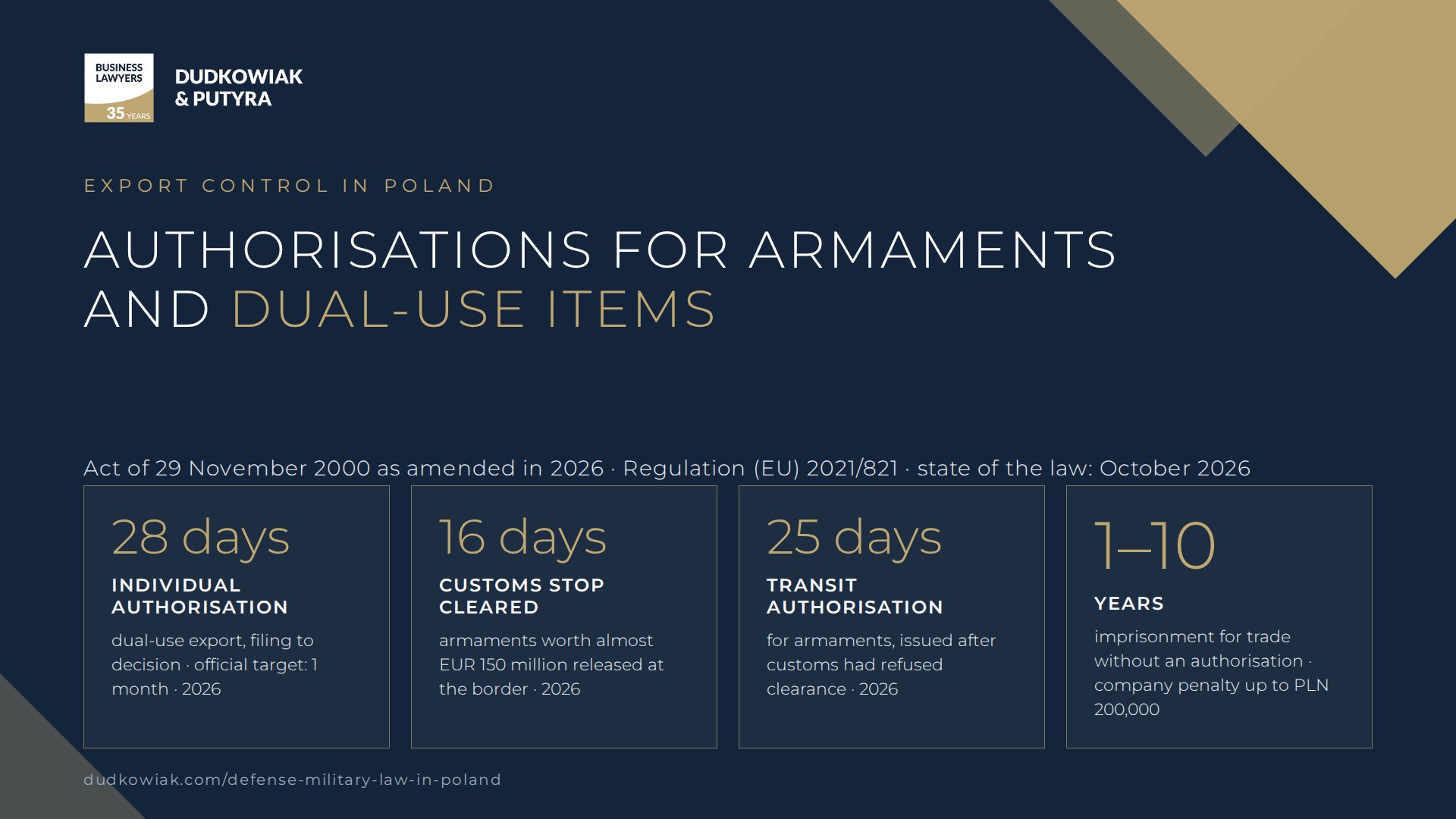
28 daysindividual export authorisation (dual-use items), from filing to decision – Dudkowiak & Putyra, single matter, 2026; official target: one month
16 dayscustoms stop cleared – armaments worth almost EUR 150 million held at the border and released – Dudkowiak & Putyra, single matter, 2026
25 daystransit authorisation for armaments issued after customs had refused clearance – Dudkowiak & Putyra, single matter, 2026
1–10years – imprisonment for trade without an authorisation; company penalty up to PLN 200,000 (Articles 33 and 37)
What export control in Poland covers – the six forms of trade in strategic goods
This page is the overview of export control within our Defense & Military Law in Poland guide. The Polish statute uses one word – obrót, trade – for six different movements and services (Article 3(8) of the Act). Each has its own authorisation rule, and the rules differ for armaments and for dual-use items.
| Form of trade | Definition (Article 3 of the Act; Article 2 of Regulation 2021/821) | Armaments | Dual-use items |
|---|---|---|---|
| Export | Movement from Poland to a country outside the EU customs territory; includes re-export and the transmission or making available of software and technology to a person outside the EU | Authorisation for Annex 1 items of the military list; WSK required | Authorisation for Annex I items; catch-all for non-listed items |
| Intra-EU transfer | Movement from an entity in one Member State to an entity in another without leaving the EU customs territory | Authorisation for Annex 3 items out of or through Poland; transfers into Poland use the dispatch-state authorisation | Authorisation only for Annex IV items; other Annex I items move freely with record-keeping |
| Brokering services | Negotiating, commercial advice, assistance in concluding a contract, participation in movement or transfer between two countries other than Poland | Individual or global authorisation for Annex 1 items | Individual authorisation where the end-use conditions of Article 6 of the Regulation are met |
| Technical assistance | Support for repair, development, manufacture, testing, maintenance or other technical services, including instruction, training, transfer of know-how and consulting | Individual or global authorisation for Annex 1 items | Individual authorisation where the end-use conditions of Article 8 of the Regulation are met |
| Import | Introduction into Poland from a country outside the EU | Authorisation only for Annex 2 items (in 2026 a narrow list of specified LU7 toxic agents) | No authorisation; ABW notification 14 days in advance for 5A001.a, 5A001.b.4 and Category 5 Part 2 items |
| Transit | Movement through Poland between a Member State other than Poland and a third country, or between third countries | Authorisation for Annex 1 items | Individual authorisation only if imposed by the control authority under Article 7(2) of the Regulation; transit may be prohibited |
Three movements that look like trade are outside the authorisation requirement: a sale concluded and performed entirely outside Poland by a foreign company, movements of weapons by private individuals for non-commercial purposes (separate rules), and the transfer of dual-use items between two Polish entities. What is not outside it is the intangible: uploading controlled software for a customer in a third country, giving a non-EU subsidiary access to controlled drawings or sending maintenance instructions to a foreign operator are exports or technical assistance in the statutory sense.
Concession and authorisation are two different permissions. The MSWiA concession is standing permission to manufacture or trade in listed items in Poland. A strategic-goods authorisation permits one movement or service across the border. Where both regimes apply, both permissions are needed, and the authorisation application must declare the concession held (Article 9(6)(1) of the Act).
Armaments and dual-use items – two regimes under one Act
| Criterion | Armaments | Dual-use items |
|---|---|---|
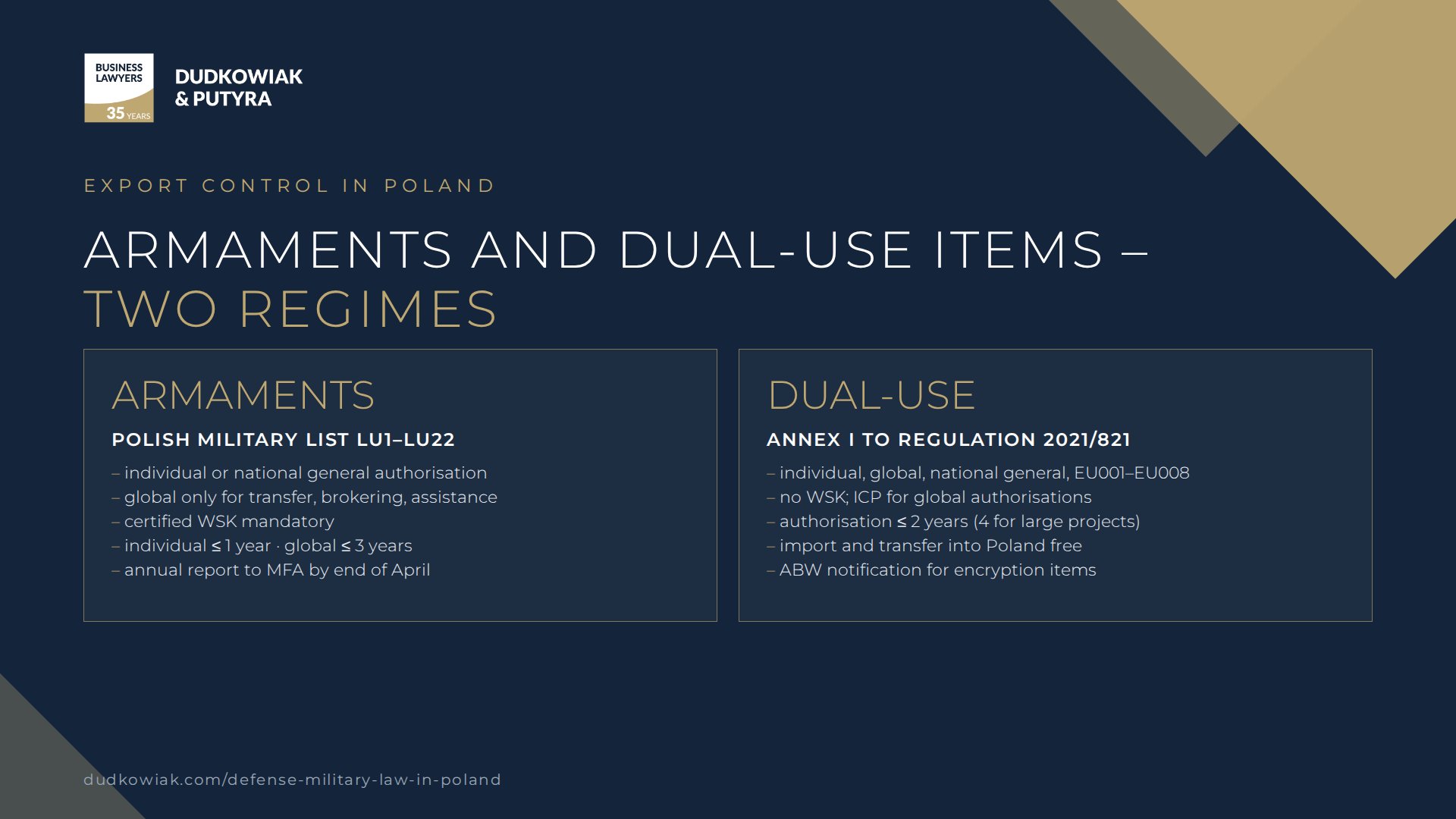
| List | Polish military list, Regulation of the Minister of Finance and Economy (Journal of Laws 2026, item 719), LU1–LU22, three annexes by form of trade | Annex I to Regulation (EU) 2021/821 (categories 0–9); Annex IV for intra-EU transfer |
| Legal source of the control | Polish law (Article 6a of the Act), following the EU Common Military List and Directive 2009/43/EC on intra-EU transfers | EU law applied directly, supplemented by the Polish Act |
| Authorisation types | Individual or national general; global only for intra-EU transfer, brokering and technical assistance (Article 7(2)) | Individual, global, national general (ZG-PL-DU-1) or EU general EU001–EU008 |
| Validity | Individual up to 1 year; global up to 3 years (Article 14(5a)) | Individual and global up to 2 years; large-project authorisations up to 4 years (Article 14(5b)) |
| Internal control system | Certified WSK mandatory for every enterprise applying for an authorisation or using a national general authorisation (Article 11) | No statutory WSK; an internal compliance programme (ICP) is required for global authorisations and for the intra-group general authorisation EU007 |
| Import into Poland | Authorisation for Annex 2 items only | Free; ABW notification for listed telecom and information-security items |
| Intra-EU transfer into Poland | Authorisation of the dispatching Member State is valid in Poland (Article 6a(2)) | Free |
| Refusal grounds | Article 16: defence and security, embargoes and international commitments, internal repression, humanitarian law, regional conflict, diversion risk, reliability of the applicant | Article 15: defence and security, international commitments, reliability, WMD risk; discretionary: diversion risk, prior breaches |
| Annual reporting | Report on actual exports and transfers to the Minister of Foreign Affairs by the end of April (Article 27a) | Annual information for general authorisations by the end of the first quarter (Article 26) |
| Guide page | Trade with strategic goods in Poland | Dual-use goods in Poland |
Which regime applies is a question of classification, and a single product can fall under both: a radar module may be LU5 as part of a military system and 6A008 as a stand-alone civil item. The authorisation is applied for under the list that fits the configuration actually shipped.
The Act treats a Polish exporter of ammunition and a Polish exporter of encryption software under the same procedure, but not under the same conditions. The first needs a certified WSK before the application is complete; the second does not. Knowing which side of the line you are on saves three to six months.
Types of export authorisation in Poland – individual, global, national general, EU general
| Authorisation | What it covers | How it is obtained | Validity | Typical use |
|---|---|---|---|---|
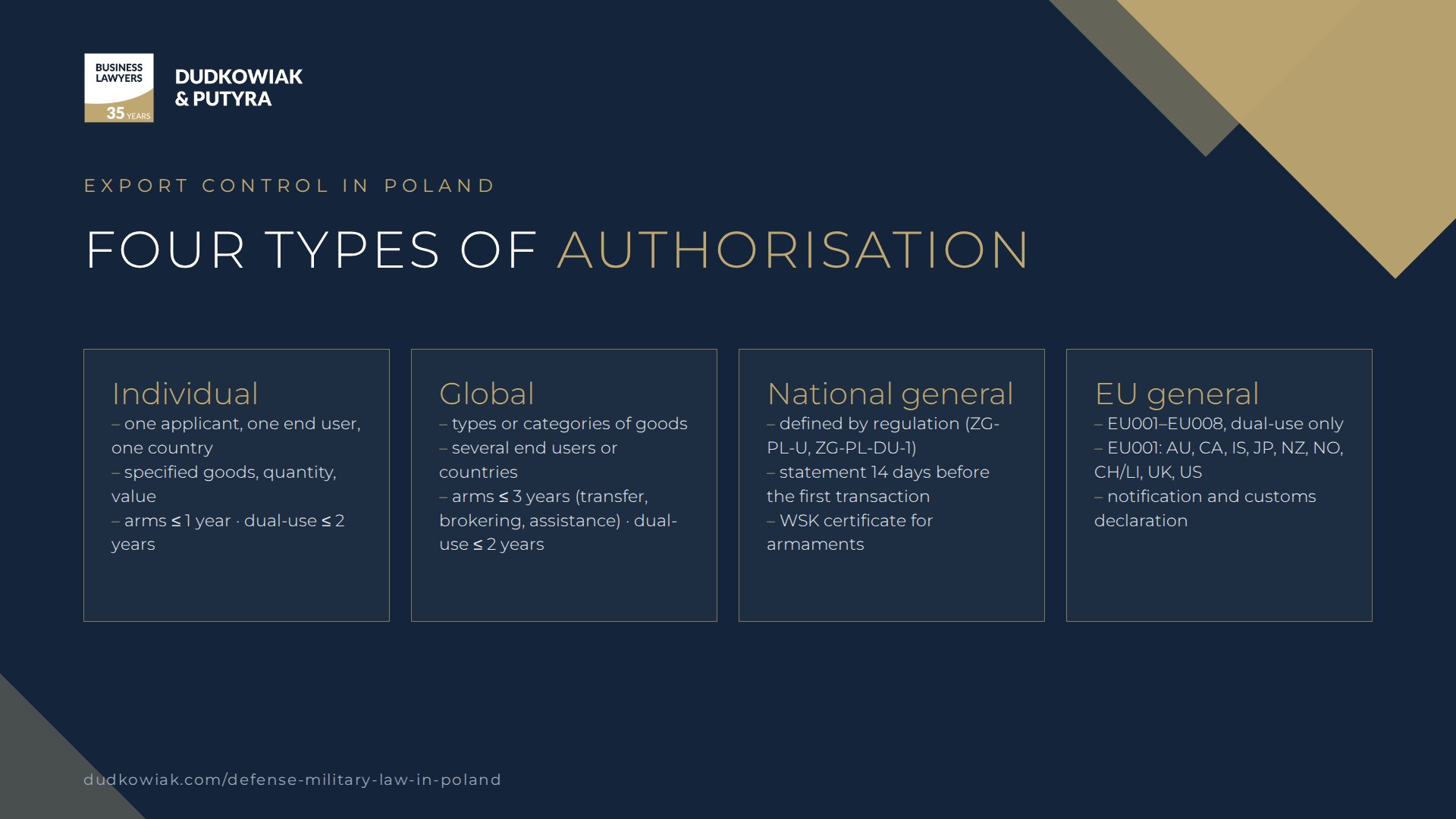
| Individual (zezwolenie indywidualne) | One applicant, one end user, importer or recipient in one country, specified goods of specified quantity and value | Application to the control authority; administrative decision after opinions | Armaments ≤ 1 year; dual-use ≤ 2 years | Standard route for armaments; one-off or project-based dual-use exports |
| Global (zezwolenie globalne) | One applicant, defined types or categories of goods, one or more end users in one or more countries | Application; the authority will look at the applicant’s compliance programme | Armaments ≤ 3 years (transfer, brokering, technical assistance only); dual-use ≤ 2 years, ≤ 4 years for large projects | Recurring flows to known customers; group supply chains |
| National general (krajowe zezwolenie generalne) | Cases, countries, recipients and goods defined in a regulation of the minister responsible for the economy (ZG-PL-U series for armaments; ZG-PL-DU-1 for dual-use exports to Ukraine) | No decision: a statement of the start date filed at least 14 days before the first transaction; WSK certificate attached for armaments; entry in the register | As long as the regulation and the conditions apply | Transfers to EU armed forces, repairs and returns, exhibitions, deliveries to Ukraine – within the exact published scope |
| EU general export authorisation (EUGEA, EU001–EU008) | Dual-use exports defined in Annex II to Regulation 2021/821: EU001 to Australia, Canada, Iceland, Japan, New Zealand, Norway, Switzerland and Liechtenstein, the United Kingdom and the United States; EU002–EU008 for specified goods and destinations | No decision: notification to the control authority within the period set for each EUGEA; declaration in the customs entry | As long as the Regulation provides | Routine dual-use exports to allied markets; not available for armaments |
Two rules decide the choice. First, where a national or EU general authorisation covers the export, it is used instead of an individual one (Article 6(6) of the Act) – but only within its exact scope, exclusions and conditions; a destination, end user or purpose outside the text sends the shipment back to the individual route. Second, a general authorisation never removes the end-use controls: if the exporter is informed or aware of a WMD, military or cyber-surveillance end use, the EUGEA cannot be used and an individual authorisation is required.
How to obtain an individual or global export authorisation in Poland
Procedure · six steps
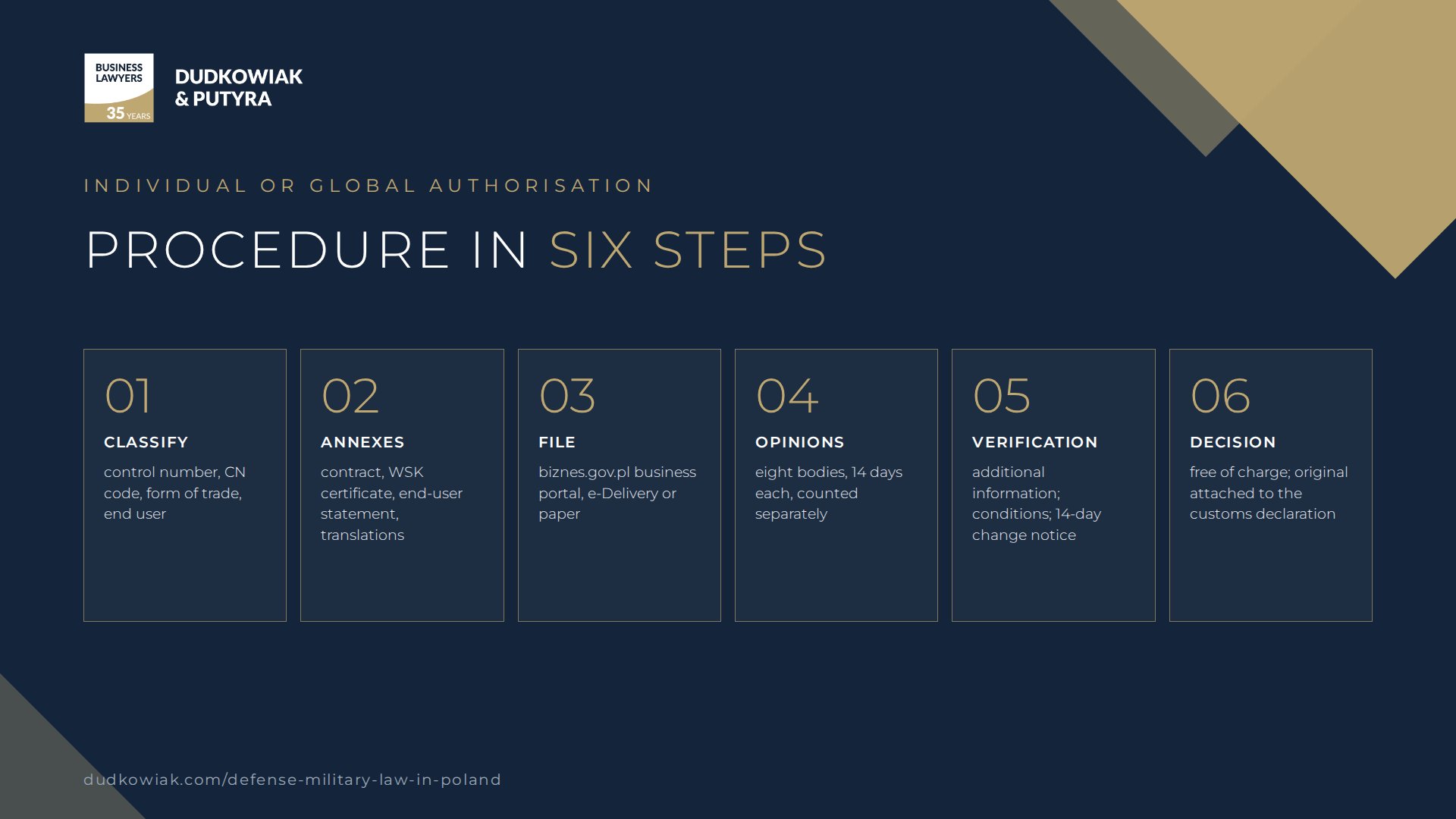
- Classify and define the transaction. Control number (LU or Annex I), CN code, quantity, value and currency, form of trade, country of origin, Member State of customs declaration, end user and end use (Article 9(2)–(5)). Result: the data set for the application form.
- Assemble the annexes. Declaration of concessions held; contract, draft, letter of intent or request for quotation; WSK certificate for armaments; foreign import certificate or end-user statement for export and intra-EU transfer; foreign re-disposition consent where an earlier undertaking requires it; sworn Polish translations with a declaration that the originals are held (Article 9(6)–(7)). Result: a complete file.
- File electronically. Through the biznes.gov.pl business portal (PIP), on the e-Delivery address or on paper (Article 9(7a)–(7b)); the applicant chooses electronic or paper communication. Result: a registered application.
- Opinions. The control authority asks the opinion bodies – the ministers of foreign affairs, the interior and finance, the heads of SKW, SWW, ABW and AW, and for nuclear items the President of the National Atomic Energy Agency – whether there are grounds for refusal; they have 14 days, not counted in the decision period (Articles 12 and 12a). The authority also checks whether another Member State refused an essentially identical export in the last 3 years and consults it (Article 12b). Result: opinions on file.
- Verification and conditions. The authority may request information verifying the application and may make the authorisation conditional, in particular on an end-user statement or import certificate (Articles 12(3) and 14(4)). Any change in the application data must be reported within 14 days (Article 12(4)). Result: an agreed draft.
- Decision. The authorisation names the goods, parties, value, validity and conditions; it is non-transferable and its original is attached to the customs declaration (Article 14). A refusal may be challenged by a request for reconsideration and then before the Voivodeship Administrative Court in Warsaw. Result: an authorisation entered in the register.
The official target published for a correctly completed application is one month; the 14-day opinion period runs in parallel and may be extended in a complex case under Articles 36–38 of the Administrative Procedure Code. In practice the file is only as fast as its slowest annex – most delays in Dudkowiak & Putyra’s matters arise from an end-user statement that lacks the destination authority’s certification, from a WSK certificate that has not yet been issued, or from a contract whose parties do not match the application.
The ministry does not negotiate with your customer. If the end-user statement is missing one signature from the destination authority, the application waits for the courier from Riyadh or Seoul, not for the Polish official. Start the end-use paperwork the day the contract is initialled.
End-use documents: end-user statement, import certificate, delivery verification
| Document | Who issues it | When it is needed | Key rule |
|---|---|---|---|
| Foreign end-user statement (EUC) | Foreign end user; certified by the foreign importer and the authority of the country of final destination | Polish export or intra-EU transfer of strategic goods (Article 23) | Must contain the undertakings not to retransfer without the Polish authority’s consent and not to supply embargoed destinations; for armaments exported to end users outside the EU (other than the countries in Annex II section A part 2 of the Regulation) the statement is legalised by the Polish consul (Article 23(6)) |
| Foreign import certificate (IC) | Authority of the importing country | Alternative to the EUC for export or transfer | Confirms that the foreign authority has taken the transaction under control |
| Polish import certificate | Polish control authority, on request of the Polish importer (Article 22) | When the authority of the foreign exporter requires Polish end-use assurance – typical for US (ITAR, EAR) and Korean suppliers | Administrative decision; expires if not presented abroad within 12 months (Article 22(6a)); may be refused where the importer has no WSK or no reliability record |
| Certified Polish end-user statement | Polish control authority certifies the statement of the Polish end user (Article 22) | Same purpose as the Polish IC, where the foreign authority asks for a statement rather than a certificate | The Polish authority may commit to the restrictions imposed by the foreign authority (Article 22(1a)) and may refuse later Polish exports if they are breached (Article 22(1b)) |
| Delivery verification certificate (DVC) | Head of the customs office competent for the Polish end user, on request within 30 days of release or receipt (Article 24) | Proof to the foreign authority that the goods arrived in Poland; the Polish authority may demand the foreign equivalent after a Polish export (Article 24(6)) | The applicant bears the customs office’s costs |
| Duty to inform the recipient | Polish supplier | Every delivery of strategic goods from Poland (Article 22(3a)) | Documented information on the authorisation conditions and disposal restrictions, with the number and date of any certified end-user statement; penalty up to PLN 100,000 (Article 37b) |
The 2026 amendment relaxed the formality in one respect: copies or digital reproductions of the EUC or IC may be filed with a declaration, under criminal liability for a false statement, that the originals are held, and the originals must be kept for 5 years from the date of the authorisation (Article 9(6a)–(6c)). The statement may omit some of the undertakings where the destination country participates in the export-control regimes and the item is low-technology and non-lethal or the end user is a state body (Article 23(5)).
WSK internal control system and ICP – certification for trade in armaments
An enterprise applying for an authorisation to trade in armaments, or using a national general authorisation for armaments, must set up and operate an internal system of control and management of trade in armaments – the WSK (wewnętrzny system kontroli, Article 11). The system defines the tasks of corporate bodies and of each position in the control of trade, personnel selection, archiving, internal audit, order execution and training. It is certified for conformity with ISO 9000 and the statutory requirements by an accredited body named in the ministerial regulation; the certificate is valid for 3 years, during which the body conducts three on-site compliance audits. A certificate is attached to every armaments application and to the statement of use of a national general authorisation.
| Criterion | WSK (Polish Act) | ICP (Regulation 2021/821) |
|---|---|---|
| When mandatory | Every enterprise applying for an armaments authorisation or using a national general authorisation for armaments; also a condition of the Polish import certificate and the certified-recipient certificate | Global authorisations for dual-use items (Article 12(4) of the Regulation) and the intra-group general authorisation EU007; recommended for EU008 and otherwise good practice |
| Standard | ISO 9000 plus the statutory elements of Article 11(2) | Commission Recommendation (EU) 2019/1318 on ICPs: management commitment, organisation, screening, transaction review, performance review, records, training, reporting |
| Certification | Mandatory, by an authorised accredited body; certificate 3 years with 3 audits | No certification; assessed by the authority in the authorisation procedure |
| Authorised bodies | Bureau Veritas Polska; Quality Certification Centre of the Military University of Technology (WAT); CeCert; Polish Centre for Testing and Certification (PCBC); TÜV Rheinland Polska; Office of Technical Inspection (UDT) | — |
| Relation to the concession | Separate: a concession does not replace WSK and WSK does not authorise business in Poland | Separate |
An ISO 9001 certificate alone is not the WSK certificate. A newly established Polish subsidiary should plan the WSK before its first armaments contract: the body audits an operating system, not a set of documents, and the certification timetable is not regulated. Dudkowiak & Putyra’s certified WSK auditor builds the system around the company’s actual order flow – classification, screening, authorisation check, release, intangible transfers, records – so that the first audit finds evidence rather than templates.
Import, intra-EU transfer and transit – what still needs a permission in Poland
| Movement into or through Poland | Armaments | Dual-use items |
|---|---|---|
| Import from a third country | Individual authorisation only for items in Annex 2 to the military list (specified LU7 toxic agents in 2026); otherwise no strategic-goods authorisation – but an MSWiA concession for trade in Poland and a Polish import certificate for the foreign exporter’s authority | No authorisation (Article 6c); ABW notification at least 14 days before import for 5A001.a, 5A001.b.4 and Category 5 Part 2 items, with a concession copy attached for information-security items (Articles 21a–21c); penalty up to PLN 100,000 (Article 37a) |
| Intra-EU transfer into Poland | Authorisation of the dispatching Member State is valid in Poland; for transfers under another Member State’s general transfer licence the Polish recipient needs a certified-recipient certificate issued by the Head of ABW for 5 years (Articles 21e–21p) | No authorisation; ABW notification for the Category 5 items above |
| Intra-EU transfer out of Poland | Authorisation for Annex 3 items: individual, global or national general | Authorisation for Annex IV items only; information and record duties for other Annex I items |
| Transit (third country involved) | Authorisation for Annex 1 items, unless an EU transfer authorisation covers the through-Poland leg | No general requirement; the control authority may prohibit transit or impose an individual authorisation (Article 7 of the Regulation; Article 17a of the Act) |
| Customs offices | Export, import and transit of strategic goods are cleared only at the customs offices designated by the Minister of Finance (Article 20) | |
The certified-recipient certificate (świadectwo wiarygodności odbiorcy) is the Polish implementation of the certified-recipient mechanism of Directive 2009/43/EC. It is granted to a Polish enterprise that holds an MSWiA concession for trade in armaments and a WSK certificate, has appointed a senior employee responsible for transfers and exports, and gives the undertakings listed in Article 21h – including the list of armaments contracts of the previous six months. It allows the enterprise to receive armaments from other Member States under their general transfer licences without a transaction-specific authorisation. A separate page on transit through Poland is in preparation; until then, the rules are summarised on Trade with strategic goods in Poland.
Continuing duties and penalties under the Polish export-control regime
| Duty | Deadline or period | Penalty for breach |
|---|---|---|
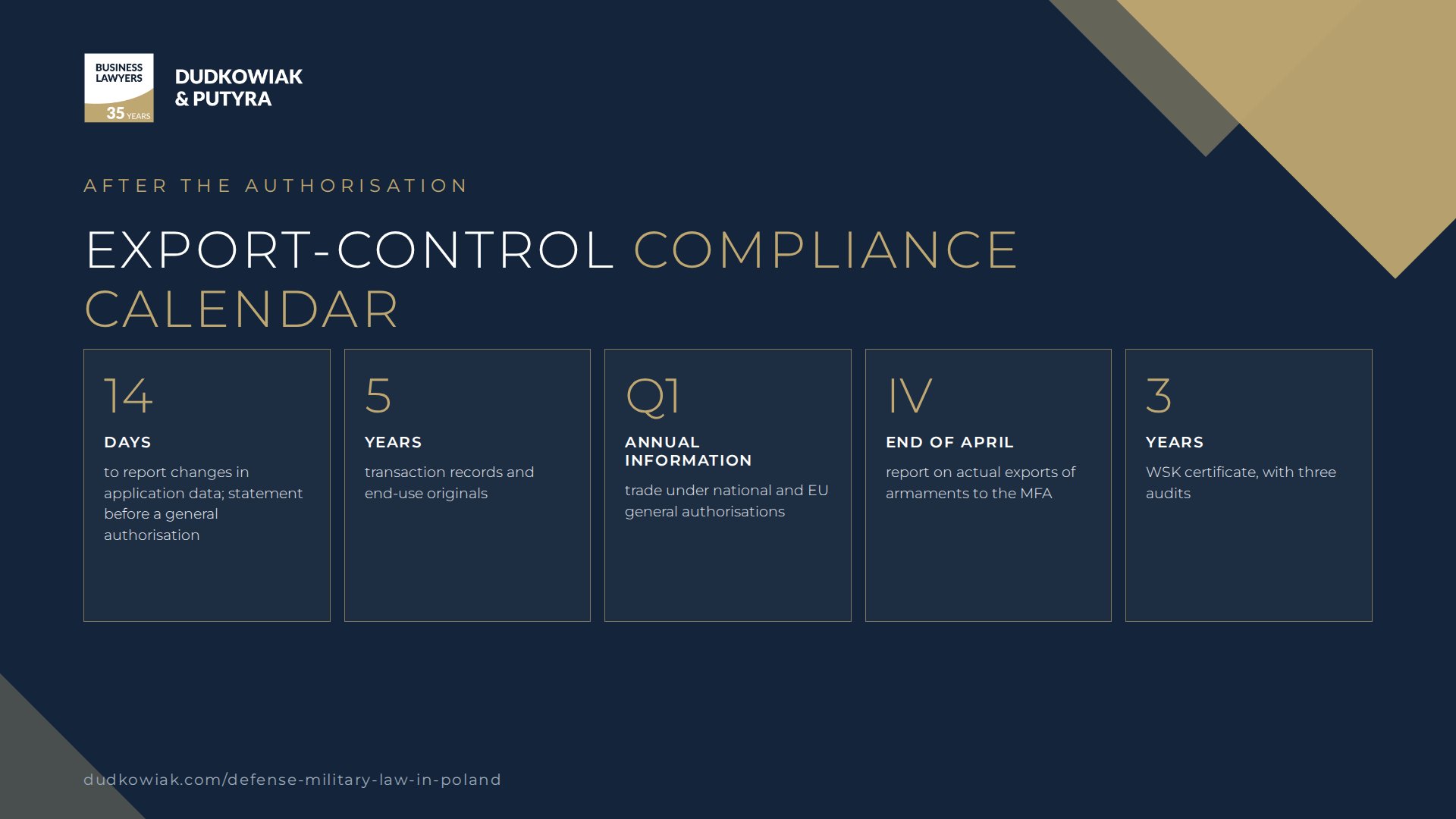
| Report changes to data in an application | 14 days (Article 12(4)) | Up to PLN 100,000 for false or incomplete data (Article 38); criminal liability up to 2 years (Article 33(2a)) |
| Keep records of every strategic-goods transaction – description, quantity, value, dates, parties, end use, proof of information to the recipient and, from 8 October 2026, the authorisation number | 5 years from the end of the calendar year of the transaction (Article 25); on paper, in the ministry’s online register or in an own system | Up to PLN 100,000 (Article 37b) |
| Annual information on trade under national or EU general authorisations (including nil returns) | By the end of the first quarter of the following year (Article 26) | Fine (Article 34); up to PLN 50,000 for a company (Article 39) |
| Annual report on actual exports and intra-EU transfers of armaments to the Minister of Foreign Affairs | By the end of April of the following year (Article 27a) | Up to PLN 100,000 (Article 37b) |
| Statement before first use of a national general authorisation | At least 14 days before the start (Article 8(3)); WSK certificate attached for armaments | Up to PLN 100,000 (Article 37b); refusal to accept the statement |
| Inform the recipient of authorisation conditions and disposal restrictions | With each delivery (Article 22(3a)) | Up to PLN 100,000 (Article 37b) |
| Act on and report irregularities | Without delay (Article 13); restore compliance within one month of a call (Article 31) | Revocation of authorisations; one-year bar on new authorisations |
| Renew the WSK certificate | Every 3 years; three audits in between (Article 11) | Applications incomplete; general authorisation unavailable |
| Trade without an authorisation or contrary to its conditions | — | Imprisonment 1–10 years (Article 33(1)); negligent breach remedied: fine or up to 2 years; company penalty up to PLN 200,000 (Article 37); forfeiture of goods and proceeds |
| Obstructing an inspection | — | Fine (Article 35) |
Inspections are conducted by the control authority with officers delegated by the opinion bodies and may cover the conformity of transactions with the authorisation, the operation of the WSK and the records (Articles 28–30). The inspected company may comment on the protocol within 14 days. A finding of irregularity leads first to a call to restore compliance within one month; only then are authorisations revoked.
Most export-control penalties we see are not for smuggling. They are for the annual return that nobody filed, the shareholder change that nobody reported and the recipient who was never told in writing what he may not do with the goods. The calendar is the compliance programme.
Cost and time of an export authorisation in Poland
Polish lawyers do not publish fee schedules, and Dudkowiak & Putyra quotes each file individually after a scoping call. The official costs are set by law and are low; the time is set by the annexes.
| Item | Amount or period | Source |
|---|---|---|
| Individual or global authorisation | No fee | Article 14(6) of the Act |
| Decision on a complete application | Official target 1 month; opinions 14 days counted separately; extendable in a complex case | Business portal information; Article 12a; Articles 35–36 of the Administrative Procedure Code |
| Binding explanation whether an authorisation is required | The Act sets no fee; 3 months, extendable to 6 | Article 10 |
| Polish import certificate or certified end-user statement | No separate fee under the Act; valid 12 months for presentation abroad | Article 22 |
| Delivery verification certificate | Costs of the customs office reimbursed by the applicant; request within 30 days of release | Article 24 |
| Certified-recipient certificate (ABW) | Issued for 5 years | Articles 21e–21j |
| WSK certification | Fee of the certifying body; certificate 3 years with 3 audits; no statutory turnaround | Article 11 |
| Sworn translations, consular legalisation of the EUC | Per page; consular fee under the Consular Law | Articles 9(7) and 23(6) |
| Legal work | Quoted individually; hourly basis | — |
Which export authorisation do I need? A short test
Test · five questions
Answer the five questions and press Check.
The test indicates the likely authorisation route under the Polish Act and Regulation 2021/821. The exact scope and conditions of each general authorisation, and the classification of the goods, remain fact-specific and are not legal advice.
Export-control work of Dudkowiak & Putyra
Dudkowiak & Putyra has advised on the regulation of explosives, weapons, ammunition and military technology since the early 1990s, and today runs a defence and security team led by two managing partners. Export-control files are handled together with the concession and classification work for the same clients: Polish subsidiaries of foreign manufacturers, distributors, integrators and technology companies that use Poland as a production, repair or logistics base.
What goes wrong in export-control files – the recurring findings. An end-user statement signed by the customer but not certified by its authority. A WSK “in preparation” at the date of an armaments application. A concession scope that does not match the control numbers in the authorisation request. Firmware updates sent to a non-EU operator without anyone treating them as technical assistance. A national general authorisation used for a return shipment that its text does not cover. An annual nil return for an EU001 registration that was never filed. None of these is exotic; each has cost a client weeks or a penalty decision.
A dedicated defence team
Seven lawyers who work on defence, security and dual-use matters, led by two managing partners and supported by a certified WSK auditor and former military and security officials.
Classification, concession, authorisation – one file
The three permissions are prepared from the same classification record, so the scope of each matches the products actually shipped.
End-use paperwork across borders
End-user statements, import certificates, consular legalisation and US re-export conditions are coordinated with the customer’s and the supplier’s authorities.
Clear scope, English-language reporting
The scope and the timetable are agreed before work starts; correspondence with the ministries is conducted in Polish and reported to you in English.
Case studies
Case study · transit of armaments · 2026
Drone components worth almost EUR 150 million released at the Polish–Ukrainian border in 16 days
A consignment of unmanned-aircraft components, exported from another EU Member State to a Ukrainian manufacturer under a valid export licence of the country of dispatch, was stopped by Polish customs at the border with Ukraine: the goods were on the Polish military list and no Polish transit authorisation had been obtained. Dudkowiak & Putyra, engaged by the exporter, the end user, the forwarder and the carrier, joined the customs proceedings, secured an extension of the customs deadline and coordinated the Polish transit application. The goods, worth almost EUR 150 million, were released within 16 days of the stop.
What it shows: an export licence of another Member State does not cover transit through Poland – armaments moving from the EU to a third country across Polish territory need a Polish transit authorisation before the lorry reaches the border; when a shipment is stopped, the customs deadline, not the ministry’s, sets the pace.
Case study · explosives at sea · 2026
Survey vessel held in a Polish port with explosives for unexploded-ordnance clearance at sea
A third-country-flagged survey vessel of a non-EU offshore contractor arrived in a Polish port with explosives and detonators on board, for the disposal of unexploded ordnance on the seabed in Polish maritime areas. The contractor held the Polish permit for the works, but customs refused permission to sail until a decision of the control authority covering the cargo was presented. Dudkowiak & Putyra classified the material as armaments rather than dual-use items, established that the movement was a transit under the Act, and supported the application filed by the Polish subcontractor. The transit authorisation was issued within four weeks of the customs refusal and the vessel returned to operations.
What it shows: a permit to carry out works in Polish waters is not a permit to bring explosives into Poland; the classification of the material (armaments or dual-use) and of the movement (import or transit) must be settled before the vessel enters port, and the ministry will deal only with a Polish applicant.
Case study · counter-drone system · 2026
Regulatory roadmap for a telecommunications infrastructure operator building a counter-drone system
A Polish operator of telecommunications infrastructure planned a system for detecting and neutralising drones around its sites, built from components imported from a non-EU manufacturer together with radio-frequency jamming and signal-takeover effectors. Before the first import, Dudkowiak & Putyra delivered a regulatory roadmap for the project: which classification outcome – armaments, dual-use item or civil product – would trigger the MSWiA concession, a certified WSK and the authorisation requirement for each form of trade, and in what order the certification, concession and authorisation steps have to be taken. The technical classification of the individual components follows, with an external classification expert.
What it shows: for counter-drone equipment the classification decides everything – jamming and takeover effectors sit close to the line between dual-use items and armaments, and the regime (concession, WSK, authorisations) follows the classification, not the civil purpose of the buyer; the import of dual-use items into Poland needs no authorisation, while the same equipment classified as armaments puts the importer under the concession and WSK rules.
Export control training for companies trading through Poland
Most companies first meet the export-control regulator by accident – a customs stop, a question from a bank, a request from a US supplier for an import certificate. Dudkowiak & Putyra trains compliance, logistics and sales teams and management boards on the Polish and EU rules, in English or Polish, online or on site, around the participants’ own products and routes.
Past trainings and webinars
| Date | Topic | Host | Speakers | Materials |
|---|---|---|---|---|
| 9 April 2026 | „Towary o znaczeniu strategicznym bez ryzyka” – obligations of a company trading in dual-use items and arms (online training, in Polish) | Rzeczpospolita | Dudkowiak & Putyra defence team | Summary · Event page |
How we help with export control in Poland
Classification and route
Control numbers, CN code, form of trade and destination; choice between individual, global, national general and EU general authorisations.
Applications
Individual and global authorisations, import certificates, certified end-user statements and delivery verification certificates; filing through the business portal and correspondence with the opinion bodies.
WSK and ICP
Design, implementation and certification of the internal control system; internal compliance programmes for dual-use flows and EU general authorisations.
Intangible transfers
Rules for software, technical data, remote support and group engineering teams; technical-assistance authorisations.
Records and reporting
Transaction records, annual information and armaments reports, registration for general authorisations, change notifications.
Inspections and stopped shipments
Representation during ministry inspections and when customs detains goods for a classification or authorisation question.
Who you talk to first
The first call is always with one of the three partners below. They scope the application, confirm the operating model and stay on the file until the decision is issued.

Michał Dudkowiak
Barrister (adwokat), Managing Partner · Author of this guide
Admitted to the Bar in 2014; graduate of Adam Mickiewicz University in Poznań and holder of a University of Cambridge diploma in British and EU law. Heads the defence and security practice of Dudkowiak & Putyra and advises foreign manufacturers, importers and exporters on concessions, strategic-goods authorisations and the regulatory structuring of defence projects in Poland. Author of the Polish Defence Market Legal Guide 2026 and speaker at Rzeczpospolita’s training on trade in strategic goods (April 2026).

Piotr Putyra
Barrister (adwokat), Managing Partner
Admitted to the Bar in 2019. Advises on defence and strategic-trade law at Dudkowiak & Putyra: concessions, export and transfer authorisations, dual-use classification and the structuring of defence projects.

Michał Puk
Barrister (adwokat), Supervising Partner (Commercial and Regulatory) · Reviewer of this guide
Admitted to the Bar in 2019, Adam Mickiewicz University in Poznań. Represents applicants before MSWiA in concession proceedings, including supplement calls, requests to expedite and amendments, and advises on the corporate side of licensed entities at Dudkowiak & Putyra.
Who works on your file
Depending on the scope, the matter team is drawn from the lawyers below and from the firm’s corporate, tax and employment practices.

Maria Łupicka
Barrister (adwokat), Counsel
Admitted to the Bar in 2025. Advises on regulatory matters in the defence sector and on export, import and transit controls for military and dual-use goods.

Wiktor Galusiński
Lawyer, barrister trainee, certified WSK auditor
Prepares concession and authorisation files and audits internal control systems for trade in armaments.

Tomasz Halec
Lawyer, attorney trainee, defence and dual-use
Drafts applications, supplements and correspondence with MSWiA and MRiT; dual-use and military compliance training.
Technical and military experts we work with
A licence application is not a purely legal exercise. For the premises opinion, the classification of explosives and ammunition, storage design, WSK certification and product conformity we work with authorised certification institutions, explosives and ballistics specialists, former officers of the armed forces and the security services, and former officials of the licensing authorities. Dudkowiak & Putyra coordinates their input so that the client has one point of contact – the defence one-stop shop described on the Defence, Security & Dual-Use practice page, where the full team is presented.
Sources and methodology
Legal basis. Act of 29 November 2000 on foreign trade in goods, technologies and services of strategic importance for state security and for the maintenance of international peace and security (ustawa o obrocie z zagranicą towarami, technologiami i usługami o znaczeniu strategicznym; consolidated text Journal of Laws 2023, item 1582, as amended by the Act of 13 March 2026, Journal of Laws 2026, item 471, in force from 15 April 2026 with Article 25(2)(7) from 8 October 2026; ISAP) – in particular Articles 3 (definitions and six forms of trade), 6–6c and 7 (authorisation requirements), 8 (national general authorisations), 9 (application), 10 (binding explanation), 11 (WSK), 12–12b (opinions and EU consultation), 14 (validity, no fee, non-transferability), 15–17 (refusal and revocation), 20 (customs offices), 21a–21p (ABW notification and certified-recipient certificate), 22–24 (import certificate, end-user statement, delivery verification), 24a–24c (register), 25–27a (records and reports), 28–31 (inspections), 33–39 (penalties); Regulation of the Minister of Finance and Economy on the list of armaments subject to authorisation (Journal of Laws 2026, item 719; ISAP); Regulation of the Minister of Development and Technology on national general authorisations, as amended (ZG-PL-U series and ZG-PL-DU-1, Journal of Laws 2023, item 787); Regulation (EU) 2021/821 of 20 May 2021 setting up a Union regime for the control of exports, brokering, technical assistance, transit and transfer of dual-use items (EUR-Lex), Articles 2–12, Annexes I, II and IV; Directive 2009/43/EC on intra-Community transfers of defence-related products; Commission Recommendation (EU) 2019/1318 on internal compliance programmes; Act of 13 June 2019 on business activity in the manufacture and trade of explosives, weapons, ammunition and products and technology for military or police use (Journal of Laws 2023, item 1743, as amended). Official information: biznes.gov.pl (business portal, electronic filing) and gov.pl.
Own data. The figures in the key-parameters row at the top of this page and in the case studies come from the matter files of Dudkowiak & Putyra: three authorisation and customs proceedings conducted for three clients in 2026. Each figure describes a single matter and is published as an illustration of the procedure, not as an average. Durations are counted in calendar days from the filing of the application – or from the customs stop or refusal – to the decision or release. The recurring findings are drawn from the firm’s matter files and described in general terms without reference to any client. Methodology and versions: DP-Stats.
State of the law: October 2026. This page is general information, not legal advice; the authorisation route for a specific transaction depends on the classification of the goods, the parties and the destination.
Also presented at: online training „Towary o znaczeniu strategicznym bez ryzyka” on trade in strategic goods, dual-use items and arms, organised by Rzeczpospolita on 9 April 2026 and delivered by the Dudkowiak & Putyra defence team (summary, event page).
Corrections: none since publication.
FAQ – export control in Poland
Which authority issues export authorisations in Poland?
The minister responsible for the economy (the control authority), after collecting the opinions of the ministers of foreign affairs, the interior and finance and the heads of ABW, AW, SKW and SWW within 14 days each.
How much does a Polish export authorisation cost?
Nothing – individual and global authorisations are issued free of charge under Article 14(6) of the Act; costs arise only for translations, certificates and legalisation.
How long does an export authorisation take in Poland?
The official target for a complete application is one month, with the 14-day opinion period counted separately; incomplete end-use documents are the usual cause of longer procedures.
Does an MSWiA concession allow me to export?
No; the concession authorises manufacture or trade in Poland, while export, transfer, transit, brokering and technical assistance each require a strategic-goods authorisation.
Do I need WSK to export dual-use items?
No; the certified WSK is mandatory for trade in armaments, while dual-use exports require an internal compliance programme only for global authorisations and the intra-group general authorisation EU007.
Can I export dual-use items to the United States or the United Kingdom without an individual authorisation?
Usually yes, under EU general export authorisation EU001, after notifying the Polish control authority and declaring EU001 in the customs entry – unless an end-use control or an exclusion applies.
Is an authorisation needed to move dual-use items from Poland to Germany?
Only for the items listed in Annex IV to Regulation 2021/821; other Annex I items move within the EU without an authorisation, with records kept and export restrictions passed on to the recipient.
Is sending software or technical data abroad an export?
Yes; transmitting controlled software or technology to a person outside the EU, or making it available to them electronically, is an export, and remote repair instructions may be technical assistance.
How long is a Polish export authorisation valid?
Armaments: an individual authorisation up to 1 year and a global one up to 3 years; dual-use items: up to 2 years, or 4 years for large-project authorisations.
Do I need a permit to import armaments or dual-use items into Poland?
Armaments only for the items in Annex 2 to the military list; dual-use items never, except that listed telecom and encryption items must be notified to ABW 14 days before import.
What is a Polish import certificate and when do I need one?
A decision of the Polish control authority confirming that the import is under Polish control, requested when the foreign exporter’s authority (for example under ITAR or EAR) demands it; it expires if not presented abroad within 12 months.
What are the penalties for exporting without an authorisation from Poland?
Imprisonment of 1 to 10 years for the individual, an administrative penalty of up to PLN 200,000 for the company and forfeiture of the goods and proceeds.


