
Written by Alicja Myśluk-Landowska, Attorney (radca prawny), Partner and Head of Employment and Labor Law
Reviewed by Joanna Stankiewicz, Barrister (adwokat), Senior Counsel
First published: 29 September 2026
Last updated: 29 September 2026
DP-Stats 2026.4
In short
Mobbing claims in Polish courts: what 120 judgments from 2024–2026 show
Dudkowiak & Putyra analysed 120 judgments of Polish common courts issued between January 2024 and September 2026. Each judgment refers to mobbing – the Polish legal term for workplace bullying – or to art. 943 of the Labour Code. In 28 of them an employee brought a mobbing claim against the employer.
All of these cases were decided under the definition of mobbing that applies until 4 November 2026. They show how mobbing claims have been decided so far, and which parts of an employer’s defence the amendment in force from 5 November 2026 removes. The new rules themselves are explained in our guide to mobbing, workplace bullying and harassment in Poland.
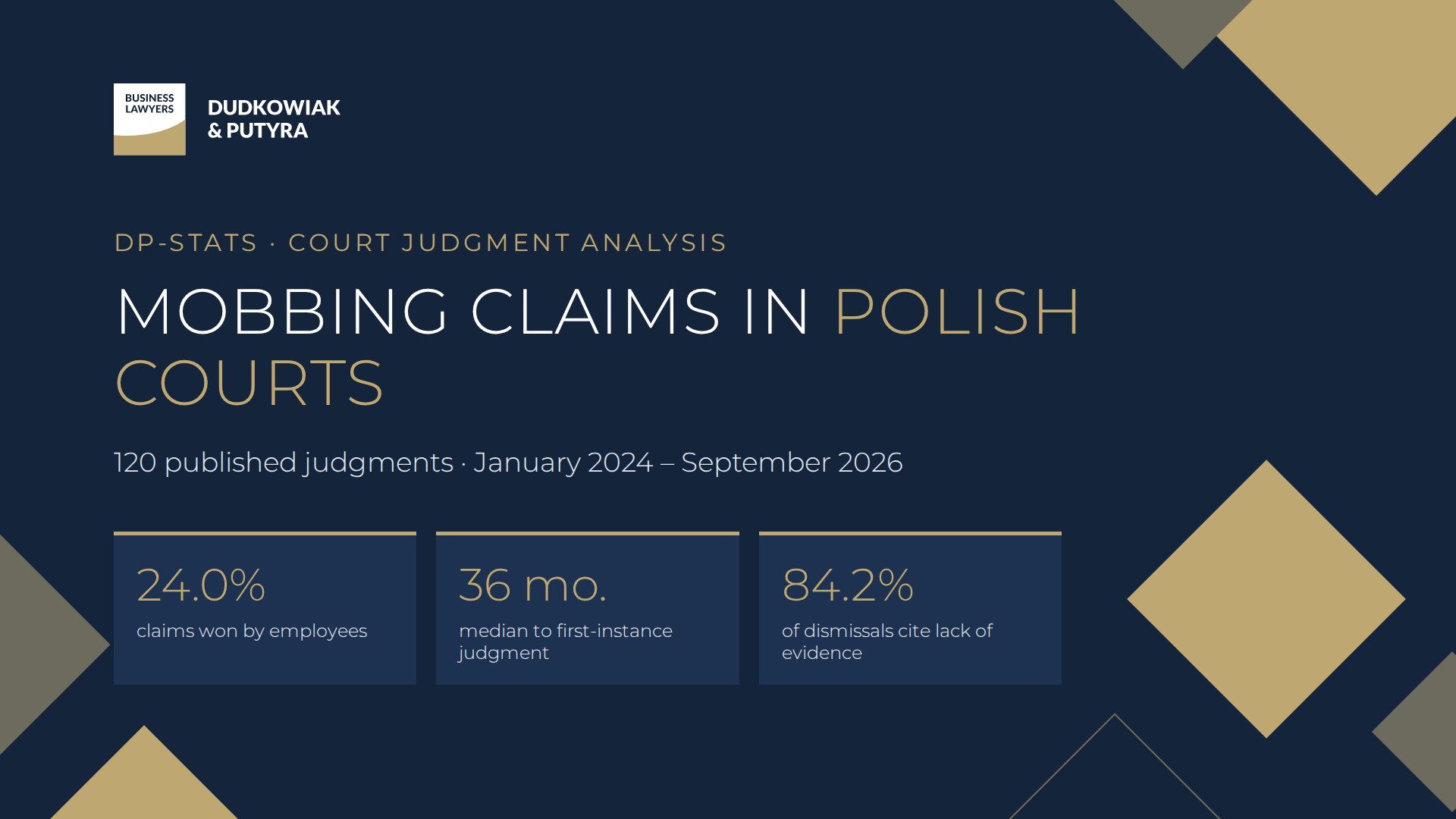
24.0%
of mobbing claims decided on the merits were won by the employee
6 of 25 cases
36 months
median time from filing the claim to the first-instance judgment
16 cases; range 3 to 72 months
PLN 19,750
median compensation awarded in successful claims
6 cases; median claimed: PLN 40,000 (27 claims)
84.2%
of dismissed claims failed, among other reasons, for lack of evidence
16 of 19 cases
Source: Dudkowiak & Putyra analysis of judgments of Polish common courts, January 2024 – September 2026, DP-Stats 2026.4. Method: see below.
Employees won about one mobbing case in four
In the 2024–2026 judgments analysed by Dudkowiak & Putyra, the court upheld the mobbing claim in 6 of the 25 cases decided on the merits, or 24.0%. The other 19 claims were dismissed. In all 6 appeals in the sample, the second-instance court upheld the first-instance judgment.
Why mobbing claims fail: most often, lack of evidence
In the 2024–2026 judgments analysed by Dudkowiak & Putyra, courts dismissed 19 mobbing claims, usually for several reasons at once, so the shares below do not add up to 100%.
Base: 19 dismissed mobbing claims. Source: Dudkowiak & Putyra analysis of court judgments, 2024–2026, DP-Stats 2026.4.
Lack of evidence and ordinary workplace conflict account for most dismissals. Under the rules in force until 4 November 2026 the employee carried the burden of proof throughout, so a claim without documents or witnesses rarely succeeded.
Expert medical evidence decided most successful claims
41.7%
success rate where the court admitted an opinion of a psychiatrist or psychologist (5 of 12 cases)
7.7%
success rate without such an opinion (1 of 13 cases)
In the 2024–2026 judgments analysed by Dudkowiak & Putyra, an expert opinion was present in 5 of the 6 successful claims. The reason is legal rather than tactical: until 4 November 2026 compensation for harm under art. 943 § 3 of the Labour Code required proof that mobbing caused a health disorder, and an expert opinion was the usual way to prove it.
How long a mobbing case takes in Poland
In the 2024–2026 judgments analysed by Dudkowiak & Putyra, the median time from filing the claim to the first-instance judgment was 36 months, based on the 16 cases in which the filing date appears in the reasons. Each dot below is one case.
11 of 16 cases (68.8%) took more than two years and 8 of 16 (50.0%) more than three. In the three cases that also went through an appeal, the total duration was between 4.5 and 7 years.
What employees claimed and what courts awarded
In the 2024–2026 judgments analysed by Dudkowiak & Putyra, the median compensation for harm claimed was PLN 40,000 across 27 claims. In the 6 successful cases employees claimed a total of PLN 302,700 and courts awarded PLN 133,200, or 44.0%; the median award was PLN 19,750. In half of the successful cases the court awarded the full amount claimed.
| Court and year | Sector | Claimed | Awarded |
|---|---|---|---|
| District court, 2024 | Retail | PLN 35,000 | PLN 25,000 |
| District court, 2025 | Private sector | PLN 150,000 | PLN 15,000 |
| District court, 2025 | Education | PLN 3,700 | PLN 3,700 |
| District court, 2025 | Retail | PLN 49,000 | PLN 24,500 |
| Regional court, 2026 (appeal) | Services | PLN 10,000 | PLN 10,000 |
| District court, 2026 | Private sector | PLN 55,000 | PLN 55,000 |
Compensation for harm (zadośćuczynienie) under art. 943 § 3 of the Labour Code. Source: Dudkowiak & Putyra analysis of court judgments, 2024–2026, DP-Stats 2026.4.
Damages under art. 943 § 4, available to an employee who terminated the employment because of mobbing, were claimed less often: the median amount claimed was PLN 12,109 across 11 claims. Three claims for very high amounts – PLN 500,000, PLN 6 million and PLN 1.5 billion – were dismissed or transferred to another court.
AFTER 5 NOVEMBER 2026
In the 2024–2026 judgments analysed by Dudkowiak & Putyra, 5 of the 6 compensation awards were below PLN 28,836 – the statutory minimum for mobbing from 5 November 2026 (PLN 29,700 from 1 January 2027).
What employees complained of, and about whom
In the 2024–2026 judgments analysed by Dudkowiak & Putyra, employees described the following conduct in their claims. One claim usually covers several forms.
Base: 28 mobbing claims.
Employees most often named their direct supervisor. Co-workers were named in fewer than one claim in five – a group the amended definition now names expressly.
Base: 28 mobbing claims; more than one perpetrator may be named in a claim.
Women brought 17 of the 28 claims (60.7%). Private-sector employers were defendants in 15 claims (53.6%) and public-sector employers in 12 (42.9%), including public administration in 6.
Mobbing also appears in other disputes
In the 2024–2026 judgments analysed by Dudkowiak & Putyra, mobbing was a side issue in 71 of the 120 judgments (59.2%), most often in appeals against termination or summary dismissal. In 6 cases the employer had dismissed an employee for committing mobbing. In half of them the dismissed employee obtained compensation or reinstatement, because the employer had not specified the allegations, had not proved them, or had missed the one-month deadline for summary dismissal.
What changes for mobbing claims from 5 November 2026
The judgments show which lines of defence have carried employers so far. The amendment removes several of them.
Arguments that disappear
In 9 of the 19 dismissed claims the court relied, among other reasons, on the absence of a health disorder or of a causal link, and in 3 on the absence of a purpose or effect of humiliation. Neither argument is available under the new definition. Duration is no longer required, although conduct must still be persistent.
Evidence works the other way
Lack of evidence was the most common reason for dismissal. Once the employee makes the breach probable, the employer has to show that no breach occurred, so gaps in the employer’s own records will count against the employer.
Expert opinions matter less for liability
Compensation for harm no longer depends on a health disorder, so claims that failed without an expert opinion may now succeed.
Legitimate management remains a defence
In 14 of the 19 dismissed claims the court found ordinary conflict or criticism within normal management. The Act now states expressly that justified conduct expressed in a proper manner is not mobbing.
Practical conclusions for employers. Document performance decisions against objective criteria; respond to every report and record the steps taken; when disciplining a manager for mobbing, specify the allegations, gather the evidence first and observe the one-month deadline for summary dismissal; and, with at least 10 employees, adopt written anti-mobbing rules by 5 May 2027. The duties are set out in full in our guide to employer duties under the new rules.
Dudkowiak & Putyra’s Employment and Labor Law team – eight lawyers working in employment law only – defends employers in mobbing, harassment and unequal-treatment claims and runs internal investigations. Between January 2022 and September 2026 the team handled 47 mobbing-related assignments for 28 client companies from 18 countries.
Methodology
- Source. Judgments of Polish common courts obtained and analysed by Dudkowiak & Putyra. Only judgments that courts have made public can be analysed, so the sample is not a complete picture of all mobbing cases in Poland.
- Sample. 120 judgments issued between January 2024 and September 2026 that contain the word “mobbing” or refer to art. 943 of the Labour Code. In 28 an employee brought a mobbing claim; in 71 mobbing was a side issue.
- Review. The judgments were reviewed for claims, amounts, dates and outcomes using automated text analysis, with manual verification of selected cases.
- Bases. Win rates and reasons for dismissal were calculated for the 25 employee claims decided on the merits; withdrawn claims, claims transferred to another court and one criminal case were excluded. Duration was calculated for the 16 cases in which the filing date appears in the reasons.
- Figures. Medians, not averages; shares rounded to one decimal place; the number of cases is stated with each figure. Given the small sample, percentages should be read as indicative.
- Law applied. All judgments were given under the definition of mobbing in force before the Act of 19 June 2026 (Dz.U. 2026 poz. 1046), which applies from 5 November 2026.
These figures are published as part of DP-Stats 2026.4, which describes the sources and methods behind all figures in Dudkowiak & Putyra’s guides. They may be quoted with the source named: Dudkowiak & Putyra, DP-Stats 2026.4, analysis of court judgments 2024–2026, published at https://www.dudkowiak.com/employment-law-in-poland/mobbing-in-poland/mobbing-claims-polish-courts. We plan to repeat the analysis once the first judgments under the new definition are published. A version of this analysis, Mobbing Claims in Polish Courts: What 120 Judgments from 2024–2026 Tell Employers Before the New Rules Apply, is also published on Mondaq and Lexology.
Read more
Mobbing in Poland – the new rules | Employment discrimination in Poland | Employment termination in Poland | Employment law in Poland
FAQ – mobbing claims in Polish courts
How often do employees win mobbing cases in Poland?
In the 2024–2026 judgments analysed by Dudkowiak & Putyra, employees won 6 of the 25 mobbing claims decided on the merits, or 24.0%, and all 6 appeals in the sample were dismissed.
How long does a mobbing case take in Poland?
In the 2024–2026 judgments analysed by Dudkowiak & Putyra, the median time from filing the claim to the first-instance judgment was 36 months across 16 cases, and cases that went through an appeal took between 4.5 and 7 years in total.
How much compensation do Polish courts award for mobbing?
In the 2024–2026 judgments analysed by Dudkowiak & Putyra, the median compensation awarded was PLN 19,750 across 6 successful claims, against a median of PLN 40,000 claimed; from 5 November 2026 the statutory minimum is PLN 28,836, and PLN 29,700 from 1 January 2027.
Why do mobbing claims fail in Polish courts?
In the 2024–2026 judgments analysed by Dudkowiak & Putyra, the most common reason was lack of evidence, cited in 16 of 19 dismissed claims (84.2%), followed by ordinary conflict or criticism within normal management in 14 (73.7%).
Does an expert opinion matter in a mobbing case?
In the 2024–2026 judgments analysed by Dudkowiak & Putyra, claims with an opinion of a psychiatrist or psychologist succeeded in 5 of 12 cases (41.7%) and claims without one in 1 of 13 (7.7%), because compensation required proof of a health disorder, which is no longer the case from 5 November 2026.
Who is most often accused of mobbing in Poland?
In the 2024–2026 judgments analysed by Dudkowiak & Putyra, employees named their direct supervisor in 20 of 28 mobbing claims (71.4%), senior management or the board in 18 (64.3%) and co-workers in 5 (17.9%).