1,569 new EU sanctions listings: what should component suppliers and distributors check?
On 12 October 2026, the Council of the EU added 826 Russian defense-industry companies and 743 individuals serving as their CEOs to the EU sanctions list. It is the largest single set of listings in the history of EU sanctions against Russia. For businesses trading in electronics, optics, communication equipment or aviation components, this means an immediate re-screening of counterparties, intermediaries and their beneficial owners.
A record package of listings: what has the Council adopted?
The new listings were adopted under the EU sanctions regime targeting actions that undermine Ukraine’s territorial integrity, sovereignty and independence. The legal basis is Council Decision (CFSP) 2026/2279 and Council Implementing Regulation (EU) 2026/2281 implementing Regulation (EU) No 269/2014. Both acts have already been published in the Official Journal of the EU, so the listings have been binding since 12 October.
The package targets so-called mid-level suppliers – companies which, according to the Council, form the core of Russia’s defense industry. The listed companies supply key components for missiles, drones and aircraft, including:
- electronics – semiconductors, microcircuits and computers,
- communication equipment – radars, antennas and transceivers,
- aviation, satellite and missile systems,
- explosives and ammunition,
- optics and navigation systems.
Together, they generate at least EUR 20 billion in annual turnover and employ more than 250,000 people. Following the update, the list under this regime comprises close to 4,600 entries.
Some media outlets refer to the new acts as the “22nd sanctions package”. However, the Council’s press release refers only to a package of listings and announces neither new trade restrictions nor changes to Annex IV to Regulation 833/2014.
The 50% rule: why checking the counterparty’s name is not enough
Listed persons and entities are subject to an asset freeze and a prohibition on making funds or economic resources available to them, directly or indirectly. Natural persons are also subject to an EU travel ban. In practice, the prohibition covers every transaction: the delivery of goods (including civilian goods), payments, services and the performance of contracts concluded before 12 October.
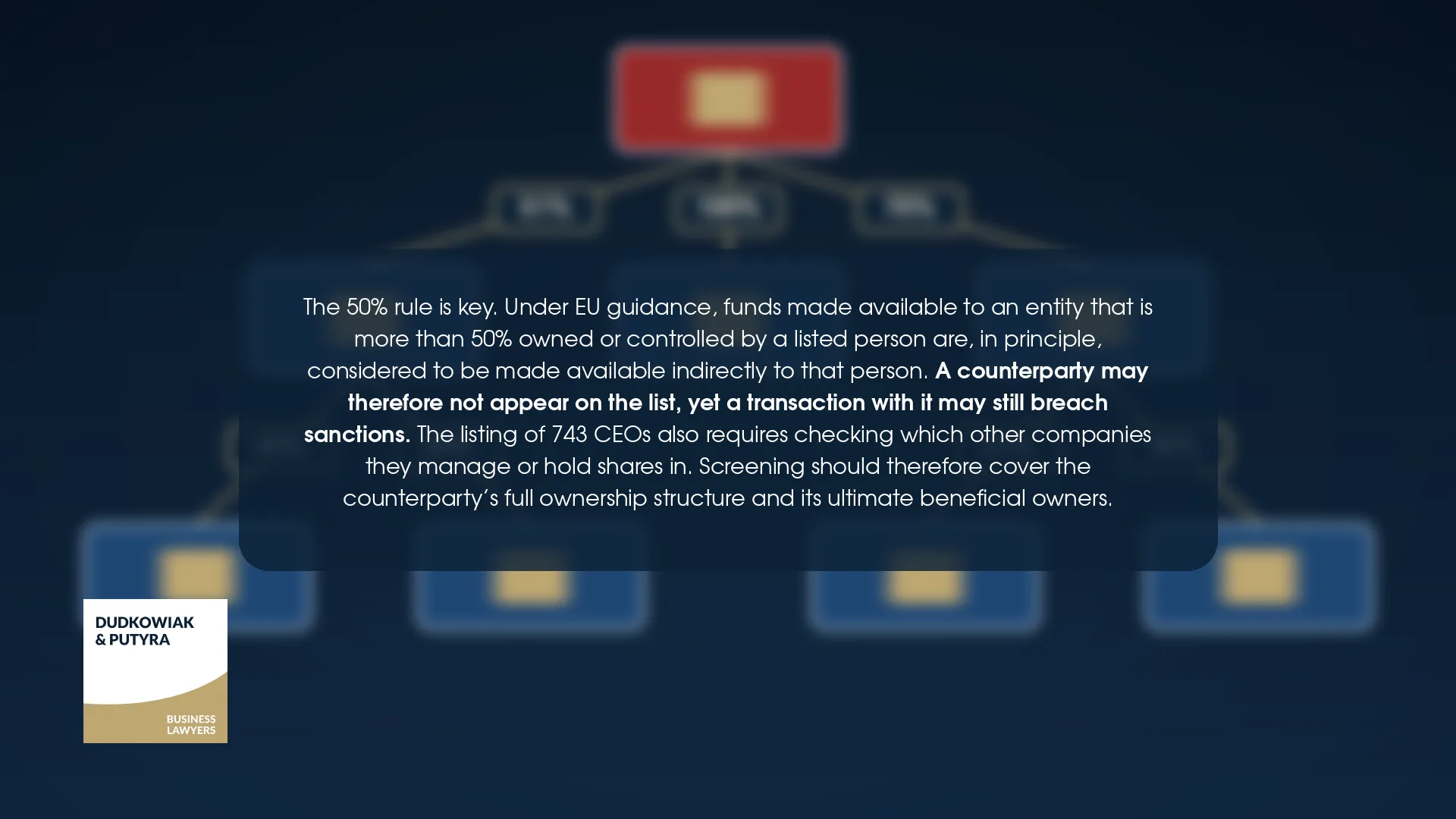
The 50% rule is key. Under EU guidance, funds made available to an entity that is more than 50% owned or controlled by a listed person are, in principle, considered to be made available indirectly to that person. A counterparty may therefore not appear on the list, yet a transaction with it may still breach sanctions. The listing of 743 CEOs also requires checking which other companies they manage or hold shares in. Screening should therefore cover the counterparty’s full ownership structure and its ultimate beneficial owners.
How can supplies via third-country intermediaries breach sanctions?
The listed companies are Russian, but components rarely reach them directly from the EU. They usually pass through distributors and trading companies in third countries. Supplying such an intermediary where the circumstances indicate that the goods will end up with a listed entity may be treated as indirectly making economic resources available. Knowing and intentional participation in such a scheme constitutes circumvention of sanctions (Article 9 of Regulation 269/2014).
Red flags include:
- a new customer with no trading history ordering components that do not match its business profile,
- payment from a third party or from a country other than the customer’s seat,
- a delivery address in a different country from the buyer’s registered office,
- evasive answers to questions about the end user and end use of the goods.
Regulation 269/2014 vs Annex IV to Regulation 833/2014: how do the two lists differ?
In practice, the two lists are often confused, although their effects differ:
- Annex I to Regulation 269/2014 – individual sanctions: an asset freeze and a ban on making any funds available. It covers all goods and payments and, through the 50% rule, also subsidiaries. This is where the 12 October listings were added.
- Annex IV to Regulation 833/2014 – a list of end users supporting Russia’s military-industrial complex, including entities in third countries. Listing triggers stricter restrictions on exports of dual-use goods and advanced technology, not an asset freeze.
The absence of an entity from one list does not mean that a transaction is permitted. The same entity may appear on both. Screening should therefore cover both lists and the Polish national (MSWiA) sanctions list and, for international groups, the US and UK lists as well.
How long will EU individual sanctions against Russia remain in force?
On 22 September 2026, the Council extended the individual sanctions under this regime by 36 months – until 22 September 2029 (previously, they were renewed every six months). For businesses, this means greater predictability. However, removal from the EU list does not lift national sanctions (Latvia has announced its own sanctions against both oligarchs) or US and UK sanctions.
What are the penalties for breaching sanctions?
Under the current Polish Sanctions Act, failure to freeze assets or making funds available to a listed entity is subject to an administrative fine of up to PLN 20 million, and breaching EU prohibitions to imprisonment of no less than 3 years – a liability that may also fall on board members. A draft new Polish sanctions act additionally provides for corporate fines of up to PLN 200 million or 5% of revenue.
How should businesses update their sanctions procedures after 1,569 new listings?
Businesses should now:
- re-screen their entire counterparty base – including carriers, freight forwarders and customers’ banks – against the updated lists,
- update beneficial ownership and control data,
- suspend orders and payments in the event of a match or reasonable doubt, and document the analysis,
- report frozen funds to the competent authorities (Article 8 of Regulation 269/2014).
Our law firm assists exporters, distributors and component suppliers with sanctions screening, ownership-structure analysis of counterparties and the adjustment of compliance procedures. For more on exporters’ obligations, see our guide Sanctions on Russia and Belarus & Export Control in Poland.
Contact our team to discuss the risks in your supply chain.
 D&P Legal