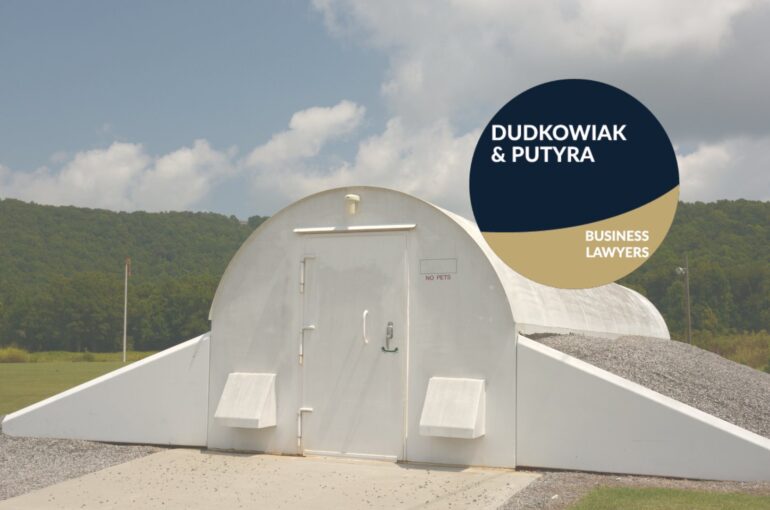


Over PLN 102 billion for civil protection: what does the OLiOC Programme 2027–2031 mean for businesses?
The Polish government has adopted the Civil Protection and Civil Defence Programme for 2027–2031 (the OLiOC Programme). Over five years, more than PLN 102 billion is to be allocated to civil protection and civil defence, and the largest share of these funds will go to protective infrastructure – shelters, refuges, temporary shelter sites, warehouses and resilient hospitals. While the public debate is dominated by the amounts, what matters more for the industry is what the money will actually be spent on and on what terms contracts will be concluded. The Programme means a multi-year stream of public contracts, but also new contractual risks that are worth identifying before submitting the first bid.
Civil Protection and Civil Defence Programme 2027–2031: how much money and when?
The Programme continues the measures taken in 2025–2026, for which the government allocated nearly PLN 34 billion. The five-year horizon is intended to make it possible to plan investments that – like the construction or modernisation of protective facilities – extend beyond a single budget year. According to the announcement of the Ministry of the Interior and Administration (MSWiA), the funding has been broken down by year as follows:
- 2027 – at least PLN 19.1 billion,
- 2028 – PLN 19.7 billion,
- 2029 – PLN 20.4 billion,
- 2030 – PLN 21.2 billion,
- 2031 – PLN 21.9 billion.
The funds from the Programme will go primarily to local governments. For contractors, this means that the main investors will be municipalities, districts (powiats) and regions (voivodeships), and most of the works will be commissioned through public procurement procedures.

What will the OLiOC Programme funds be spent on?
From a market perspective, the most important areas are those in which the Programme finances, among other things:
- the construction of new and the adaptation of existing shelters, refuges and other collective protection facilities,
- the creation of temporary shelter sites (MDS),
- resilient medical infrastructure – including adapting hospitals overseen by the MSWiA to operate in armed conflict conditions, with energy independence in the event of a blackout,
- warehouses and survival points intended to ensure continuity of supply of energy, heat, food and drinking water,
- energy and water infrastructure,
- the modernisation of public buildings.
Other areas of the Programme include, among others, the purchase of rescue vehicles and equipment, the development of the Civil Defence Corps, additional equipment for volunteer fire brigades (OSP), and training and education of the population.
Who will benefit from the OLiOC Programme? Not only general contractors
Protective infrastructure involves highly specialised works. Alongside large general contractors, there will be demand for specialised subcontractors, including:
- structural engineering firms – e.g. for strengthening existing underground storeys,
- installation firms, in particular in ventilation and filter ventilation,
- sanitary engineering firms – water intakes and tanks, emergency installations,
- energy firms – backup power supply, generators, energy storage,
- geotechnical firms,
- manufacturers of prefabricated and modular components.
Since the money will go mainly to local governments, the market will be fragmented: alongside large contracts, there will be many smaller, local tenders in which regional firms also have a chance – on their own or in consortia.
What does the OLiOC Programme mean for property owners, developers and investors?
The OLiOC Programme is not only about local government tenders. The new civil protection legislation also changes the rules for carrying out and operating private investments.
These changes concern developers and investors, who must already take into account the obligation to design underground storeys and underground car parks so that temporary shelter sites (MDS) can be organised in them. The obligation applies to new multi-family residential buildings and public buildings, and the investor must attach to the building permit application a declaration made under penalty of criminal liability. It is therefore worth analysing the transitional provisions for projects in preparation and reflecting the new requirements in contracts with designers and general contractors.

Owners and managers of existing facilities, such as underground car parks, halls or shopping centres, will also have to take the new obligations into account. They should expect that local governments may include their properties in municipal civil protection plans. This entails obligations: keeping the shelter site in proper technical condition and making it available for civil protection purposes. It is worth establishing in lease and management agreements who bears the costs and who is responsible for these obligations.
The Programme finances warehouses and survival points, and some local governments and services will be looking for ready-made space or facilities built to their needs (build-to-suit), which will be a significant market opportunity for investors and property managers.
It should be strongly emphasised that compliance with civil protection and civil defence regulations will become a new category of risk that must be verified in a properly conducted due diligence process.
How to prepare for tenders financed by the OLiOC Programme?
It is worth starting now to:
- monitor procurement plans published by local governments in the Public Procurement Bulletin (BZP),
- review your own experience and references against the conditions for participation, and consider a consortium or reliance on the resources of a third party,
- prepare a checklist for reviewing draft contracts: price indexation, contractual penalties, acceptance procedure, procedure for changes and additional works,
- organise the flow of documents on the construction site – notifications, memos, correspondence and entries in the construction log, on which the outcome of any dispute depends,
- for subcontractors – obtain the contracting authority’s approval of the subcontract before the crew enters the site,
- for facilities of particular importance – check whether the contracting authority requires access to classified information; if so, an industrial security clearance may be necessary.
For the construction industry, the Civil Protection and Civil Defence Programme is not only a state security project. It is a multi-year investment impulse that will generate new contracts – but also new legal and contractual challenges.
The opportunity is not limited to construction. Spending on rescue vehicles and equipment, as well as on public warning systems, emergency power supply and warehouse equipment, opens up the market for manufacturers and suppliers from the defence and security sector.
The Civil Protection and Civil Defence Programme is therefore not only a state security project. It is also a multi-year investment impulse that will generate new contracts for construction companies and suppliers from the defence sector.
Legal support for investments under the OLiOC Programme
Our law firm supports businesses in the defence and security sector, including in public procurement in the fields of defence and security and industrial security clearances. Contact our team to discuss how to prepare your company to take part in investments financed by the OLiOC Programme.
 D&P Legal

 D&P Legal