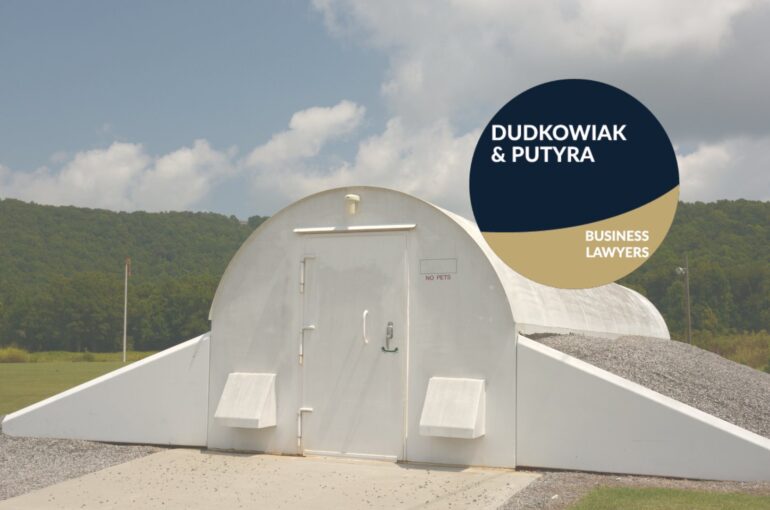


Shelters and temporary shelter sites in buildings – obligations of owners and managers under the Civil Protection and Civil Defence Act
The State Fire Service and the Ministry of the Interior and Administration have launched the “Gdzie się ukryć PL” (“Where to Shelter PL”) app, which identifies more than 88,000 shelter points for approx. 24 million people – including in private office buildings, shopping centres, hotels and residential buildings. We explain when a private property may be included in the civil protection system, what obligations this entails and what opportunities the new regulations create.
The “Gdzie się ukryć PL” app – what does it show?
The tool was developed by the State Fire Service and replaces the earlier “Schrony” (“Shelters”) app. The database has grown significantly – in December 2025, when the web platform was launched, it covered approx. 70,000 locations. For each point, the app shows the address, type of facility, accessibility and GPS coordinates, and since September 2026 the designated sites have been physically marked on the ground. The app can be downloaded free of charge from the App Store and Google Play (the gdziesieukryc.pl website is also available); it plots a route to the nearest point and works offline.
The Ministry stresses, however, that shelter points are not shelters – they protect against, among other things, fragments and violent weather events, but do not provide the level of protection offered by protective structures. This distinction determines the scope of the owner’s obligations.

Four categories of protective infrastructure: shelters, refuges, MDS and shelter points
The amended Act of 5 December 2024 on Civil Protection and Civil Defence (amendments in force since 29 May 2026) distinguishes four categories of facilities: shelters, refuges, temporary shelter sites and shelter points. The category determines who designates the facility and what obligations rest with the owner or manager.
Shelters and refuges – protective structures meeting detailed technical requirements – offer the highest level of protection. They are designated by the civil protection authority, and the owner or manager must keep them in proper condition and make them available on the authority’s instruction.
Temporary shelter sites (MDS) are most often underground storeys or garages adapted for the temporary sheltering of people. They are identified by the civil protection authority, and in new buildings designing them is the developer’s obligation; the owner is responsible for keeping MDS in proper condition and making them available.
The least formalised category is shelter points (Article 84a) – with no detailed technical requirements, protecting against fragments, among other things. They are designated by the district (municipal) State Fire Service commander without issuing a decision, and the owner is merely notified. The owner’s obligations boil down to marking the point by 31 December 2026 and making it available “where possible” in the event of an alarm.
When can a private building be designated as a place of shelter?
Shelter points (Article 84a) are identified by the district (municipal) State Fire Service commander in cooperation with the building supervision authorities – without an administrative decision and without the consent of the owner or manager, who is merely notified. A point may comprise an entire building or part of it, e.g. an underground garage or basement. Information about the designation is entered in the Central Register of Collective Protection Facilities and in the app. An owner therefore cannot “declare” its own property a shelter point, but nor can it effectively object to the designation – in practice, it can only influence how the resulting obligations are fulfilled.

In new developments, underground storeys in public-use buildings and multi-family residential buildings, as well as underground garages without a protective structure, must be designed so that MDS can be organised in them – this applies to building permit applications filed after 31 December 2025.
The amendment clarified how capacity is calculated: in multi-family buildings the number of places must correspond to the total floor area of the apartments divided by 20 m² per person, and in public-use buildings – divided by 15 m² per person. Failure to include appropriate solutions in the design may delay the building permit and increase project costs.
Obligations of the building owner or manager
1. Marking the shelter point – deadline: 31 December 2026
The Regulation of the Minister of the Interior and Administration of 28 September 2026 (Journal of Laws of 2026, item 1276), in force since 30 September 2026, requires points identified before that date to be marked without delay, and no later than 31 December 2026. Compliance may be verified by the State Fire Service as part of its inspection and reconnaissance activities, and the cost of marking may be covered by the OLiOC Programme. The obligation covers:
- on the façade – a 200 × 200 mm sign bearing the civil defence emblem (a blue triangle on an orange background), with a green “PUNKT SCHRONIENIA” (“SHELTER POINT”) plate below it;
- on the entrance doors to the building and to the point – an 80 × 80 mm sticker bearing the civil defence emblem.
2. Making the point available during an alarm
Under Article 103a of the Act, once an alarm has been declared, the owner or manager makes the shelter point available where possible – according to the Ministry, whenever it is physically possible. The Act does not require round-the-clock availability, and no penalty is currently provided for refusal; reputational and civil liability risks remain, however.
In practice, it is worth determining now who will open the point, and how, once an alarm has been declared – including outside working hours – and reflecting this in the fire safety instructions, the building rules and agreements with the property manager and security company.
In commercial properties, lease agreements also need to be reviewed (third-party access to common areas, allocation of costs within the service charge, liability for damage), as does the scope of property and third-party liability insurance in case the building is used by members of the public. Tenants – particularly in multi-tenant properties – should in turn know whether their building is a shelter point and reflect this in their internal safety procedures and staff training.
3. Temporary shelter sites – maintenance and availability
The owner or manager of an MDS is responsible for keeping it in proper technical condition (Regulation of the Minister of the Interior and Administration of 9 July 2025) and making it available for civil protection purposes. Unlike with shelter points, failure to perform this obligation carries criminal liability (detention, restriction of liberty or a fine).

Civil protection authorities continuously review existing and planned buildings, selecting those that may be recognised as collective protection facilities or adapted as MDS. In non-public buildings, such facilities serve primarily to protect their users.
The OLiOC Programme and local government procurement – an opportunity for contractors
The OLiOC Programme for 2025–2026 provides for nearly PLN 34 billion, part of which has gone to local governments as grants, while the programme for 2027-2031 provides for approx. PLN 102.4 billion. According to Atlas Przetargów, the number of local government tenders in this area (January–September) rose from 7-11 per year in 2021–2024 to 1,661 in 2026.
This is a market for the coming years for contractors, designers and installation suppliers – one that requires, however, efficient navigation of Public Procurement Law procedures and grant settlement rules. The largest share of the value of contracts concluded (approx. PLN 312 million) related to shelters and refuges – expert assessments, designs and conversions of basements in schools, clinics, hospitals and public offices.
Of the 2027-2031 programme budget, approx. PLN 30 billion will go to regions and local governments, enabling them to finance, among other things, collective protection facilities, alternative sources of energy, water and food in case of crisis, and training for residents. Besides construction contractors and design offices, opportunities are also open to expert appraisers and suppliers of ventilation systems, emergency power and prefabricated modular shelters.
For more on the 2027–2031 period, see our article “Over PLN 102 billion for civil protection: what does the OLiOC Programme 2027–2031 mean for businesses?”.
Legal support for property owners, managers and contractors under the Civil Protection Act
The Dudkowiak & Putyra team supports owners, managers, investors and contractors in, among other things, auditing obligations under the Act, reviewing lease, facility management and security agreements, real estate due diligence and procedures financed under the OLiOC Programme. A property’s status in the civil protection system should also be taken into account in transactions – as a new element of due diligence and risk assessment, alongside fire safety and environmental requirements. Contact us.
 D&P Legal